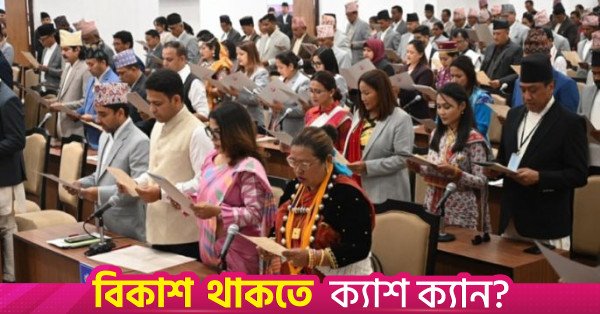
Today, Nepal stands at the top in South Asia, with women holding 34.9% of parliamentary seats followed by Pakistan at 21.7% and India at 13.8%. By comparison, Bangladesh’s total representation is expected to reach only 16.3%.
Photo: Kathmandu Post
“>

Photo: Kathmandu Post
Nepal shows the magic of what happens when women’s voices are not just heard, but turned into power. In the revolutionary waves preceding the 2026 elections, women stood at the centre of protests in both Nepal and Bangladesh, shaping movements that promised change.
In Nepal, that momentum carried through into record breaking representation in parliament, while in Bangladesh the same energy struggled to translate into lasting political inclusion.
Today, Nepal stands at the top in South Asia, with women holding 34.9% of parliamentary seats followed by Pakistan at 21.7% and India at 13.8%. By comparison, Bangladesh’s total representation is expected to reach only 16.3%.

Infographic: TBS
“>

Infographic: TBS
2026 election results
Nepal’s 2026 election results and the subsequent appointment of five women to key cabinet portfolios set a historic benchmark for inclusive governance in South Asia. By securing 96 seats in parliament, ensuring that 35% of the elected body, women have reached their highest level of representation in the nation’s history. Nepal has empowered female leaders with critical portfolios like law, health, and agriculture. Nepal’s success approaches the progress seen in advanced economies like Australia (46.0%), New Zealand (46.3%), Iceland (46.0%), and Sweden (44.7%), where female representation has moved from a marginalised goal to a core pillar of governance.
However, just across the border, the political landscape shifts into a starkly different reality in Bangladesh. Bangladesh’s 2026 election saw a stagnant female participation rate. Only 83 women contested the direct elections, representing just 4% of the total candidate pool. Of those who participated, only seven women won their seats through a direct vote. With the inclusion of the 50 reserved seats, the total number of women in parliament will reach 57, comprising only 16% of the total body.
Constitutional mandate drives higher female representation in Nepal
Nepal’s advantage lies in its legal framework. The 2015 Constitution requires that at least 33% of parliamentarians must be women. This is not a guideline but a binding rule. If parties fail to meet the quota through direct elections, they must fill the gap through proportional representation before taking office.
Bangladesh, by comparison, has traditionally relied on the Representation of the People Order, 1972, which sets out the legal framework for the registration of political parties with the Election Commission. It vaguely suggests a 33% internal party representation goal, a target that has largely gone unmet and unenforced. The July National Charter 2025 attempted to address this by setting a gradual path towards parity.
The charter required parties to nominate women for at least 5% of direct seats in the first election, rising to 10% in the next, and increasing by 5% in each cycle until reaching 33%. While widely supported, implementation fell short. In the 2026 elections, only 20 of 51 parties nominated female candidates, and overall participation stayed at just 4%, below even the initial target. Among the major parties, the Bangladesh Nationalist Party (BNP) nominated 10 women, the National Citizen Party (NCP) nominated three, while Jamaat-e-Islami did not nominate any female candidates for direct seats.
Why the gap persists
Nepal’s progress is largely due to turning gender inclusion into a legal requirement. The 33% floor removes political discretion and ensures women are part of decision making.
Bangladesh continues to depend on reserved seats, where women are appointed by parties rather than elected directly. This system limits competition and reduces incentives for parties to nominate women in general constituencies.
The difference is also visible at the local level. In Nepal, women make up 41% of representatives across 753 local bodies, supported by Local Level Election Act requiring at least one of the top two local leadership positions to be held by a woman. This has normalised women in leadership roles.
In Bangladesh, Political culture remains a barrier, with the field widely viewed as a male-dominated battleground. However, as demonstrated by the transformative leadership of Jacinda Ardern in New Zealand and Julia Gillard in Australia, women have already proved they can redefine national success, yet this potential remains sidelined by local social pressures. Families may discourage women from participating due to safety concerns and social pressure. Without strong legal backing, these barriers continue to restrict entry into politics.
Democracy scores reflect the divide
The gap was already visible before the elections. In the 2024 Democracy Index by the Economist Intelligence Unit, Nepal ranked 96th with a score of 4.60, while Bangladesh ranked 100th with 4.44. Both were classified as hybrid regimes.
Nepal’s higher score in political participation pointed to structural inclusion, which later translated into higher female representation. Bangladesh’s lower score reflected weaker structural inclusion, which was evident in its limited progress in 2026.
At its core, democracy rests on the principle that women are equal stakeholders. Overall, the contrast underscores that democracy is not only about elections, but about how inclusive and enforceable its institutions are. Nepal’s model demonstrates that when representation is guaranteed by law, participation follows, placing it ahead of Bangladesh in advancing meaningful political inclusion.
About The Author