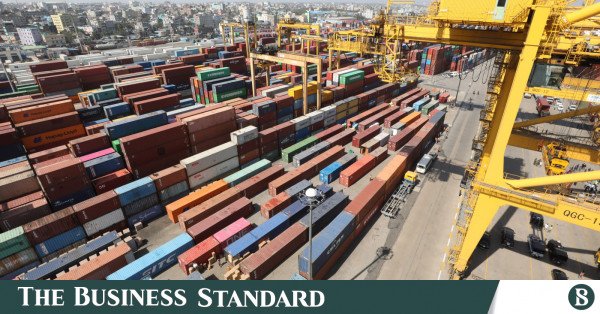
Containers carrying potatoes, agro-products, frozen foods and ready-made garments are now stranded at private inland container depots (ICDs), as exporters wait for shipping routes to reopen while absorbing additional depot and plugging charges
Photo: TBS
“>

Photo: TBS
Highlights:
- Middle East war stalls over 1,000 TEUs weekly exports from Chattogram
- Shipping lines suspend Middle East bookings due to rising security risks
- Potatoes, frozen food, garments stranded at inland container depots
- Exporters face rising storage, plugging, and depot charges
- Garment exporters fear missing crucial Middle East Eid shopping market
- Freight rates from China to Bangladesh rise amid shipping disruptions
The war in the Middle East has stalled more than 1,000 TEUs (twenty-foot equivalent units) of weekly exports from Chattogram Port after major shipping lines suspended bookings, leaving exporters facing mounting storage costs and uncertainty.
Containers carrying potatoes, agro-products, frozen foods and ready-made garments are now stranded at private inland container depots (ICDs), as exporters wait for shipping routes to reopen while absorbing additional depot and plugging charges.

One of the first casualties of the disruption is a seasonal potato shipment prepared for export to Dubai.
After processing and packaging, a 28-tonne consignment from SR Impex Ltd arrived in Chattogram from Bogura on 1 March. It was scheduled to be shipped to Jebel Ali port the following day. But the cargo never left the depot.
The container is now sitting at a private ICD after shipping lines abruptly stopped accepting bookings to Middle Eastern destinations due to security risks.
“While we were loading the cargo, the shipping line suddenly informed us they would no longer accept bookings and cancelled the slot,” said Mohammad Forkan, managing director of SR Impex Ltd and general secretary of the Fresh Food and Fruits Exporters Association.
Infograph: TBS
“>

Infograph: TBS
“We somehow arranged another container from a depot and plugged it in to preserve the potatoes. Now we are paying plugging and depot charges just to store them. We do not know what will happen next,” he said.
He added, “Every week, around 450 tonnes of potatoes, another 450 tonnes of agro and food products, and nearly 300 tonnes of frozen foods are exported to Middle Eastern countries through the Chattogram port and the airport. Including RMG and other exports, the total value reaches around $17 million. Most of these shipments are now disrupted.”
Exporters fear the disruption could deepen if the conflict drags on, squeezing Bangladesh’s trade and raising costs across multiple industries.
Garment exporters fear missing Eid market
The disruption is also worrying exporters in Bangladesh’s largest export sector – ready-made garments.
Although the Middle East accounts for only over $800 million, or roughly 2% of Bangladesh’s apparel exports, the market becomes crucial during the Eid shopping season.
Exporters say the conflict erupted just as shipments normally begin for the festive market.
“We have already purchased raw materials, produced goods and placed orders,” said garment exporter Abdus Salam.
“Our buyers need these products to stock their showrooms for Eid. Normally, shipments begin at the start of Ramadan. But the war started exactly at that time.”
He added, “Our goods cannot be shipped and their showrooms are empty. At the same time, our workers expect Eid bonuses and salaries. We are facing a very difficult situation.”
Shipping lines suspend bookings
Shipping companies confirm that container bookings to many Middle Eastern destinations have been suspended.
Azmir Hossain Chowdhury, head of operations at MSC Shipping, said the company had received instructions not to accept bookings for the region and had suspended bookings from 2 March.
“Other shipping lines are doing the same. As a result, weekly exports of around 800 to 1,200 TEUs to Middle Eastern countries are being affected,” he said.
Freight costs from China rise
The crisis is also adding pressure on Bangladesh’s import supply chain.
With maritime routes facing disruption, freight rates from China — the main source of raw materials for the country’s industries — have already started rising.
Industry insiders say shipping costs from Chinese ports have increased by roughly $300 per container in recent days.
Rakibul Alam, a former vice-president of the Bangladesh Garment Manufacturers and Exporters Association, said the higher freight cost is becoming a major concern for importers.
“For high-cube containers, freight from China has increased by around $500 in some cases,” he said.
“Chinese ports have resumed exports after earlier disruptions and our import flow is picking up again. But the biggest challenge right now is the higher shipping cost.”
Major carriers restrict services
Global shipping companies have begun tightening operations in the conflict-affected region.
Shipping giant Maersk has suspended all vessel transits through the Strait of Hormuz since 1 March and stopped accepting new bookings to several destinations, including the United Arab Emirates, Saudi Arabia, Kuwait, Qatar and Oman.
COSCO Shipping Lines has also temporarily suspended cargo services to certain ports, including Qatar, Bahrain, Iraq and Kuwait, due to security concerns and navigation restrictions.
However, COSCO said operations would continue to ports that do not require vessels to pass through the Strait of Hormuz, such as Jeddah in Saudi Arabia and the UAE ports of Khor Fakkan and Fujairah.
About The Author