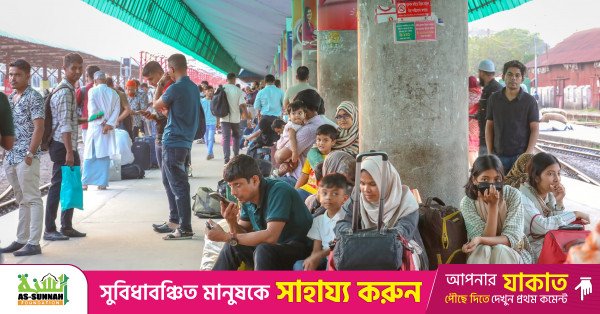
Passengers seen waiting around outside a ticket counter at the Chattogram Railway Station on 17 March. Photo: Mohammad Minhaj Uddin/TBS
“>

Passengers seen waiting around outside a ticket counter at the Chattogram Railway Station on 17 March. Photo: Mohammad Minhaj Uddin/TBS
With Eid approaching, securing train tickets has again become a battle for homebound travellers. Despite repeated complaints over irregularities, many passengers say the situation has hardly improved.
Passengers allege that the dominance of online ticket sales, unusual practices involving penalty fares and black market activity are making it difficult for genuine travellers to obtain tickets.
For many unfamiliar with smartphones or the internet, buying tickets also remains a major challenge.

A visit to Chattogram Railway Station revealed little crowd around ticket counters. Some passengers were seen approaching the counters only to return disappointed.
Inside the station, two travelling ticket examiners (TTEs) were issuing printed tickets using handheld thermal printers to groups of passengers. The tickets included penalty charges.
When asked why such tickets were being sold near the counters, one ticket examiner declined to comment, saying only that higher authorities were aware of the matter.
Abid Ali, a passenger who bought a ticket with a penalty fee, said he had tried to buy a ticket from the counter. “They told me even standing tickets were sold out. I had no choice but to buy a penalty ticket.”
He added that he does not use a smartphone and has no experience with internet services, which prevented him from buying a reserved ticket in advance.
Another passenger, Shahriar Rifat, said he had tried for three days to book tickets online but failed due to server issues. “Whenever I managed to log in, all the tickets were already gone,” he said.
Allegations over penalty ticket sales
Railway rules allow standing tickets to be sold up to 25% of total seat capacity on the day of travel. These tickets are meant to be purchased only from station counters. Passengers allege that even after this limit is reached, some are being charged an extra Tk50 and issued tickets with penalty fees.
Under railway rules, penalty tickets are issued only when a passenger is caught travelling without a ticket.
Mahbubur Rahman, chief commercial manager (East) of Bangladesh Railway, said counters cannot issue tickets once the standing ticket quota is exhausted.
He added that passengers who bought higher-priced tickets from ticket examiners did so by choice.
Tickets sell out in minutes
Advance ticket sales for intercity trains ahead of Eid-ul-Fitr began on 3 March 2026. Return tickets for post-Eid journeys went on sale from 13 March to ease passengers’ return to workplaces.
This year, as in recent Eids, all tickets for Eid travel are being sold online. Bangladesh Railway introduced the system during Eid-ul-Fitr in 2023, and it has remained in place since then.
The introduction of the Bangladesh Railway Integrated Ticketing System was expected to make online purchases easier. However, passengers continue to report technical problems.
Many complain that tickets sell out within minutes of sales opening. Others cite slow server response, difficulties accessing the website or mobile app, and frequent service disruptions.
Experts believe that high demand alone does not explain the rapid sell-out. They suspect organised ticket-scalping networks may also be playing a role.
Passengers allege that syndicates are exploiting the digital system by creating multiple accounts using national identity numbers of relatives and acquaintances. These groups reportedly purchase large numbers of advance tickets and later resell them on social media or directly to buyers at inflated prices.
Questions over private operator gains
Questions have also been raised over the decision to sell all tickets online, with discussions centring on whether the Shohoz-Synesis-Vincen joint venture – which runs the railway’s online ticketing system – is receiving undue benefits.
Under the contract, the target was to sell 8 crore tickets online and 12 crore through station counters over five years. However, priority was later given to online sales.
As per the agreement, the joint venture receives an initial fee of Tk0.25 from every ticket sold, whether online or at counters. In addition, it earns an extra Tk6.50 for each ticket sold online.
Media reports citing railway sources suggest the venture was expected to earn about Tk30 crore from ticket sales and advertising over five years. However, higher online sales have created an opportunity for an additional Tk92 crore in revenue.
About The Author