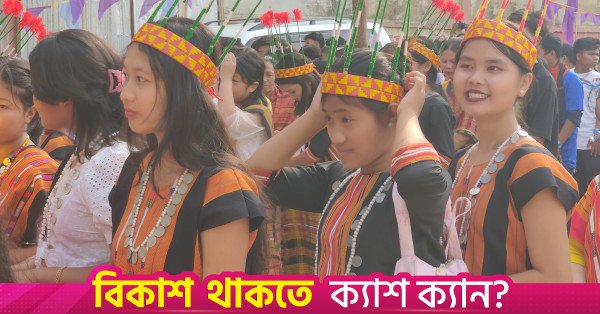
Participants, dressed in colourful traditional attire, danced and sang their way through the streets in celebration
Members of 11 ethnic communities residing in the district participated in the procession in their traditional clothes. Photo: TBS
“>

Members of 11 ethnic communities residing in the district participated in the procession in their traditional clothes. Photo: TBS
The Marma community’s traditional New Year festival, Sangrai Poye, began today (13 April), with a vibrant procession through Bandarban town.
Participants, dressed in colourful traditional attire, danced and sang their way through the streets in celebration.
The festivities commenced this morning with a colourful Mangal Shobhajatra organised by the Sangrai Festival Celebration Council. The procession, which started from Rajar Maath area in the town, was inaugurated by lawmaker Sa Ching Prue.

It wound through various city streets before concluding at the Small Ethnic Groups Cultural Institute (KSI). Following the procession, a discussion meeting, a painting competition, and an “elderly worship” ceremony were held at the KSI auditorium. During the ceremony, senior members of the community were honoured with gifts of candles, cash, and new clothing.
According to the Sangrai Festival Celebration Council, this year’s six-day event features a variety of cultural and traditional activities.
While the celebrations began with folk sports on 11 and 12 April, the programme for the coming days includes a Buddha bathing ritual and a “Pitha Utshob” tomorrow afternoon (14 April).
Communities following the Burmese calendar also observe their own New Year festivals under various names, decorating their homes with flowers and welcoming the new year with diverse rituals. Photo: TBS
“>

Communities following the Burmese calendar also observe their own New Year festivals under various names, decorating their homes with flowers and welcoming the new year with diverse rituals. Photo: TBS
The final two days, 15 and 16 April, will feature traditional sports, honours for distinguished artists, the Maitri Pani Barshan (water splashing) ritual, and cultural performances.
Members of 11 ethnic communities residing in the district participated in the procession in their traditional clothes. Among the 11 communities in the Chittagong Hill Tracts, excluding the Bawm, Pankho, and Lusai, the others observe their respective new year social festivals under different names.
Collectively, these celebrations–known as “Boisabi”, comprising “Baisu” for the Tripura, “Sangrai” for the Marma, and “Biju/Bisu” for the Chakma and Tanchangya communities–aim to bid farewell to the old year and welcome the new one.
Communities following the Burmese calendar, such as the Chak, Mro, Khiang, and Khumi, also observe their own New Year festivals under various names, decorating their homes with flowers and welcoming the new year with diverse rituals.
Meanwhile, the Biju festival of the Chakmas, the Bisu of the Tanchangyas, and the Boisu of the Tripuras began yesterday, with the tradition of floating flowers in the river.
The Chakma and Tanchangya communities celebrate the first day as Phul Biju, the second as Mul Biju, and the final day as Goijja Poijja.
A highlight of these festivities is the preparation of “Pachon,” a traditional dish made from a medley of mixed vegetables, which is served to guests who visit during the festival.
About The Author