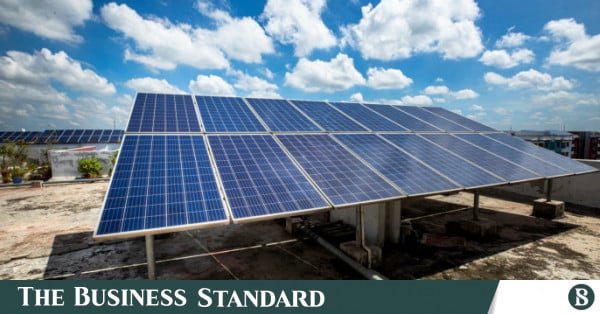
Another 500MW from roof solar expected this year
Control over electricity transmission infrastructure could become a source of future conflict. Photo: TBS
“>

Control over electricity transmission infrastructure could become a source of future conflict. Photo: TBS
Highlights:
- Factories adopt rooftop solar amid gas shortages, rising energy costs
- Over 500MW solar installed; another 500MW expected this year
- Solar meets 15–20% demand, supports operations during disruptions
- Falling costs and tariffs make solar more economical long-term
- Global buyers pressure industries to cut emissions, adopt renewables
- Net metering policy boosts adoption, allows exporting surplus electricity
Rising Group, one of the country’s leading composite garment manufacturers, relied equally on grid and captive power two years ago. It now sources around 15% of its electricity from a 9MW rooftop solar installation, allowing it to scale back captive generation amid tightening gas supply.
Similarly, Pacific Jeans installed a 7MW rooftop solar system four years ago, which now supplies about 12% of its total electricity needs, according to its managing director, Syed Mohammed Tanvir.

These companies illustrate a broader shift towards solar across Bangladesh’s industrial sector. The trend, primarily influenced by a global green compliance campaign, is now proving to be a partial shield against sudden energy shocks like the one triggered by the ongoing Middle East conflict.
Infograph: TBS
“>

Infograph: TBS
Factories across Bangladesh have installed more than 500 megawatts of rooftop solar power as manufacturers seek to protect production from gas shortages, grid instability, and rising energy costs.
Solar developers expect another 500MW of rooftop solar capacity to be added this year, driven by pressure from global buyers to cut emissions and by higher grid electricity tariffs.
The shift has gathered pace over the past year and is now deemed more important than ever amid fears that the ongoing Middle East war could be prolonged, disrupting fuel shipments through the Strait of Hormuz, a vital route for liquefied natural gas and oil imports.
While rooftop solar cannot fully meet demand, it can sustain operations for three to four hours, covering 15-20% of total power needs and helping minimise costly disruptions.
“There is huge pressure from global buyers to reduce emissions, and renewable energy – especially rooftop solar – is one of the few practical options,” said MA Jabbar, managing director of DBL Group.
DBL has installed 5.4MW of rooftop solar and plans to add another 1.5MW this year, he added.
Shafiqul Alam, lead energy analyst at the Institute for Energy Economics and Financial Analysis (IEEFA), said rooftop solar has gained traction in recent years due to its financial viability, as costs remain significantly lower than grid electricity.
“We have to maintain this momentum and accelerate it further,” Shafiqul told TBS.
Industry adoption began to rise after the introduction of the net metering guideline in 2018, which allows excess solar power to be fed into the national grid. Since then, installations have expanded steadily, according to project developers.
Industries that have already installed rooftop solar include 40MW at the Korean EPZ by Youngone Group, as well as facilities belonging to Ha-Meem Group, Microfiber Group, Masco Group, Pacific Jeans, Fakir Knitwears, Snowtex, DBL Group, Akij Group, BSRM, BRB Cables, GPH Ispat, Meghna Group of Industries, and Kazi Farms, among dozens of others.
Installations are currently underway in many more factories.
‘More predictable and economical solution’
Tofael Ahmed, chief executive of Superstar Renewables, told TBS that the company has implemented 90 industrial rooftop solar projects, generating around 100MWp. Another 25 projects are underway, expected to add 28MWp to the grid.
He said enquiries from industrial clients are rising amid ongoing energy uncertainty. “Many factories have faced gas shortages, grid instability, and rising tariffs in recent years. Low gas pressure and power outages often force reliance on costly diesel generators,” he said.
As a result, industries are seeking stable and predictable energy alternatives, with rooftop solar emerging as a practical option. Tofael said cost management is also a key driver.
“Solar helps reduce long-term electricity expenses and stabilise costs over a 20-25-year lifespan. Compared with grid and diesel power, it offers a more predictable and economical solution,” he added.
Solar installation cost declines
Masudur Rahim, chief executive of Omera Solar, said the company has installed more than 100MW of industrial rooftop solar, mostly over the past two years.
“We’re receiving strong interest from industries and hope to install another 100MW by 2026,” he told TBS. He said Omera is currently installing a 23MW rooftop system at Meghna Group’s Narayanganj complex.
Masudur added that falling equipment costs are driving demand. “Installing 1MW now costs around Tk3.5 crore, down from Tk5.5 crore two years ago,” he said.
Naznin Akther, director of business development at Solaric, also reported rising interest from industrial clients. Solaric has implemented 162MW.
“We have ongoing projects generating 36MW and expect to install 60-80MW this year,” Naznin said.
Scube, another major solar solutions provider, has delivered 210 projects generating 254.9MWp. It has 43 ongoing projects that will generate over 90MWp, according to the company’s website. There are other solar solutions providers, but their scale is smaller than these four companies.
Tariff matters
Despite requiring capital investment, factory owners are rushing to rooftop solar solutions because of long-term benefits, industry insiders said.
For instance, if a factory owner wants to install 5MW of solar on a factory rooftop, it requires around Tk20 crore in capital investment upfront. However, in the long term, it will save a significant amount.
Masudur of Omera Solar said that, taking a solar panel’s life of 20 years (though it may last 25 years), the per-unit electricity cost would be less than Tk3.5, compared with the national grid’s Tk9.7 per unit.
Return on solar investment for a factory owner takes, at best, four years, he added.
Global brands and buyers’ pressure
Tofael Ahmed of Superstar Renewables said export-oriented industries, especially in sectors like garments and textiles, are facing growing pressure from buyers to improve their sustainability and carbon footprint.
Masudur Rahim of Omera Solar said factories in Bangladesh nominated by H&M alone would require around 2,000MW of renewable energy if they aim to achieve net-zero emissions.
“Many global brands now encourage or require their suppliers to adopt renewable energy, which is also driving factories to explore solar installations,” he said.
As a result, previously hesitant clients are now initiating feasibility studies, rooftop assessments, and return-on-investment evaluations, with a focus on cost savings, energy security, and compliance, he added.
Net metering system encourages factory owners
Adoption of rooftop solar accelerated after the Bangladesh Energy Regulatory Commission introduced net metering in 2018, allowing factories to export surplus electricity to the grid and receive bill credits.
Under the system, an industrial facility installs rooftop solar panels connected to its power system. During the day, solar electricity powers machines, lighting, and equipment, with any surplus exported to the national grid.
At the end of the billing cycle, the electricity bill is calculated based on net consumption. For instance, if a factory uses 1,000kWh from the grid and exports 300kWh, it pays only for 700kWh.
The withdrawal of restrictions, such as the cap allowing industries to install rooftop solar up to a maximum of 70% of their sanctioned load, has also encouraged factories to invest in solar. The interim government lifted this cap last year, allowing industries to install as much rooftop solar capacity as they need.
Industries demand versus solar power
According to the latest assessment by the IEEFA, the industrial sector accounts for 27.63% of grid-based electricity consumption in Bangladesh. With current power generation hovering around 10,000MW, industrial use from the grid stands at roughly 2,700MW. If industries source 500MW from rooftop solar, it would offset about 16-17% of their grid electricity demand.
However, Shafiqul of IEEFA noted that industries have built up substantial captive power capacity, estimated at around 6,000MW. Many factories rely heavily on their own generation and, in some cases, use little to no grid electricity.
Industry insiders explained that factories engaged solely in stitching or cutting consume less electricity, allowing their rooftop solar systems to generate surplus power, which can be fed back into the grid. By contrast, energy-intensive operations such as dyeing, washing, and spinning rely on rooftops for only 10-15% of their electricity needs.
Potential of industrial rooftop solar
Masudur of Omera Solar said H&M‑nominated factories alone would need around 2,000MW of renewable energy for net-zero emissions, with other factories requiring a similar amount, bringing total demand to 4,000MW.
Naznin Akther of Solaric also estimated industrial rooftop solar potential at around 4,000MW.
However, Masudur said available rooftop space in industrial facilities could generate only about 2,000MW, indicating a significant gap between demand and capacity.
Mohammed Zahidullah, chief sustainability officer of DBL Group, said energy-intensive industries like dyeing, washing, and spinning cannot meet demand from rooftops alone.
“To achieve net-zero emissions, we may need to go beyond factory rooftops. Government‑allocated land for joint solar projects would be very helpful,” he added.
About The Author