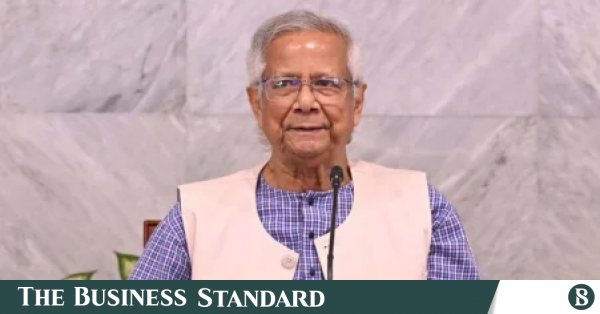
Just before the end of his tenure as chief adviser of the interim government, Muhammad Yunus declared himself a VVIP for one year and secured protection from the Special Security Force, while institutions under the Grameen umbrella, founded by him, were allegedly granted special privileges, prompting widespread criticism and raising questions among observers.

Within two months of being sworn in as chief adviser on 8 August 2024, Grameen Bank was granted a tax exemption lasting until 2029. National Board of Revenue (NBR) officials noted that this provided the bank with an unfair advantage over other microcredit institutions.
That same month, the High Court withdrew a ruling requiring Grameen Kalyan to pay Tk666 crore in taxes, despite the court having previously ordered the payment of these funds.
Furthermore, the government’s 25% ownership stake in Grameen Bank, which had been in place since the bank’s inception, has been reduced to 10% despite the institution’s profitability.

Beyond these developments, analysts have raised concerns over a clear “conflict of interest” regarding the approval of a new university under the Grameen name, the granting of a manpower export licence, and the authorisation of a digital wallet service for Grameen Telecom.
Furthermore, during Yunus’s tenure, the Grameen health-tech social business “Sukhi” was awarded the medical service contract for the Chittagong Port Authority.
It has also emerged that the interim government has issued an ordinance to establish a microcredit bank aimed at expanding Yunus’s “Social Business” model within the banking sector. The draft for this ordinance was reportedly prepared within the Chief Adviser’s Office before being sent to the finance ministry.
Contacted, Iftekharuzzaman, executive director of Transparency International Bangladesh, told TBS, “These are examples of a sheer failure to manage conflict of interest. Although disappointing, it is no surprise. For our power-holders, the capacity to distinguish between what is public and what is private is almost absent, as a result of which due process is often unabashedly undermined.
“Achievements that could perhaps have been genuinely realised if left to due process have now become questionable, creating scope for doubts regarding the abuse of power – a legacy not to be proud of.”
VVIP gazette withheld from website
On 10 February, just two days before the 13th national election, a gazette notification was issued designating Yunus as a “Very Important Person” (VVIP) for one year from the date of his handover of responsibility.
The gazette stated that this status was granted under Section 2(a) of the Special Security Force Act, 2021, ensuring he would receive SSF protection for one year. The notification was issued by Md Saifullah Panna, the then-secretary to the Chief Adviser’s Office.
Under Section 2(a) of the relevant Act, the government possesses the authority to designate individuals as VVIPs through a gazette notification, in addition to foreign heads of state or government. According to the law, outgoing heads of government do not automatically receive SSF protection; it only comes into effect once a formal gazette notification is issued.
While official gazettes are typically published and archived on the Bangladesh Government Press website, a review of the “Extraordinary Gazettes (Monthly)” archive for 10 February 2026 failed to locate the specific notification.
Addressing this, Mohammad Abu Yusuf, deputy director of the Bangladesh Government Press, told this newspaper that the gazette issued on 10 February was indeed printed based on documents sent by the Chief Adviser’s Office.
He said, “The gazette originated from the Honourable Chief Adviser’s Office. It was not uploaded to the website due to reservations expressed by them.”
Yusuf further explained, “Whenever a government department sends a gazette for printing, they specify whether it can be uploaded online. In the case of this particular gazette, there was a reservation regarding its online publication.”
Other benefits
The High Court had previously dismissed separate writ petitions filed by Grameen Kalyan, which challenged the validity of the Tax Commissioner’s decision regarding a Tk666 crore tax claim covering five assessment years from 2012-13 to 2016-17. Although a High Court bench delivered the verdict on 4 August 2024, the same bench took the unusual step of suo motu withdrawing its own ruling on 3 October – just two months later.
Shortly thereafter, on 10 October, the National Board of Revenue granted Grameen Bank a five-year tax exemption, effective until 2029. At the time, the NBR stated that the decision was made to maintain consistency with other similar institutions.
However, several NBR officials, speaking to TBS on condition of anonymity, said that Grameen Bank has been granted advantages far exceeding the standard tax exemptions typically afforded to other microcredit organisations.
A senior official from the NBR’s Tax Policy Department said, “All forms of income for Grameen Bank have been declared tax-exempt, beyond just its microcredit earnings. This includes interest income from bank deposits, rental income from properties (if any), and returns from any other investments.”
The official further noted, “For any other similar microcredit institution, there is no tax exemption on income generated from sources other than their core microcredit operations.”
The official added, “For any other similar microcredit institution, tax exemptions do not extend to income generated outside of their core microcredit operations.”
A senior official from Grameen Bank also confirmed that all of the bank’s income is tax-exempt, noting that this privilege had existed previously. According to the official, the bank only lost this benefit for two years starting from the 2020-21 financial year under the former Awami League government, before it was reinstated in October 2024.
Since its inception, the government held a 25% ownership stake in Grameen Bank, with the remaining 75% owned by its female borrowers. However, the then-Chief Adviser’s Office sent a draft amendment of the Grameen Bank Act to the Financial Institutions Division of the finance ministry, with instructions to issue it as an ordinance.
While that draft initially proposed reducing the government’s share to 5%, the interim government eventually issued an ordinance setting the state’s ownership at 10% following consultations with stakeholders.
“The government has suffered financially by reducing its stake in such a profitable bank,” noted an official from the Financial Institutions Division.
Furthermore, during Yunus’s tenure as chief adviser, the government approved the establishment of a private university named “Grameen University.” This higher education institution will operate under the Grameen Trust.
Remarkably, it received approval on 17 December 2024, within just three months of submitting the application. It marks the first private university to be approved under the interim government led by Yunus.
In January 2025, Grameen Employment Services Limited, founded by Yunus, secured a lucrative manpower export licence from the BMET. By April, the company also attained membership of the Bangladesh Association of International Recruiting Agencies.
Shortly after Yunus assumed the role of chief adviser, “Samadhan Services Limited” – a subsidiary of Grameen Telecom – received approval on 2 September 2024 to operate as a Payment Service Provider. Following the issuance of an NOC by the central bank on 29 September that year, the entity was granted its PSP licence.
Furthermore, just three days after Yunus took office as Chief Adviser on 8 August 2024, a Dhaka court acquitted him in a money laundering case. Additionally, on the day before his swearing-in, the court also acquitted Yunus and the directors of Grameen Telecom in a labour law violation case, in which they had previously been sentenced to six months’ imprisonment.
The 84-year-old Yunus was jointly awarded the Nobel Peace Prize in 2006 alongside Grameen Bank for his role in alleviating poverty for millions through microcredit initiatives. Yunus first drew the scrutiny of the Awami League during the military-backed caretaker government of 2007-08, when he announced the formation of a political party named “Nagarik Shakti.” At that time, Hasina and her archrival, the then-BNP chairperson Khaleda Zia, were both arrested on corruption charges.
Following the Awami League’s return to power in the 2009 national elections, the relationship soured further; two years later, Bangladesh Bank removed Yunus from his position as managing director of Grameen Bank, citing age-limit regulations.
Following the fall of the Hasina government on 5 August 2024, amidst a student-led mass uprising, the interim government organised the national election on 12 February, eighteen months later.
After the BNP formed a new government under the leadership of Tarique Rahman on 17 February, Yunus vacated the official residence, Jamuna, on 28 February.
Previously, the Awami League government enacted a special law titled the “Security of Family Members of the Father of the Nation Act, 2009” to permanently ensure SSF protection for Sheikh Hasina, her sister Sheikh Rehana, and their children. However, the interim government amended the law to abolish these privileges.
Shafiqul Alam, who served as press secretary during Yunus’s tenure, maintained in a Facebook post that the former chief adviser “violated no laws” by securing SSF protection for one year after his departure. He argued that this should not be viewed as an unusual or unprecedented step.
He wrote, “A notification had to be issued due to the procedural requirements of the SSF, as the force does not provide security to any former head of government without formal authorisation.”
The former press secretary also shared a copy of a similar order issued by the administration of then-chief adviser Latifur Rahman before he left office in 2001.
It can be noted that Latifur Rahman took the benefits as the chief adviser of a non-party caretaker government, a constitutional system which was abolished during the tenure of the Hasina government in 2011.
In Novernment 2025, the High Court reinstated the system, stating that it will be effective from the 14th parliamentary election.
About The Author