Prime Minister Tarique Rahman today (12 March) called on lawmakers to rise above party lines and turn the 13th parliament into a meaningful “people’s parliament,” but the very first day of the session took a different turn as opposition MPs staged a walkout in protest of President Mohammed Shahabuddin’s address.
The protest began when the president arrived in the House to deliver his constitutionally mandated speech, which had been approved by the Cabinet Division to mark the start of the session.
As soon as the announcement of the president’s entry was made, opposition MPs stood up in protest and displayed red cards bearing the slogan “No betrayal with July”.


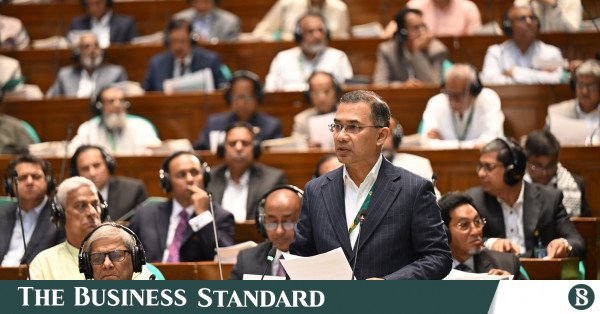
Just moments earlier, the premier had called for making the parliament meaningful, effective and vibrant through debates and constructive discussions.
“This is the Parliament of the people of Bangladesh… independence and democracy-loving citizens of the country are looking to this Parliament with hope and expectation,” he said in his brief address after the election of the new speaker and the deputy speaker.
Earlier in the day, Major (retd) Hafiz Uddin Ahmed, the lawmaker from Bhola-3, was unanimously elected as the speaker, while Barrister Kayser Kamal of Netrokona-1 was elected deputy speaker.
President Mohammed Shahabuddin administered the oaths at his Jatiya Sangsad office this noon.
The inaugural session, which began at 11:05am with senior leader Khandaker Mosharraf Hossain in the chair, marks a turning point in the country’s democratic journey as the 13th Parliament begins its journey just a month after the 12 February general election.
Congratulating the speaker and the deputy speaker, the Leader of the House said the duo no longer belongs to any party and all elected members will be treated equally by them from now on.
“You are the guardians of this Parliament.”
“In the interest of the people, we want to make this parliament meaningful. We should not oppose anything for the sake of opposition. Rather, through reasoned discussion and debate, we want to make this House vibrant and effective,” he said.
Meanwhile, while the Leader of the House and members of the ruling party stood up to welcome the President, opposition lawmakers adopted a different form of protest by remaining seated in their chairs.
When the bugle sounded and the national anthem began to play, a section of MPs belonging to Bangladesh Jamaat-e-Islami remained seated.
At that time, LGRD Minister Mirza Fakhrul Islam Alamgir and parliamentary officials signaled to the members, reminding them about the playing of the national anthem and requesting them to stand.
Although some MPs eventually stood up, others continued to remain seated.
Meanwhile, a post captioned “Get out Chuppu” circulated on social media, shared by National Citizen Party (NCP) Chief Organiser (South) and Cumilla-4 (Debidwar) MP Hasnat Abdullah.
Shortly after President Shahabuddin began delivering his speech, opposition lawmakers started shouting slogans inside the parliament and walked out.
During his speech, the premier gave a significant directive, reminding lawmakers that their primary identity has shifted with their election.
“I offer you my heartiest congratulations. From today, you are no longer members of any specific party,” he stated, emphasising a departure from partisan politics in favour of national service.
Reflecting on the political landscape of the past decade, the Leader of the House remarked that those who identified themselves as MPs during that period did not truly represent the people.
He asserted that the current parliament is a genuine reflection of the public will, noting that the country’s pro-democracy people are looking toward this House with great hope and expectation.
Tarique Rahman said that a people-accountable and truly representative parliament elected by the people has begun its journey again in the country through the tears of countless victims of fascism and the sacrifice of thousands of lives.

“At this historic moment of Bangladesh’s Jatiya Sangsad, I would like to express gratitude to the Almighty Allah, by whose infinite mercy, we have been able to begin our journey towards building a just, democratic and humane Bangladesh,” he said, reports BSS.
The prime minister underscored the government’s commitment to fostering a “constructive dialogue” within the chamber, stating that the administration intends to make the parliament truly vibrant.
Directly addressing the newly elected speaker and deputy speaker, he noted that their role is paramount in achieving this goal.
“In this regard, your role is greatest,” he told the Chair, pledging his full cooperation and support to ensure the House remains a centre of effective governance.
During his speech at the inaugural parliamentary session, the prime minister paid tribute to all those who had been martyred in the struggle for democracy and rights, from the War of Independence in 1971 to the struggle to protect the country and its people in 2024.
At the beginning of the 13th Jatiya Sangsad, the premier also recalled with gratitude those who lost their children, near and dear ones and relatives, those injured people who had to loss their comfortable lives in the movement for democracy and human rights as well as those who lost everything due to torture, political harassment or false cases during the fascism.
In this connection, he mentioned people from all walks of life—including students, farmers, workers, teachers, poets, writers, journalists, doctors, engineers, lawyers, craftsmen, fishermen, weavers, drivers, businesspeople, government and private employees, homemakers and leaders, activists and supporters of democratic political parties across the country—who endured repression, abduction, killings, torture and harassment.

The prime minister said even brutal detention centres described as “Ayna Ghar,” enforced disappearances and various forms of repression could not suppress their democratic aspirations.
He said it was the courageous role of the people—especially the students and masses—that restored democracy in the country.
Addressing the lawmakers, the prime minister said former prime minister Begum Khaleda Zia had established parliamentary democracy in Bangladesh and institutionalised the system to ensure people’s rights.
Tarique Rahman, also BNP chairman, said that the democratic system was later turned into a mockery and the Jatiya Sangsad had been reduced to a subject of ridicule by establishing an authoritarian regime and exploitation in the country.
Noting that Begum Khaleda Zia fought until the last day of her life to restore parliamentary democracy and people’s rights, Tarique Rahman said she never compromised with autocracy or fascism.
“That long-cherished parliamentary democracy began its journey once again in the country today, Alhamdulillah,” the Leader of the House said.
“The founder of parliamentary politics, Khaleda Zia, could not witness this auspicious moment in the success of the country and the people. Therefore, standing in this House, we remember with deep respect the late Khaleda Zia, an uncompromising leadership to protect the country and its people as well as a memorable, distinguished and exemplary political figure,” he said.
Citing a quote from late president Ziaur Rahman, he said, “If the people themselves become a political party, then I belong to that party.”
He said this statement reflects that the interest of the people must come before the interests of individuals or parties, which is the core philosophy of BNP’s politics.
Stating that he has been elected as a member of parliament (MP) from the Bangladesh Nationalist Party (BNP) for the first time and has also been chosen as the parliamentary party leader, he said, “Although I represent (my) party in the Jatiya Sangsad, as the prime minister, I represent the entire country in this House,” he added.
About The Author