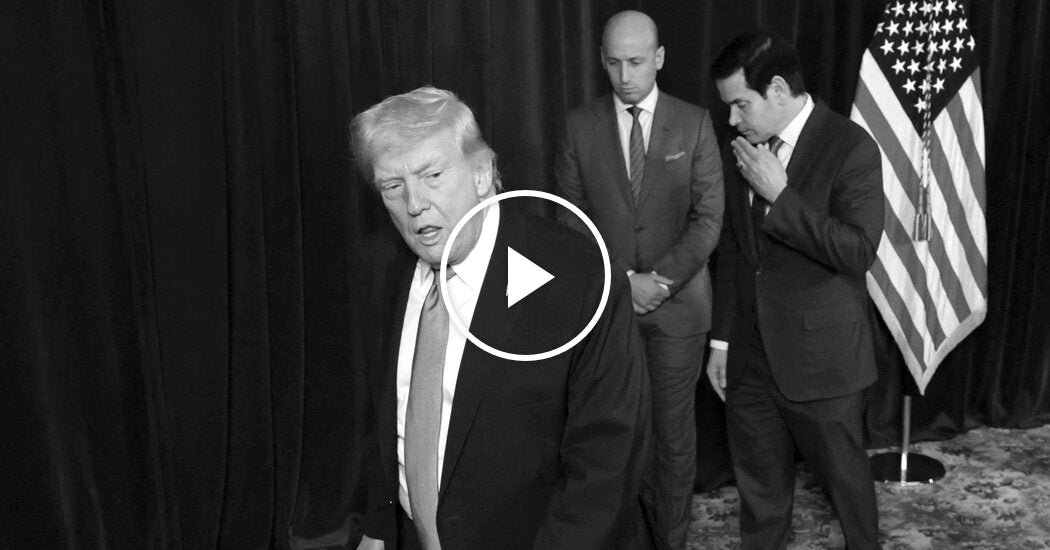
In the early 20th century, there was this anarchist idea about the propaganda of the deed. The propaganda of the deed was that there were these forms of direct action, many of them violent — assassinations, bombings — that when you did them, they were so spectacular, everybody would hear about them. And when everybody heard about them, there would be copycats. By making clear society did not work how you thought it worked, it could rupture society itself and create the possibility of a moment of revolutionary upheaval. I think there is a way in which you should and can understand the Trump administration as operating often through propaganda of the deed. Now, they’re not an anarchist collective. They’re a state. They’re a regime. But they operate not so often through the dull work of rules and laws and legislation and deliberation, but through spectacle, through the meaning of particular spectacles. Venezuela was a spectacle. They do not seem to have planned for the aftermath. They were decapitating the Maduro regime, but they left the regime otherwise completely in place. “For us to just leave, who’s going to take over? I mean, there is nobody to take over.” But it was a object lesson, an example, an act that showed something. And even before the capture of Maduro, they had chosen not to fight the drug war, the fentanyl scourge, through laws and legislation on addiction and drugs, but instead do these very high profile bombings of alleged drug boats that even if they were drug boats, were probably carrying cocaine. It was spectacular. It was a message. It was showing what they could do. It was a deed that everybody could see and would talk about. Liberation Day. You can keep going on and on and on. The Trump administration is an administration of spectacle. And I’ve heard it sometimes described as a reality TV administration. But I don’t think that’s quite right, because what reality TV wants is ratings. But these spectacles, this propaganda, is meant to carry messages. It is meant to make clear how the world now works. My guest today is M. Gessen, who grew up in the Soviet Union, who’s my colleague here. At Times Opinion and has written remarkable books like “The Future Is History,” about living under Vladimir Putin, and who’s been a clear and relentless and very perceptive voice on what it means and what it is like to live in a country that is turning into a different kind of regime. As always, my email ezrakleinshow@nytimes.com. M. Gessen, welcome to the show. Great to be here. So on one level, the target of the recent operation in Venezuela was obviously President Nicolas Maduro. On another level, you’ve argued that the target was the New world order of law, justice, and human rights that was heralded in the wake of World War two. Tell me about that. So I always feel a little like I have to make a lot of caveats when I talk about the post-world War Ii order. All these multilateral institutions were created, all these mechanisms, international courts, the UN, the Security Council, because it was in many ways an aspiration, an aspiration to creating an order that would a prevent a New global war, something at which it has been very successful and B prevent the kind of disregard for human life that made the atrocities of World War II possible. And in that it’s been much less successful. But the aspiration remained. And I think even though the United States was historically one of the parties that violated this order because it had the power to do so, it still did it under the cover of respecting those aspirations. And what I think has changed with the pullouts from all these different multilateral institutions and the blatant disrespect for them and actually contempt for them that Trump personally and his administration have articulated. And I think it’s culminated with Venezuela. I think that if there is an event that I think of as the nail in the coffin of the New international world order, it will be Venezuela. I guess when we talk about international law here, the history, including recent history of what it has clearly not been capable of preventing or bounding is pretty long. I mean, Israel and Gaza is ongoing. Russia inside Ukraine is ongoing. There was much about the drone strikes and the Obama administration that was not working through, let’s call it, a normal set of due process. And frankly, Maduro himself, right, which I think is very important to say in all of this, he was not a peaceful, humanistic, democratically elected leader. He was a brutal, repressive dictator, destroying his political opposition, remaining in power after losing an election. And so when we talk about there being a tipping point, are we just upset because it is Donald Trump doing it. But he is just revealing the way the world really works and has worked, just stripped of its veneer of bureaucratic opacity. Well, first of all, the veneer is important, that it’s important that at least that George W Bush administration felt it was necessary to lie to the UN rather than disregard the UN altogether out of respect for the institution. I mean, it sounds ridiculous, right. But there was a moment after the full scale invasion of Ukraine when it seemed that actually all these mechanisms that were so painstakingly created and one step forward, two steps back, that they may all finally kick into gear because there was this unprecedented consensus, at least Western consensus on Russia’s crimes in Ukraine. And then with Gaza, that consensus fractured. And the hope for these institutions really kicking into gear dimmed. At the same time, there was the International Court of Justice hearing initiated by South Africa’s suit against Israel. That was itself a New phenomenon in international law, and it’s very easy to look at all the ways in which international law has failed. It’s much more difficult to be able to measure what it has prevented. Certainly, one thing that it has prevented over the last 80 years is another global war. And at least until Venezuela, it seemed that it wasn’t a foregone conclusion that the attempts to create an international rule of law were doomed I’ve been thinking about the differences and similarities of Venezuela and Iraq, because ultimately Iraq is also the invasion of is a betrayal of the international order. But you watch through the quite long run up to that invasion, the Bush administration doing two things at least reflect a view that it should be caught trying. One is there’s a very long period of deliberation in America itself. Deliberation with Congress, deliberation on Sunday Morning News shows. There is a long debate in this country in which arguments are being made back and forth, in which Bills are being considered, in which debate is being had. And there’s also a debate internationally, Colin Powell going to the UN and giving a presentation we now know had falsehoods in it. And in some ways New then. And ultimately the UN does not go along. And then you have the coalition of the willing. And it is a betrayal of the order. But it has this idea that the US should still be working within. And you can understand as having both continuity and discontinuity. And I’m curious how you see that. Well, exactly. It’s very difficult to say. It’s better to lie to the United Nations than to disregard the United Nations. But I think maybe it is better to lie to the United Nations. But I think I wouldn’t just look at the Iraq war as precedent. I think Kosovo is a really interesting precedent. Kosovo, which was an air war launched by NATO, but without sanction of the UN Security Council, and that seemed to me even at the time, hugely problematic. But there was a kind of there was still lip service to first of all, NATO, second one to respecting international norms. And, we can point to times when the president didn’t get congressional approval. We can point to times when the United States didn’t get approval of the UN Security Council. We can point to times when it acted independently of NATO. We can point to times when it blatantly lied about what it was doing. But I can’t really think of a time when it was doing all of that at the same time demonstratively. And I think there’s a transition of the quantity of things that this administration is doing to New quality of being in the world. And the Trump administration both, I think, appreciates, but in many ways governs through spectacle, where other administrations govern much more through rules and laws and regulations. They really focus on spectacle. And Venezuela was structured as spectacle. Not a long planning process for what the post decapitation of the regime will look like. But just you go in and then you have this picture of Maduro on the plane blindfolded. You have this, very triumphant press conference from Donald Trump. What is the role of spectacle here. So I think there’s the level Yeah of this love of a particular aesthetic of strength. Particularly aesthetic of dominance and organization. The Trump seems to be instinctively drawn to it. And we’ve known that since his first term. His obsession with military parades, and obviously, the spectacle of the transformation of the White House, both the creation of all the gold leaf and the destruction of the East Wing. The demonstration of dominance and power. But I also think that Trump is always in a movie. He’s always watching himself on screen. And that’s something that makes him different from anyone I’ve ever read or written about. There just seems to be this constant external observation of this character that he’s playing, which I think is in some ways, his superpower. It’s what gives him the ability to shake his fist after literally dodging a bullet and saying, fight, fight, fight. And having that incredible photo op, because even at a moment when he really was, when he really did come face to face with death, what he’s thinking of is what it looks like from the outside. So I think there’s a whole other level of spectacle that we’re seeing here that we still need to understand. I think sometimes about the way in which Joe Biden and Donald Trump are not far apart in age. Biden felt fundamentally of another era. Biden was a politician of the past who was somewhat governing as a caretaker of the present. Trump, to me, sometimes feels like he is somewhat from the future. He is hyper modern. What I mean by that he is always his profile picture. There’s no I don’t want to say truly. There is no backstage to him, but I am not sure there is a backstage to him. I just think that there is a way in which he fully inhabits himself as a public brand and has for so long that it is absorbed on a cellular level to him in the way that even many people who are understood as influencers or famous, or they’re a little bit faking it. But for him, Donald Trump as a media spectacle, as a human being turned into a spectacle is a fully inhabited persona Yeah, exactly. I think that’s what I’m trying to get at. And I didn’t mean to say that he is thinking, what will this look like online. What will this look like on the front page of the paper newspaper. It’s that all there is the external view. There’s no internal there. It would be one thing if it’s just him, but it’s no longer just him. And my sense is that people all over the administration understand this on some level, is what it means to be doing politics. Kristi Noem going to the Salvadoran torture prison and posing in front of all these human beings stacked up behind each other in a cage, that’s an. That’s not who Kristi Noem was 15 years ago. That’s an attempt to learn in an artificial way what Donald Trump embodies in an intuitive way. But it’s turned his like, his instincts into not a governing philosophy, exactly, but a governing mode. I think that’s a great observation. I do want to temper it a little bit. Because I think there’s a craziness to what we’re living through that has to do with how we got here, which is that politics should have a spectacle. Politics should have a public dimension. We in the preceding more quote unquote, normal administrations. We didn’t have that. The Biden administration was bizarrely closed, Black box, bizarrely, for any administration, but particularly for a Democratic administration, it was an administration that utterly failed to tell any kind of story. And I’m sure a lot of it had to do with Biden’s deterioration and his inability to really be in public. But really, it was like a closed management company that was just trying to get stuff done without being distracted to doing public by doing public politics. So the transition from that to this is even more bizarre. We’re not seeing a juxtaposition of two different kinds of public politics. We’re seeing that this is what public politics in America now looks like. I think that’s a really interesting point. And I began thinking while we were talking about this, about a moment I haven’t thought about in a long time, which is Barack Obama was capable of spectacle and created spectacle during the fight over the Affordable Care Act. Deep in it, Obama functionally holds a public debate on c-span with him and a bunch of congressional leaders, of which, for the Republicans, Paul Ryan ends up being the star and lead communicator in which they are just arguing the details of Health Policy in front of the public. And there are many things happening in that. But in some ways, it was a spectacle of deliberation. It was a spectacle very aligned with sophisticated policy making in a democracy where the view was that people might align to whoever made the best argument and the message of a lot of Trumpist spectacle. To me is the wiping away of all that. Again, the absence of Congress here, I think, is a very, very important thing, the absence of Congress in so much of it, I think in part because Congress is like anti spectacle. It’s slow, you get bogged down, it’s details, but it also is itself a to the degree it is a spectacle. It a spectacle of constraint. So you’ve allied at one point where you say that it is institutions and norms and laws that make a democracy. And I think the spectacle here, the way the Trump administration does it, is actually about the contempt for those institutions and norms and laws such that the message is we are not that kind of system. We are this kind of system run by this one man. Absolutely I agree with everything you just said. And I would just add one thing. It’s not just institutions and laws and norms that make a democracy, its institutions and laws and norms functioning in public transparently, that make a democracy. And that’s what we’re lacking and we’re lacking it demonstratively. I think that that’s your observation about why he’s not using Congress is spot on. Because even using this. Using the power that he has now with the trifecta to effectively, as we might imagine, rubber stamp White House legislation would be empowering something other than himself. You have a line in one of your pieces where you say that Trump and autocrats like him are opposed to deliberation as such. And I’ve been thinking about this line because the idea that the US just entered into. As Trump himself has now said repeatedly, a multi-year, an open ended commitment to in some form or another, running Venezuela with 0 domestic debate about it. No real debate with the Senate “Foreign Relations Committee is not debating this. What it means for America has not been described by anybody. So tell me, in your view, both about the relationship between leaders like Trump and deliberation and what it means that there was so little deliberation for such a profound assumption of responsibility and violence here. So I think there are two aspects to deliberation. One is just a way of exercising power. I think Trump it’s hard to get inside his head, but I think that his conception of power appears to be something that’s wielded unilaterally, and it is diluted by any kind of public deliberation. There’s probably deliberation happening behind closed doors, but the concept of power that he projects is the kind of power that’s unilateral. There’s also another aspect to deliberation, which is that deliberation is and I’m using an idea that I borrowed from Borland, who’s a Hungarian political scientist who I think is just the absolute best and clearest thinker on autocracy out there. And he talks about deliberation as an expression of our obligations to one another. And I think that’s a very useful way to understand what that projection of power is. It is a rejection of any kind of obligations to one another. I was very struck by Stephen Miller, who I think is functionally the prime minister of the US right now. Talking to Jake Tapper about the possibility of America taking Greenland, which again under structure of international law is unthinkable. We live in a world in the real world, Jake, that is governed by strength, that is governed by force, that is governed by power. These are the iron laws of the world. But are you saying since the beginning of time. Let me start here. What do you think when you hear that comment. I think Putin and this is I think that we’ve had actually since the end of World War two, we’ve had two post-world War Ii orders. There’s the structural one, the institutional one, the rhetorical one. This is the order that is that aims to prevent another global war. And then there’s the Victor’s order. The order that’s summed up by I think, Putin’s favorite photograph of Stalin, Churchill and Roosevelt sitting in Yalta, which is now in Russian occupied Crimea. Carving up the world. And he refers to that constantly when he talks about his right to do what he has done, and most for the last four years when he talks about the war in Ukraine. And that’s basically the argument that he’s been putting forward is, look, strong men carve up the world. And really what I’m willing to sit down and discuss is how we draw the lines, not what any international institution has to say about it. And so what I hear Stephen Miller saying is basically the exact same thing. There always seems to me to be here an assertion not just about international institutions or nations, but also about human beings. I think when I listen to MAGA and Trump and then its theorists and its followers, I hear something being said about this idea that we have restrained the animal, masculine, dominance oriented, conquest oriented instincts that on some level made humanity great that in the Elon Musk version that will get us to Mars in the future and tied them up in hollow liberal values and self restraints and debate and discussion and deliberation and rules and procedures and there is something being said that is operating really at all levels. The way America is acting under Trump is the way America should act, the way a superpower should act. That is what it means to be a superpower. It is to be unrestrained. But the way Trump acts is also the way a man should act. I think that’s a very astute observation. And I think you’re absolutely right. And, I’m going to use the word fascism here because I don’t think we can analyze this well enough without some kind of framework. And we often talk when we talk about fascism. We talk about ideology of superior race. But it’s also a worldview. And what’s fundamental to that worldview is that the world is rotten and that everyone in the world is rotten, and anybody who pretends not to be rotten is lying. And part of the mission is to expose that lie. And so it’s impossible to talk to a person who’s encased in that kind of ideology, because everything you say is a priori a lie. If you say that you value human rights and human dignity and human life, well, then obviously you’re being a hypocrite and you must be exposed. And I think that that’s what we’re seeing and that’s what we’re hearing from Stephen Miller. I don’t always hear them saying that everybody else is lying. I hear them saying almost something different their idea of the woke mind virus, that something has happened and an ideology has taken over that is poisoning ambition and aggression and a set of forces, a kind of vitality. That is what drove civilization forward. No, I think that’s a great observation Yeah they’re seeing a weakness virus, a weakness virus. It’s a better way to put it. I want to play for you a clip of Pete Hegseth, the Secretary of Defense, talking about at least one of the ways in which he wanted to change the culture of the US military. Frankly, it’s tiring to look out at combat formations or really any formation and see fat troops. Likewise, it’s completely unacceptable to see fat generals and admirals in the halls of the Pentagon and leading commands around the country. In the world. It’s a bad look. It is bad, and it’s not who we are. He goes on to launch an attack on beards also, in that there is a real obsession with aesthetics across this administration who at a point and then what they want from the people beneath them. What do you make of that. I mean, it feels so familiar to me. I grew up in the Soviet Union, where we watched parades on TV. One of the happiest days of my life as a kid was finally receiving the red kerchief. What is a red kerchief? A red kerchief was is a sign of membership in the young pioneers, which is the kids Communist organization. And it’s amazing because I grew up in a dissident family by the time I was 10 years old, which is when you get inducted, I was quite aware of where we lived and what we thought about it, and yet the aesthetics of it were irresistible because I mean, it was beautiful. And it was also other people. And you could March in formation nation, and it’s so incredibly appealing and embarrassingly right. And I just watched there’s this terrific New documentary called Mr. nobody against Putin, which was filmed in secret by a teacher in a Russian school in a small town, a town of 10,000 people in the Urals. Over the course of a couple of years after the start of the full scale invasion. And it’s partly about it’s really about the imposition of propaganda in the school and how. That school and all other Russian schools became retooled as junior military organizations. But you can also see the imposition of an aesthetic. These kids starts. They start marching in formation. They start carrying the flag. They eventually get these uniforms that hearken back to those exact uniforms that with the red kerchiefs that I wore 50 years ago. It’s a fascist aesthetic and it’s what we have. It’s what the 20th century taught us about what power looks like, what strength looks like. Why do this is something I’ve become slightly weirdly obsessed with. Why do fascist movements, authoritarian movements. Why do they seem to care so much more about aesthetics and in their own way, beauty than Keir Starmer’s government or Joe Biden’s government. Even Donald Trump coming into office and omits everything else he had to do. Deciding to chair the board of the Kennedy Center, as that was clearly the thing he really wanted to do. And then recently, having his name etched into the institution, the Trump Kennedy Center, it’s now called if you go to the website, if you go to the building, he immediately signed an executive order about bringing classical architecture back to federal construction. I do not share Donald Trump’s aesthetic. He filled the Oval office with gold. But he really does have one. And he really understands it as a dimension of politics and power and cultural control. And this goes through other leaders like him. I mean, Putin has his bare chested photos and his aesthetic. And you go back to the mid-century and early 20th century fascists and you see an incredible I have a whole book on Nazi aesthetics at home. I have come to think it’s first a weakness of liberal politics, that it does not see itself as having a relationship really to beauty, that it does not believe beauty should be part of politics necessarily. It likes beauty. It wants other people to do beautiful things. But, we’re the people in the suits who have the charts and can tell you how the health system is run, not the people who have views on what is and is not beautiful. Why do you think it is that these movements see spectacles, see beauty, see aesthetic as so much more central to how politics should operate and how power is wielded, then certainly, liberal left wing coalitions do. So I think it has to do with two things. One is the past and the other one is race. We’ve talked about how Trump is a leader of the future, which I think is a really interesting observation that you made. But he’s also, of course, a leader of the past. His singular political promise is I will take you back to an imaginary past before all this happened, before all the bad things happened, before you felt uncomfortable, before you felt scared about what would happen to you. Before you felt scared about being alienated from your children. It’s going to be warm and cozy and exactly as you imagine the past to have been. And aesthetically, a representation of that past is classical architecture. It’s an entirely white American history. It’s the great monuments and whatever else that he has promised to bring back. But it’s really interesting how the Soviet Union, the initial revolutionary movement was artistically experimental. And then very quickly, with the establishment of terror, it turned back into this classical architecture and extremely conservative art. And all of it as though as though the Soviet Union was trying to transport itself back into the 17th and 18th century aesthetically. So I think that’s one dimension of it. The other dimension of it is the assertion of a superior race. This is the other dimension of fascism. And aesthetically it’s very present. And race can be defined differently. But what we’re seeing is white cis men who are in excellent physical shape. That’s what the ideal of this administration looks like. And of course every fascist administration, it’s not actually led by men who look like that, but they want to look like that, and they want to be surrounded by men who look like that. And they appoint men who look like that. And they appoint women who look a certain way too. But I think we might be falling into of equivalency trap. And I’d be careful here. It’s not incumbent on whatever we want to call this politics. Liberal, Democratic, left, anti-fascist. It’s not incumbent on us to produce an equal and opposite aesthetic. It’s actually much more complicated task, which is to assert an entirely different aesthetic direction. which is oriented toward difference and variety and things that you haven’t seen before. And that is objectively much more difficult. How do you create an ideal of beauty that includes all sorts of things and all kinds of people, and a kind of architecture that no one has seen before. I don’t know. So I want to talk about a different dimension of spectacle that you have written quite a lot about which is that the constancy of spectacle Trump everywhere all the time that there is a way. And the times had an amazing review of Trump’s media presence in 2025, and showed that it he was twice as prevalent as he himself was in 2017. It has gone up from his first term that it kind of crowds everything else out. Tell me a bit about that dimension of using attentional capture as a tool. So during Trump’s first term we used to talk about the shiny object. And it almost seems quaint now that we thought were the things that we thought about as shiny objects. But I remember distinctly that sense of just extreme fatigue, because you always felt like you were looking at something that was occupying your attention fully, but you had a deep suspicion that there are other things that should also be claiming your attention that may be more important or equally important. And I think that gave rise to a lot of conspiracy thinking about distractions. And I think we’ve moved past talking about distractions. And that’s a good thing because there was never I don’t think, a strategy of doing one thing to distract from another. I agree with this. It was just an overall policy of distraction. Well, they themselves are also distracted, which I think is an important point. They don’t have some attentional reserve. Nobody else has. They are running from one thing to another, not watching how the last thing worked out, which does create problems for them. I mean, there is distraction becomes everybody’s condition and it is Trump’s fundamental condition as a human being. He cannot hold a topic for a paragraph. He is distracted. Absolutely but he’s also driven and he’s driven to create one attention dominating spectacle after another. Again, that’s how he thinks power operates. That’s how he asserts his presence in the world. If there isn’t a movie to be shot today, then today is a wasted day Say more about that. How you think he thinks power operates. I mean, again, I can’t get inside his head so I can observe from the outside. What I see from the outside is that it’s a nonstop production of spectacle, of big events, of assertions. We have done this today. We have liberated Venezuela. We have protected the American people. All of this obviously in quotes we have arrested criminals. We have deported them to Salvador. We’re waging war in the streets of American cities to protect you from crime. And we know. We know that at this point, we’ve gotten used to the fact that if Venezuela happened three or four days ago, the chances that we’re still going to be talking about Venezuela next week are almost 0. Well, I mean, it happened he really just days ago. Still, and already today there is a different spectacle that I’m almost having trouble having this conversation because the thing I am thinking about is a public execution of Renee good in Minnesota, and it’s a little unclear what happened. Their car was in the middle of the street, and then you watch the federal agents rush the car, and she begins executing like a multi-point turn to try to leave. And then an agent shoots her dead in the middle of the street. And the Trump administration is saying she was trying to run them over. And you can very easily see that she was not trying to run anybody over. She was parked first. They run at her and she tries to leave and not even speed out. Just leave. And it is a spectacle of its own and it is a kind of thing they’ve always been creating the conditions to see happen. I’m not saying they intended for this to happen at the top, but everybody is predicted. Things like this happening, myself included. And it feels like a message to every protester. I’m just curious how you have understood her killing this moment. What it means, what its meaning is. I think this is a huge event, for lack of a better word, which I also feel is important to say because in one sense, the spectacle of a driver being executed in an American street is not unfamiliar. It actually happens all the time. Police shoot black men in their cars with stunning regularity. What was different here was that it wasn’t police, it was ice. And the person that they killed was a white woman and not a Black man. So this is another one of those instances where we’ve been on this descent and then fell off a cliff. And the particular cliff is Trump has been for almost a year now talking in military terms and war terms about American cities. He has deployed ice as a military force or not. Actually, I shouldn’t say as a military force as his own paramilitary force, which is another essential component of a fascist dictatorship, is to have a paramilitary force that reports directly to the president that doesn’t have independent authority, which is effectively what ICE is. And ice has been recruiting thugs all over the country and swelling its ranks. And Trump has talked about the protesters. Sisters against ICE, in particular in Portland, not in Minneapolis where this happened. But as the criminals, as extremely dangerous as people that war should be waged against. So the stage has been set for this execution for nearly a year. It’s almost surprising that this didn’t happen earlier. But now that it’s happened. What happens as autocracy establishes itself is that this space available for action shrinks very rapidly. And I talk about this a lot when I do public speaking, people ask me, what should we do. And I say, well, do something. Because whatever you can do today, you’re not going to be able to do tomorrow. So act where you can act. And one of the places where people have been able to act is in Ice Watch protecting their neighbors against ICE. It hasn’t been terribly effective, but I think as an organizing mechanism and as a community level action and as protest, it has been extraordinarily effective. It’s what’s really brought people together to protect their common values and their neighbors. And that may no longer be possible. That’s what this execution signals, or the danger of engaging in that kind of activism has just grown exponentially. Well, what do you think about when you said that and when you were thinking through the ways in which it is or is not different than the Black men who are shot in their cars. Is that as much as the administration is claiming this was a form of law enforcement violence. She was threatening the officers and they had to act to defend their lives. And again, you can watch the video. This was, in my view, political violence. It was state repression. It was an act against civil disobedience or resistance to what they are doing. It is being functionally defended in at least somewhat those terms. I agree with you when you say this is a huge event. There’s this favorite journalistic cliche or political cliche this is not us. But of course, this is us. This is us now. And it’s very significant that this was carried out by ICE and not by the National guard, because this propaganda is not just this is what we do. This is what we do. Join us. But the other thing that’s happening is the way that we analyze and frame this administration and compare it to historical precedent. There are certain things that we have come to consider unthinkable. Concentration camps are unthinkable. Fascism is unthinkable. These are words that we try to avoid using because they are, by definition, hyperbole. And part of the reason that they are hyperbole, by definition, is because we’ve said, O.K, that only happens in this past that we have set aside from. From our lived reality. And so if this is happening in our lived reality, if Alligator Alcatraz is being built in this country now, then either we’re living in a country that’s building a concentration camp or it’s not a concentration camp if protesters are being executed by paramilitary forces in the streets of the city, then either we’re living through fascism or this is not. This is not fascism. And that choice is so stark and so desperate. One of the things that I found very disturbing, among many things about the way the administration has acted after goods killing. So Trump posted a video of the renegade shooting on Truth Social. And he said the video showed good was, quote, obviously a professional agitator who again quote, violently, willfully and viciously ran over the ICE officer. And you could see people arguing over this and analyzing the frame by frame. But I think there’s also something about this moment where you have this video and people can’t even agree on the reality of it. But then secondarily, and this picks up on something you’ve talked about here, how often you hear the administration describing citizens constituents as a domestic enemy within political opposition as something I mean, judges, as I remember the administration describing a judge as a legal insurrectionist, right. The real insurrection is the people who stormed the Capitol on January six. They got pardoned. But now there is this language that anybody trying to protest, et cetera, that the Trump administration is the enemy needs to be dealt with. At least as the internal logic of this looks by force. And when that happens, they’re not going to investigate or say, this is a great tragedy. We need to see what happened. They’re going to say you were the enemy and we were right to kill you Yeah, totalitarian leaders need to wage wars, and sometimes they wage wars externally. More often they wage wars internally or both. And they always designate an enemy within. Trump did it as soon as he assumed office. His main enemy within were immigrants. But the end protesters. But But the circle or the number of the enemy within has to expand constantly, because that’s the only way that you can wage war continuously. And the war needs to escalate. And that’s what we’re seeing. It was unthinkable until it happened that a white, presumably middle class protester would be executed on camera in broad daylight in an American city. And now that it’s happened, it’s the thing that can happen here. How does all this look similar or different to you from what you saw in Russia. It’s so much faster and it’s so much faster, not just in Russia, but than Hungary, then Israel, then any country that I have covered that I think we can say has become autocratic. It’s comparable to the speed at which countries that experienced an actual violent revolution have transformed that I have studied, but not lived through. But I think that this really is we can use some of the tools from, particularly from the electoral autocracies in Eastern Europe to understand some of what’s happened here. But I don’t have any tools for understanding the rate at which this country is being transformed. Do you think that the rate and the speed of it also reflects a fragility within it. And one way, I mean, that is very famously Putin has or at least had, but still has, I believe, very high approval ratings. Trump does not. And the 2025 elections, Republicans got routed everywhere they competed. Some of the spectacles we’re talking about, I think Venezuela might over time turn into this too. They don’t have a plan for Venezuela if it goes easily and we never think about it again, that’ll be fine for them. But if it ends up in civil strife and other things, and we do need to have American boots on the ground, as Trump has said he is open to. People may not like that. Liberation day was constructed very much as a spectacle with Trump, with his big poster board of tariffs on islands full of penguins. And the tariffs have been politically quite disastrous for the administration. I often say to people that if anything is going to save American democracy. It’s Donald Trump’s tariff regime. There is a lot of speed here. And sometimes the speed to me feels like it is covering up for a hollowness. They have to move so fast because they actually have not built the underlying consensus support infrastructure. But then they’re not planning for what happens after they’re not ready for it. They are also just reacting to the situations they create. And if you look at Donald Trump’s polling, if you look at recent elections, not effectively for their political standing. I don’t think I share your optimism, but I hope you’re right. And your optimism is also tempered. But I think I’m more pessimistic than this. I think that well, first of all, I suspect that the reason that they’re moving so fast is because Donald Trump is old. I think he feels a particular urgency. I think when Putin came to power, he felt like he had his entire life ahead of him and he was going to move slowly and deliberately, not in the deliberative sense of the word, but with intention. And Trump has to RAM this through very, very fast. But I also think that speed generally benefits the autocrat. Democracy is very slow. The one way and I think this is how they’ve hacked the system. And it is an inherent fragility, but it’s the inherent fragility of democracy. Institutions even protect themselves very slowly. Look at USAID now. We know that there wasn’t necessarily a plan to completely demolish USAID when they first went after it, but within a few weeks it was functionally destroyed. And you can’t just put something back together after it’s been destroyed. Especially if there’s no political will to do so. So I just think that speed is to his benefit. And whether it’s covering up a hollowness is maybe irrelevant. The other is the issue that the point is the issue of popularity. And I think we have a problem here, which is that there are different kinds of metrics. I think there are Democratic metrics. And there autocratic metrics, Democratic metrics no longer apply. Do autocratic metrics apply. Fully I don’t know. Well, say more when you say Democratic metrics no longer apply. So for example, we talk about how Venezuela, when it goes all wrong and there are boots on the ground and American soldiers are dying and nothing is working as intended. And the oil Wells are not sprouting fountains of gold that fund this whole operation and enrich the United States when none of that is happening. Does that have consequences, for example, for the midterm elections. That would be a Democratic metrics. And I very much doubt that it will have consequences for a couple of reasons. One is what’s happened to the media universe and how completely different the pictures that. Say moderate voters, for lack of a better term. See, and you and I see are and will people who need to see what’s happening in Venezuela have any idea about what’s happening there. Will people who don’t read the New York Times’ have any idea what’s happening there. I doubt it. And the other has to do with the elections themselves. We tend to think of elections in black and white terms. Either they are free and clear, or are they. Either they’re free and fair or they’re not. But actually, there are many ways to degrade elections. And some of those ways have been operative in this country for many, many years, much longer than Trump has even been a political actor. And that has speeded up greatly over the last year. And so we’re going to be to see this fractured media universe and a hugely degraded election later this year. And the combination of those two things. Let me try to take the other side of this. I don’t love talking in terms of optimism and pessimism, because I don’t actually consider myself optimistic. I’m more trying to have the best picture of reality that I can. But if I were to take the other side, and I do think I see this somewhat differently, I am not yet seeing things that would make me think that there has been some deterioration, either in the media universe such that there’s no capacity for backlash because nobody knows what’s happening. And in fact, when I look at non-aligned media, Joe Rogan or flagrant or things like that, I seem to see a turn on Trump, right. The bro podcasters and people just being a little more upset about the Immigration and not sure of what they’re seeing. And, I mean, we don’t know how the 2026 elections will go. And so, maybe it’ll go the way you’re saying. But to the extent we have signals, yet the signals seem very, very bad for Republican performance in elections starting with the Wisconsin Supreme Court election. But then, of course, moving through to the New Jersey and New York City and Virginia elections, moving through to the prop 50 redistricting ballot initiative in California are moving through to every house and so on. Special election where Democrats have been overperforming by about 14 points in one of the analyses I’ve seen. Although there are different ways of thinking about this and different ways of measuring overperformance. But I guess I would ask why the 2025 elections, which were so uniformly against the regime, haven’t made you rethink this somewhat. Well, I mean, I think you’re right. I have my own heuristic, which is that I think everything always gets worse, which doesn’t mean it couldn’t get better. I think that we’ve all become accustomed to thinking in a kind of split local federal screen, a split local federal screen. As a lot of the 2025 elections that we’re looking at had to do with local politics. And I think that projecting that onto even how people will vote for their local representative to Congress is a somewhat risky business. Because the Trump voter isn’t necessarily acting on their disillusionment with Trump. They’re actually their politics are entirely internally consistent. And so I think that Trump’s influence on the midterms will be much greater than the influence that he tried to exert on some to what extent do you think their politics, the Trump voter, the Trump AOC voter, of which there are some they’re not. I want to say actually that many, but they exist. But how much are those. Not highly attached. I don’t how much everything costs voters. And the thing, as I was saying, I was saying I’m not even joking that I think Trump’s tariffs and economic mismanagement and his evident inattention to cost. And you see him beginning to absorb this as a political threat, saying talking about the affordability hoax. How much do those voters now turn on Trump, which is why his poll numbers are bad. I mean, you have economic sentiment at levels that look like the Great Recession. That look more like moments of economic rupture. And so when I think about those voters, they often seem to me to be anti-system this whole thing isn’t working for me. Voters, not voters who are kind of Trump cultists but are willing to support a charismatic, Democratic socialist, right. So that’s really the great question. And I always think back to my series of interviews with this great Russian sociologist, Lev Gukov, who would show me these graphs of Putin’s subjective economic well-being and Putin’s popularity. And for about the first, I think, dozen years of Putin being in power, they moved in concert. So subjective economic well-being tips. Putin’s popularity dips, it rises, Putin’s popularity rises, which is normal. And then subjective. Economic well-being takes a dive and Putin’s popularity skyrockets. And his interpretation was that this is when people accepted a trade off it. You’re going to be poor, but in exchange for being poor, you’re going to belong to something great. And that’s the totalitarian trade off people made it in the Soviet Union. People make it all over the world. Are people going to make this, make it in this country. That’s what Trump is offering them. He’s going to wage war. He’s going to I don’t know whether he’s going to try to take Greenland or Cuba next, but this is going to be an imperial politics for the next year. And politics is expansion, politics of greatness, everything that we’ve been seeing, but much more aggressive on the global scale. Are enough Americans going to accept that trade off. Let me ask you a question that actually does relate then to Russia on that, because you know what. So much infinitely better than I ever will. But certainly the conventional wisdom in America on the politics of Russia under Putin has been that there is a dimension of national revenge and restoration, that the political psyche of Russia was it. We were a great power. We were the world spanning globe spanning Soviet Union. And now we have been humiliated and contained and shrunken. And the deal at some point Putin offered was you will not be rich, but Russia will again be powerful. The American psyche, as I read it and also as I read it in the 2024 election specifically, is almost the opposite. Americans feel America is powerful. It is powerful. And what they want is to be richer and what they were mad at in many ways, and what Trump very effectively potentiated in the electorate was, why is Joe Biden getting us involved endlessly in Ukraine and in Israel and Gaza. And why does anything seem to be happening here. And what Trump said was that we’re going to chill out on America’s role in the world. Stop it with all this endless engagement with foreign quagmires, and I’m going to make you rich again like me. And now we’re moving into foreign quagmires and domestic fighting. And people are upset about political division again, and you’re seeing your countrymen being murdered on national television, and you’re not getting richer, that you’re not part of something. It’s just more of people doing things that are not in your interest. When I talk to people on the right, that is the vulnerability they see for themselves. But it reflects maybe, at least in this telling, a difference in what Americans were worried about and what Russians in the period in which Putin was rising were worried about. But you would know better how fair or unfair that characterization is. I think it’s fair as far as it goes. But I think what’s interesting about and instructive about Putin is that for the first decade of Putin’s reign, rain. He really offered Russians an authoritarian, not a totalitarian bargain. And the authoritarian bargain is you’re going to live better. You’re going to. Your life is going to improve immeasurably, as long as you stay out of politics and focus on your private life. And this was a politics that suited the oil boom, that it was a moment of unprecedented economic prosperity in Russia. So he was accumulating power while Russians were eating better, living better, refurnishing their apartments, buying New apartments, and generally just enjoying a level of well-being that nobody in that generation had ever enjoyed. And once that money started running out, Putin offered the totalitarian bargain and Russians accepted it. So the question we’re really asking is, are Americans at all primed to accept that bargain. Is it going to have any purchase in this country. Because Trump’s using exactly the same politics. He’s now saying make America great again, not in the sense of you’re going to be able to afford a bigger house, but in the sense of we’re going to take Greenland. Is that going to get traction. We don’t know. And then the next question is, if it doesn’t get traction, is he destroying the Democratic mechanisms in this country fast enough that it’s not going to matter, that it doesn’t get traction. So these are just two unanswered questions. I’ve lived most of my life among people who looked to a future and to more powerful political actors to restore kind of Justice. I thought I would someday be in The Hague writing about the Putin trial. And I think that the most powerful country in the world, unilaterally canceling the moral order is an assault on hope. I think that’s a place to end. Always a final question. What are three books you’d recommend to the audience. So late last year, I spent probably three or four months just reading books about Israel Palestine, and two of them are standouts. One is called tomorrow’s yesterday, which I think you’ve talked about on the podcast. The authors have been on the show, if people would like to check that one out. And I’m not just saying it because I who’s been called “The Future Is History” by Hussein Agha and Rob Malley. And one of the incredible things about that book is just how well written it is. It’s not beautifully Yeah it. I never expected a book written by two policies, two people together, but also two policy people to be so beautiful. The other is a book that, after I read it, got the National Book Award, which is “One Day Everyone Will Have Always Been Against This.” And then I just read a galley of an auto fiction novel by a writer named Harriet Clark. And it’s called “The Hill.” And it’s a book about a girl who is raised by a mother who is serving a life sentence in prison. And it’s just an absolutely extraordinarily beautiful and intelligent novel. Thank you very much. Thank you.
About The Author