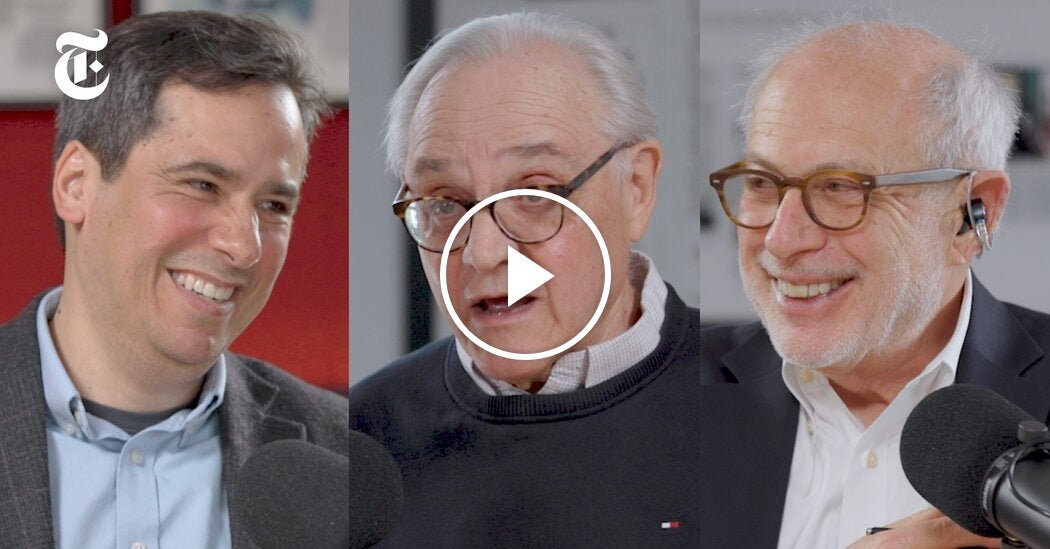
I’ve come to the conclusion that all discussions of the future. Nowadays, all questions that arise can be answered with one of two answers. It’s either China or artificial intelligence. That those two. You can use them as the answer to anything. That’s brilliant Robert. That’s really useful for columnists. Hi, I’m Robert Siegel. In conversation about politics with as always, E.J. Dionne. Great to be with you always, Robert. And we’re happy to welcome for the first time times Opinion columnist Carlos Lozada. Long time listener, first time caller. Thrilled thrilled to be here. Great to be with you, Carlos. We colleague. Lots to talk about today, but I want to start on the war in Iran, which is said to be in a state of ceasefire at the time of this recording. So a quick question for both of you. First, E.J. Did the U.S. just win a war, lose a war, or is it too soon to tell. If you really squint, you can say nobody won. Obviously, the U.S. military took out a lot of Iranian military equipment, but the U.S. didn’t get its objectives. But I think the right question to ask in this context is are is the United States stronger or weaker than it was as a result of this war. And I think the answer is very negative for this war. I think if you go down the list, Trump shattered our moral standing with his threats to wipe out Iran’s civilization. We weakened our already shaky alliances with NATO and the Gulf states. This war was ill thought through at the beginning. It was ill thought through. In the middle, it was ill thought through at the end. And we weakened ourselves in the world economy, except maybe for Russia. Now defenders of the war are going to say, wait, wait wait to see the long term consequences on the Iranian government. Well, maybe, and we will see. But I think by saying such things now, they are really admitting that right now this war looks like a strategic defeat and potentially a strategic defeat with long term consequences. Carlos well, after that, I don’t know what else there is to add. I mean, I wouldn’t say that it’s a win or a loss. I think what we can say, at least for now, it’s a failure. The United States has not been defeated militarily in Iran, but we’re discovering the limits of purely military supremacy, of superior firepower. The administration has not met many of the key objectives that President Trump laid out at the beginning. Whether destroying missile capabilities, keeping Iran from ever having from ever developing a nuclear weapon, even fomenting a kind of domestic uprising to try to change the regime. When you launch a war of choice, which is what this was, and you expend great resources and you lose brave, precious lives in the process and you don’t meet your objectives. To me, that sounds like a failure. It doesn’t matter how many targets you destroy, it doesn’t matter how many layers of leadership you’re able to kill. We’re focused right now on the Strait of Hormuz. Simply reopening the Strait of Hormuz is not the goal. It’s just exactly when the war starts. It would only solve a problem that you yourself created. Let’s move to a question that you, Carlos, wrote about in a very interesting essay recently. You wrote that the U.S. has, and I quote, ceased to be the leader of the free world. You later wrote, in place of the Pax Americana, we are seeing of Pax Americana, a world in which a careless and uninhibited and incurious U.S. superpower struts across the chessboard, heedless of the dangers it’s creating for itself and for the world. So the sun has set on us. A the United States remains enormously powerful militarily, economically, the sun has not set on American power. What I think it is setting on is on the legitimate exercise in use of that power on the world stage. For eight decades after World War II, the United States created and nurtured and led a system of alliances and institutions that not only promoted and served American values and interests, but also prevented major conflicts from breaking out among the great powers that system the Pax Americana. The American peace is vanishing and it’s vanishing because it was based on power, which we still have but it was also based on legitimacy and trust. Trust in American leadership, trust in American judgment, trust in American intentions. And that trust is eroding. It’s eroding when you attack Iran without consulting your allies. And then retroactively try to enlist them in helping you out. It is eroding when you threaten a NATO ally with taking Greenland, it erodes when you denigrate this system that you’ve created because you’ve decided that leadership is for suckers. The U.S. wants the benefit of hegemony under Trump. It doesn’t want the responsibilities of being the hegemon, ensuring collective security, promoting economic openness, nurturing these alliances. Trump doesn’t really want to behave like a superpower. He wants to wield superpowers. He wants to operate in a world unconstrained by anything except, as he’s put it, his own mind and his own morality. And so I think that legitimate exercise of power is what’s disappearing here. E.J., thoughts on this. Well, first, you should, at the end of this discussion, go back and read that piece by Carlos, because I think it’s one of the most important pieces we’ve run in a while. Let’s take apart the leader of the free world. Three words on each end. The leader of is what I want to get to. But the free world is also a very important piece of that. And it’s quite clear that under Trump, the country has really switched sides on the question of the free world we are trying to jettison. It sure looks like including after this war, our Democratic allies and the National security strategy of the United States explicitly endorses right wing authoritarian parties in Europe. Vice President Vance was campaigning for Viktor Orbán in Hungary. And so that is in question. And then the question is American leadership in the world. And that is clearly eroding again with the destruction of our alliances and these unilateral actions by the president of in Venezuela and now in Iran with the Israelis are just not enough to maintain that leadership. Now, here’s the question I ask, and I’d love to hear Carlos’s thoughts on this. His piece is really good too, because it also goes into the declinist literature of the 80s, where there were earlier predictions of American decline by some very smart people, and those didn’t quite pan out that the United States, in a way, made a comeback. And we can have a long conversation of how that happened. And the question is there an opening for a comeback now. And I would argue that Carlos is right. It can’t be reconstructed the way it was before. One term of Trump could be an accident. But two terms of Trump, the American people making that decision tells our allies this may not be a reliable ally anymore. And so I think it’s really up to the American people to decide, do they want to stay in this direction, or can we choose to recreate perhaps something different but an alliance of the democracies again. And I’m still holding out some hope that could happen. Americans are reacting pretty negatively to this administration’s approach. Those two elections we had in the last week in Georgia and Wisconsin showed a huge swing against the administration. So I think there’s another shot, but it won’t look like it did before. Carlos, I mean, is something like the demand for Greenland. Is that a bell that cannot be unrung? Is its damage permanent, or can a new administration that reasserts commitments to a broader notion of leadership can get past all this. I appreciate E.J.‘s optimism, and I want to share it very much. But I worry that leadership is especially global. Leadership is not a faucet you can turn on and off. It’s not a switch. Joe Biden, remember, Joe Biden was actually president of the United States for I think four years. And, he was fond of telling, other countries telling allies America is back right. But the question was always, for how long. For how long are you back. And one instance of the Donald Trump presidency could be conceived of as a fluke, as a one off Trump coming back to power. When it’s very clear what kind of intentions he can’t be written off. So, so easily. So you have folks like Mark Carney of Canada, speaking of the rupture of the old system. He said in that famous speech in Davos earlier this year, “The old order is not coming back. We shouldn’t mourn it. Nostalgia is not a strategy.” And so I think other countries as Carney put it, the middle powers and others need to make other arrangements. They need to diversify their partnerships as they’re doing. This is what happens when you govern as if global support and Democratic approval are simply afterthoughts. The Trump administration didn’t just fail to make the case for this war to its allies or to Congress, but to its own citizens, to the American public. This is a natural outgrowth of what’s happening in American domestic politics. The president feels that anything he does has kind of legal, if not moral, sanction. And so why would he explain himself to anyone. The American people or even people beyond our own borders. Those are all great points. And I should note that our kids have taught me the term toxic optimism. And sometimes I worry if I’m guilty of that because then you can make a whole lot of mistakes. And Carney’s speech really was important. And I think you are already seeing some fallout, as American allies or former American allies are starting to make other arrangements. In Britain, for example, Prime Minister Keir Starmer has made some real pivots toward the E.U. And it’s been ironically given, yeah, right after Brexit. And he was reluctant to do that because a lot of Labour voters, his party had voted for Brexit. But this new situation and with Trump going after him, makes some closer arrangement with Europe more attractive. So I do agree that there are questions here, but it’s also the case that it’s not clear that there is any obvious substitute for something like NATO, as a European told me last week. And so yes, it won’t be the same. Yes, our allies are going to be more wary than they’ve ever been before, but the notion that the United States of America permanently walks away from alliances with democracies. I guess I just don’t want to believe that, whether that’s toxic optimism or not, I’ve come to the conclusion that all discussions of the future nowadays. All questions that arise can be answered with one of two answers. It’s either China or artificial intelligence. That those two. You can use them as the answer to anything. That’s brilliant Robert. That’s really useful for columnists Yeah we need to feel free feel free. It’s just the three of us talking. Who knows. When Canada talked about new arrangements, it was about trade with China. Do the Chinese have the stuff to succeed the United States as the world leader, or are they ultimately leaders of that part of the world, which doesn’t care about being too free Yeah, it’s interesting the weakened standing of the United States and the Trump administration in particular, certainly plays into China’s hands if it wants to take on that role. Trump is scheduled to go to Beijing next month for a summit meeting with Xi Jinping. And if this war is not proceeding well, I think that puts him in a weakened position for that meeting. I remember during George W. Bush’s second term, Bob Zoellick, who was then the deputy secretary of state, gave a famous speech in which he called on China to become a responsible stakeholder in the global system. It caused some confusion because stakeholders didn’t translate easily. But, it sounds crazy to say this, but I think Xi Jinping could give that speech to the Americans at the summit next month. And I think that’s exactly what China is trying to do. They’re trying to say we are the stable country compared to the United States. And again, I’ll stick to my line here that fortunately, the United States has sometimes gotten saved by the behavior of its adversaries. And I think while I think the economist, I believe, said that China is so far the biggest winner from this war. I’m not sure that’s clear for the long run. How does she play his cards going forward. There are still a lot of countries in Asia that do not want to live in a world where China is dominant, there are a lot of potentially strong alliances that can be rebuilt. And I think a lot will hang on how China behaves. But to use the card metaphor, which our president likes so much, I think he has handed China some good cards to play. Well, let’s move on to a very important, I think, very influential and important piece of journalism. This week, New York Times’ reporter Maggie Haberman and Jonathan Swan reported with remarkable detail on how Donald Trump decided to go to war against Iran. And they gave more than a glimpse into how the decision process works in this particular administration. Israel’s Benjamin Netanyahu did, in fact, pitch Trump and his top aides on a war to crush Iran’s military and military industrial capacity. And then that would lead to he said, a public uprising and a change of regime. Trump heard this. Several of his top aides certainly disagreed with the latter aims of counting on a public uprising and a popular uprising and regime change. But Trump went ahead and went ahead anyway and did it. And I’m wondering what it is E.J. that we learn about decision making in the Trump in the second Trump administration from this pretty painful story to read. It was a devastating story. And by the way, an incredibly important and detailed story. The first thing to think about is how many people were willing to signal to Maggie Haberman and Jonathan Swan that they really didn’t like this idea. What comes out of that story is JD Vance was against this, and he says he’ll be loyal, but he has allowed it to be known that he thought this was a bad idea. Marco Rubio, who is seen as a little bit more of an old fashioned hawk, also signaled through this story that he didn’t like this idea and thought there should be some quick victory. And he was O.K. with the destruction of Iranian industrial and military capacity, but not for a regime change. He was on board with more limited goals, but the more he thought that was achievable, but that the rest was a pipe dream. And that in the middle of this war, a whole lot of people in the administration, John Ratcliffe, the head of the C.I.A., was very strong in raising doubts about this war. So that really tells you what an awful lot of people on the inside were thinking. And President Trump consistently goes with the optimistic view and screens out any of the doubts and the peace also, and I think importantly, puts factual grounding on what a lot of people suspected, which is that Trump thought that because Venezuela went so easily, that was the model of how he could use American power successfully. That’s pretty scary. And it turns out, no, the world isn’t all like Venezuela and an action like that yeah, I was struck by a couple of things. First, given precisely how many people in his inner circle had grave doubts about this, setting aside Pete Hegseth, there was also incredible deference to the president, almost of mystical belief in his decision making prowess. There’s a line in the piece that says everyone deferred to the president’s instincts. They had seen him make bold decisions, take on unfathomable risks, and somehow come out come out on top right. And even Trump seems to buy that idea. There’s a moment in the story that cites a conversation between Trump and Tucker Carlson, who was a big skeptic of going to this war. A big critic of the war. And they have multiple conversations leading up to it. And at one point over the phone and Carlson is worried and Trump is trying to reassure him before the war. And he said, look, I know you’re worried about this, but it’s going to be O.K. The president said. Carlson asks, how do it’s going to be O.K. And he says, because it always is right. That, to me was just an extraordinary moment. This chronic lack of self-reflection, of self-doubt that you see in the domestic arena is certainly far more important when it’s matters of war and peace. I was so struck by that same line. And it’s Trump has been able to talk his way out of all kinds of things, but you can’t talk your way out of problems in a war. And that clearly shows this. And I was struck in terms of the warnings he got of what they learned about Gen. Caine, which is very interesting because Caine did raise some real doubts. But they contrasted him with Gen. Milley, who would say strongly, no, I think you’re getting into something bad or this is a mistake. And Gen. Caine did not view his role that way, and he didn’t try to stop this. Well, we’ll just add one more fact about these discussions in the big meetings. Not present was Tulsi Gabbard, the director of national intelligence, who you’d think would have some important role to play at this particular. She was too busy examining votes down in Georgia, Fulton County. That’s her job. It was. I mean, obviously matters of war need to be tightly held, but it was remarkable that say, Jared Kushner is in the room, but the director of national intelligence is not in the room. And it was so remarkable that we don’t comment enough, I think, on Jared Kushner doesn’t work, has no formal position in the administration. Jared Kushner is out there making deals in the Middle, in the Gulf, and yet he’s in all these rooms. And yet it’s been normalized to the point where we just accept that he’s always sitting in that room and others who are actually supposed to be officials in charge or not. There’s one more thing in this piece that I wanted to mention, the case that Netanyahu made for the war reminded me of the case that the Bush administration made for Iraq. Everything would be easy, everything would be cheap. It would all pay for itself. But there’s one moment that really rang a bell, and that’s when Netanyahu makes this grand case that look, the risks of action are far outweighed by the risks of inaction. And immediately I thought of Dick Cheney’s famous VFW speech in 2002, where that is the entire speech. The entire speech is about how the risks of inaction far outweigh those of what could go wrong if we proceed. And it’s this unfalsifiable case. Because building an argument out of things that haven’t happened and you’re saying will not happen. And so you can’t counter it with of facts and logic. And for a president, President Trump, who in part, won the nomination the first time around because he was so vocal about how the Iraq war had been stupid. I see a very similar case being made for the war in Iran. You can tell how evocative this piece was because we can’t stop talking about it. I’ll stop. No well, never mind. We will move on. I want to move us on to something just a little different. And that was the holiday season twist to the rhetoric surrounding the Iran war. Defense Secretary Hegseth, who had already urged Americans to pray for victory in the name of Jesus Christ, then likened the rescue of a downed American airmen in Iran to the Resurrection. Donald Trump claimed divine support for the war. Carlos, I mean, I can’t remember a discussion of U.S. military action involving quite so much religion. Well, I’m honored that you turned to me first. When I first began reading E.J. Dionne, it was in Commonweal before even the Washington Post The great liberal Catholic magazine. Yes I think it’s impossible to separate the religious rhetoric surrounding this war with the role that kind of rhetoric has played throughout the administrations and presidency of Donald Trump. He was elected in 2016. In no small reason because of the support of Christian conservatives. That’s why Mike Pence was on the ticket. The who was going to be appointed to the Supreme Court to overturn Roe v Wade was a huge aspect of that election. When he survived an assassination attempt in 2024, what did he say. He said, God came down to save me so I could make America great again. So in a sense, it doesn’t surprise me that same kind of rhetoric would emerge surrounding the conduct of this war. What’s distinctive about it now. Not just that it’s in wartime, but that it comes as the United States is fighting a regime that it constantly denigrates as being theocratic. And so it’s a weird time to give off those vibes here. It’s especially notable with Hegseth. He published a book in 2020 called American crusade Sade where he spoke with. Almost, almost nostalgically about, the conduct of holy war. And he says, look, if you like American freedoms and you like what. We live today. Thank a crusader, because without the Crusades, there’s no Reformation, no Renaissance, and no America. So this is really the way it needs to be. He’s also very critical of radical Islam, sees himself in this direct conflict with that world. And that’s bleeding into the rest of the administration. And so I think when Trump talks about when Trump threatens to destroy a civilization, I don’t think he’s just talking about a country. I think he’s taking sides in this broader kind of clash of civilizations that involves religion. No, I think all that’s very true. Just to put on my Commonwell hat for just a moment, Pope Leo’s stand on this has been so striking and it’s so important to remember he is an American and he is also a Peruvian citizen. He can look at this from multiple perspectives. And on Palm Sunday he said, God does not listen to the prayers of those who wage war. And he quoted from Isaiah 1:15, even though you make many prayers, I will not listen. Your hands are full of blood. What an amazing thing for the pope, an American Pope, to say at this moment. I think what’s so striking about the language coming out of this administration, which so often seems sacrilegious, not religious, is how sectarian it is. You have a very narrow there is a sect that Pete Hegseth is part of that has this kind of bizarre eschatology about the world and where it’s going and it is not all inclusive. And I think the other thing about presidential invocation nation of religion is that it’s not always triumphalist, because it acknowledges that Christianity in particular teaches in principle the need for humility and the need to examine your conscience. And I ask my students every year to read Lincoln’s second inaugural address, which is a remarkable exercise in religious humility, where he could be celebrating this 1865. He could be celebrating the victory of the North over the South. And instead, he says, both sides read the same Bible and pray to the same God. And yet he didn’t necessarily listen to the prayers exactly of either. And instead, he said, the war represented God’s judgment of us because of slavery. That is a remarkably different way of evoking God, and it calls upon us to be humble, in the face of his judgment. On that note, I’m going to bring us to our it’s become our traditional conclusion of these conversations, Carlos, which is after we talk about politics and war, we talk about joy and some way in which Joy was brought into our lives recently. And I’ll start with E.J. Well, I guess I’m going to be continuing in a way, because on Passover Easter week, we had, as my wife and I had the great joy of going to a Seder with some very, very dear friends of ours. Our kids all grew up together, and it was a remarkable evening where our friend, the leader of the Seder, particularly called out the obligation of immigrants and noting that, Jews were once strangers and had to be protected and then to go to Easter Mass. I think Passover and Easter both resonate with the themes of liberation in very different ways. And to me a reminder of our country’s history of religious freedom and religious pluralism. There’s a writer called Glenn Tinder who said, our obligation is to build the attentive society where we need both to give and receive help on the road to truth. I have always loved that idea. And when we are at our best as a country, we honor that idea. And so that gave me joy. There you go. Carlos? That does sound very joyful. I have a far more mundane and personal experience of joy recently. I’d always thought that skiing, snow skiing was a pastime of wealthy people from cold climates, and I am neither of those things. And so skiing was not part of my life. But this past spring break with my wife and our three kids. We went to Vermont to visit some relatives who lived near some ski slopes, and so we tried it out snowboarding for the kids, skiing for the grown-ups. And I’m not very good at it. I fell on my butt and on my face more than once, but it was beautiful to be out on a mountain, to have to concentrate on nothing but staying upright. So none of the world could invade my mind in that moment. It’s like when I go swimming, I can’t think of anything else but my strokes here. It was just staying upright and slowly gliding down the baby slopes. The very easy slope was a wonderful experience. I felt like I had given skiing a bad elitist rap for much of my life. I don’t know that I’m going to become a regular, but just that kind of gliding, slow swishing back and forth experience was so soothing and calming that I feel that in the middle of wartime, that gave me of calm and joy that I’m going to try to hold on to. There is nothing mundane about that. I cannot tell you how much I love that. As someone who left a knee on a ski slope in Park City. I miss the beauty of what you described, so thank you for that. Well, my joy recently. My greatest joy recently was much like E.J.‘s, which was a big family Seder in New York City for Passover. And I was especially moved this year by the moment where one takes a drop of wine out of one’s glass, 10 one for each of the plagues as they are recited. And the reason for doing that, the rabbis say, is that even though the 10 plagues were what permitted the Hebrews to free themselves from slavery. They caused great pain to other people. And our joy is diminished by something which causes pain to the soldiers of one’s enemy. And it struck me as an important moment, as you would say, E.J., conscience and humility at that point. Thank you. Robert that’s beautiful. Well, thank you once again, E.J. and Carlos. It’s been great. Thanks so much for all of your writing and for being with us today. Thank you so much. You bet. Bye bye.
About The Author