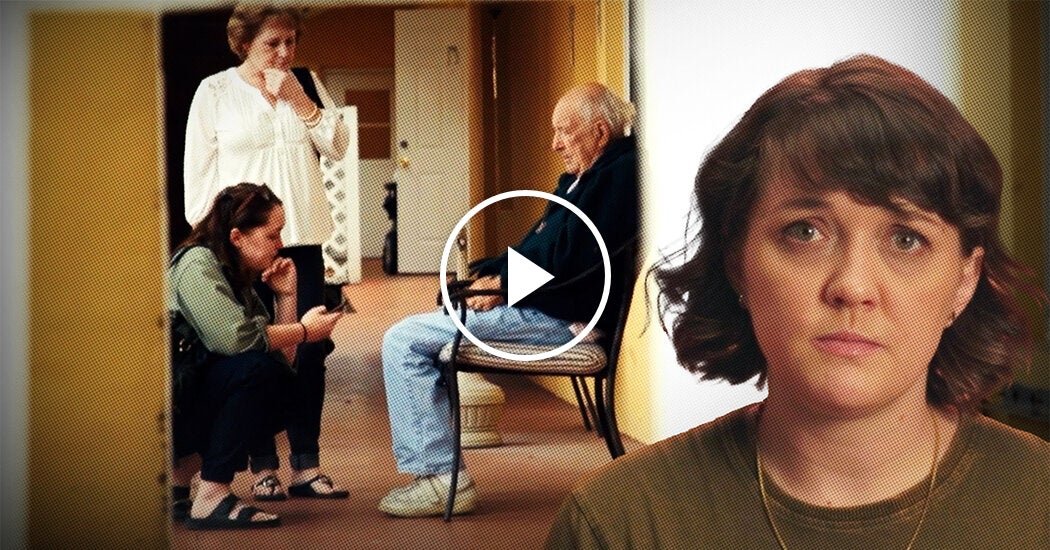
People keep telling me that I should have killed my grandpa. “This is my granddaughter, Amanda.” “Hello, gorgeous.” “Hi, Grandpa.” “Come on in.” “How are you doing?” “Mm. Good to see you, baby.” Why? Because he was a serial sexual abuser of children, some of them in my own family. And I spent eight years making a documentary about it to show what an absolute train wreck this all could be. I brought family secrets to the surface. I connected with his victims. “It started when I was 4 years old.” I even confronted him directly. “Can I ask how old she was?” “Well, she started — I think she started around an age of 9 through 11.” My film brought out some strong opinions. Nothing provokes us like child sexual abuse, and I get it. That rage is totally valid. But my story has taught me that if we really want to protect kids, then we need to confront a painful truth. “Hi there, little lady.” “Hi there.” “How you doing? I lost my little dog. Can you help me find him?” This is how our culture has taught us to think about child sexual abuse. “Stranger danger.” “It is a terrifying thing for any parent to think about.” There are monsters out there hunting your kids. “Pedophilia is a wicked and sadistic practice.” “Why don’t you have a seat right over there?” And they are better off dead. “This man is here to meet a 13-year-old boy.” “People are now assaulting predators in public.” “Slap that man!” “— videotaped beating him.” “And I, for one, think it’s an amazing thing.” “Shoot them in the face.” “Bang, bang, bang, bang, bang, bang, bang, bang. Justice is meted out. Let’s all go out and have some lunch.” In my family, that monster was Grandpa, Dad. How amazing would it be if you could just throw Grandpa in a wood chipper? But it’s not that simple when it’s somebody close. “My abuser was my father.” “My dad.” “My grandfather.” “Grandfather.” “My uncle.” “It is my older brother.” “He was my brother.” “He was a family member of mine.” “A friend of the family.” “A neighbor kid I grew up with.” “My dad’s best friend.” My family’s story might seem extreme, but child sexual abuse is way more common than we think. Fifteen percent of American adults today are child sexual abuse survivors, and 90 percent of them were abused by someone they know, maybe someone they loved. “He was one of the primary people in my life that I was supposed to be able to trust.” “He always seemed to be, like, assisting my family, buying me the best toys.” “How could he be a terrible person? Look at all these people that adore him.” The truth is, abusers usually look more like this than this. It would be so much easier if they were strangers or monsters. Because with monsters, you can just do this. [DRAMATIC MUSIC] “Aaauugh!” The reality is much more uncomfortable. “That’s the hardest part, is —” [TAKES DEEP BREATH AND SIGHS] “— is the fact that you love them.” “We were living in the same home. And I also looked up to him.” “Some of the parts of me that I love and value the most are parts that I inherited from him. So it’s just so painful and confusing that he also did this really harmful, horrific thing to me.” I don’t like it. You’re probably not going to like it. But these aren’t monsters. They’re humans that have done monstrous things. And if we can accept that, we can actually start to prevent this and stop more kids from getting abused. “For every person we have interviewed, pedophilia is an unwanted attraction. It is not a choice.” Take it from one of the world’s leading experts on child sexual abuse.” “The choice is to not offend against a child. It is in our interest to applaud and to support that choice.” “Was there anybody that you ever felt like you could talk to about it? Did you ever open up?” “I wished I could’ve. I really did wish I — I wanted to talk to somebody. But I didn’t know who I could really talk to.” What if there had been somebody he could talk to? Imagine how different things could have been for my family. In the U.S., we spend $5.4 billion a year on locking child abusers up and only $3 million on child sexual abuse prevention research. Now, let me be crystal clear. I’m not asking you to have sympathy for sexual predators. Of course we need to hold perpetrators criminally accountable. But my grandpa went to prison, and nothing changed. He continued to abuse after he was released. So we also need to give those at risk of abusing every opportunity to prevent them from hurting kids. There are postprison re-entry programs that have been shown to reduce recidivism by up to 50 percent and even programs that help prevent abuse in the first place. But they need more funding and more reach. “Physically abusing an offender will just perpetuate trauma. They need support, too. They need mental health support.” “— and to get people who harm into treatment programs that can ensure they are not able to harm again or to ensure they won’t harm to begin with.” So as uncomfortable as it was, instead of killing Grandpa, I talked to him. “Grandpa, I just need you to listen to me for a second.” “I’m listening.” I was nervous. It was terrifying. But it made me realize that nothing is going to change unless we confront this reality head-on. When we treat abusers like monsters, two things happen. One, we focus solely on humiliation and punishment, instead of prevention and treatment. And that is not keeping our kids safe. And two, we diminish the complex experiences of survivors. This stops us from being able to really hear their voices and what they need. “What would make it easier for survivors? Talking about it.” “I wish it was, like, a topic of conversation.” “I was worried about what people would think about me. How would they treat me? Would my relationships change?” “It felt like nobody wanted to help me out, to be there for me. You know, except they want to shove me to a therapist, and they wouldn’t really want to discuss it.” “It makes us feel like pariahs, like we don’t have a place in society. And then it prevents us from being able to heal.” “As soon as we can, like, break the stigma, make these conversations more normalized, that’s when the change can start.”
About The Author