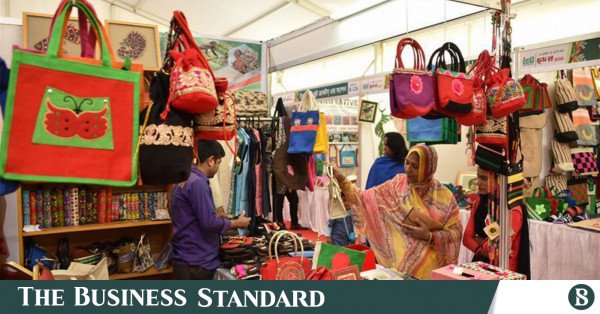
Bangladesh Bureau of Statistics’ Economic Census 2024 shows that economic units rose from 78 lakh in 2013 to 1.17 crore in 2024, marking a growth of 49.68%.
Representational Image. Photo: BSS
“>

Representational Image. Photo: BSS
The number of economic units in the country increased by nearly 50% over the past decade, led by micro and cottage industries, reflecting expansion and diversification of economic activities, according to the final report of the Economic Census 2024 published by the Bangladesh Bureau of Statistics (BBS).
The report shows that economic units rose from 78 lakh in 2013 to 1.17 crore in 2024, marking a growth of 49.68%.
The increase was recorded in both rural and urban areas. In 2024, rural areas accounted for 73 lakh units, up from 55 lakh in 2013, while urban units rose to 43 lakh from 22 lakh. This indicates expansion across different regions of the country.

In terms of types of economic units, 53.57% are permanent establishments, 4.91% are temporary, and 41.52% are households engaged in economic activities.
Division-wise, the highest concentration of economic units is in Dhaka division, accounting for 27.08%, while Sylhet division has the lowest share at 4.67%. Significant numbers are also recorded in Chattogram, Rajshahi, Khulna, Rangpur, Mymensingh and Barishal divisions.
The industrial structure shows a dominance of smaller enterprises. Of the total units, 56.67% are micro and 38.74% are cottage industries. In contrast, small industries account for 4.20%, medium industries 0.31%, and large industries only 0.08%, indicating a limited presence of large-scale enterprises.
Ownership patterns show that 87.36% of permanent establishments are individually or family-owned. Non-profit organisations account for 6.39%, government and autonomous institutions 2.22%, private limited companies 1.82%, and partnerships 1.44%.
Sector-wise analysis indicates a strong concentration in the service sector, which accounts for 90.02% of total economic units, while around 10% are in the industrial sector, suggesting a service-oriented economic structure.
Employment has also increased during the period. Total employment rose from 2.45 crore in 2013 to 3,06,32,661 in 2024, representing a 25.03% increase. Of the total workforce, about 83% are men and 17% are women.
Of the employed population, 77.53% work in permanent establishments, 2.54% in temporary establishments, and 19.93% in economic households.
By sector, wholesale and retail trade and motor vehicle repair account for the largest share of employment at 41.82%, followed by transport and storage at 22.22%, manufacturing at 9.57%, and accommodation and food services at 8.11%.
Overall, the Economic Census 2024 highlights the significant role of small entrepreneurs, family-run businesses and the service sector in the country’s economy, while also providing data for future policy planning and investment decisions.
About The Author