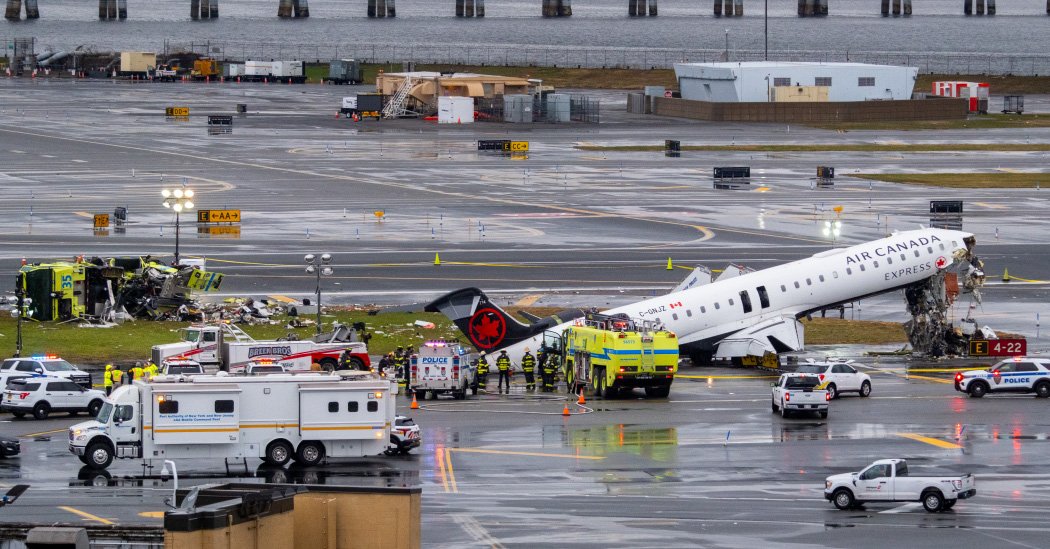
On Tuesday, the National Transportation Safety Board provided new details of the final minutes before an Air Canada jet collided with a fire truck at LaGuardia Airport in New York.
The timeline from federal investigators and air traffic audio reviewed by The New York Times both suggest that the controllers may have been distracted before the crash, which killed the plane’s two pilots and left dozens injured late Sunday.
Here are critical moments leading up to the deadliest collision at the airport in more than three decades:
Several minutes before crash
A United Airlines flight requests assistance
Air traffic controllers were responding to an emergency with United Airlines Flight 2384 several minutes before the crash, posing a possible distraction to air traffic controllers.
After being on the tarmac for over two hours, the United flight, bound for Chicago, had aborted its first takeoff attempt at 10:40 p.m. Passengers were told the plane had “a transient issue,” according to a passenger who requested anonymity in order to protect her privacy.
The pilots made a second attempt at takeoff about 40 minutes later and aborted again.
At 11:31 p.m., United flight had declared an emergency and requested a gate assignment, according to air traffic control audio reviewed by The Times. An odor on the plane had sickened members of the flight crew.
Four minutes later, the plane was assigned a gate and told to wait for emergency responders.
1-3 minutes before crash
Air Canada flight cleared to land
Air Canada Express Flight 8486 was set to land at LaGuardia Airport when the approach controller, who manages flights as they near the airport, ordered the airplane to contact the control tower, National Transportation Safety Board officials said on Tuesday.
The flight crew began lowering the landing gear. The plane was cleared to land on Runway 4 and advised that it was No. 2 for landing, said Doug Brazy, a senior aviation accident investigator with the National Transportation Safety Board.
One minute and 26 seconds before the crash, an electronic callout indicated that the plane was 1,000 feet from the ground.
A passenger told The Times that a flight attendant warned the passengers to leave any luggage behind if the plane made an emergency landing. It’s unclear why this warning was made.
20-28 seconds before crash
Fire truck cleared to cross runway
Around 11:37 p.m., or 25 seconds before the crash, “Truck 1” made a request to cross Runway 4 at Taxiway D, the same runway that the Air Canada jet was set to land on. The request was made to respond to the emergency with the United Airlines plane.
Five seconds later, the truck, which later crashed with the jet, was cleared to enter the runway, officials said. An air traffic controller quickly responded: “Truck 1 and company, cross 4 at Delta.”
12-17 seconds before crash
Fire truck approaches runway as Air Canada jet is landing
The officers aboard “Truck 1” read back the runway clearance. That’s a mandatory practice to ensure that the message was received correctly, and to verify that both the air traffic controllers and the recipient of the information understood the instructions.
Five seconds later, the plane was 30 feet above the ground, and the tower instructed a Frontier Airlines aircraft to hold its position.
Air Canada flight and fire truck collide
LaGuardia Airport has a “Runway Status Lights” system that includes red runway entrance lights at taxiway and runway crossings. The lights, which are set in the pavement, activate automatically when high-speed traffic is on the runway or approaching it.
While there is speculation about whether the fire truck ran a red runway status light, a Times analysis of the crash footage suggests the lights on Runway 4 appeared to be functioning properly when the fire truck entered the runway.
By design, the lights can go dark a couple of seconds before a landing or taking-off plane passes the intersection. The truck may have entered the runway in that brief window. What remains unknown is whether the crew members heard the controller’s instruction to stop, and, if so, why they proceeded regardless. The lights do not replace clearances given by the air traffic controllers.
Nine seconds before the collision, an air traffic controller instructed “Truck 1” to stop. There were other vehicles behind the fire truck that did not proceed to the runway.
“Stop, stop, stop, stop, Truck 1, stop, stop, stop,” the controller said. Sounds consistent with the plane’s landing gear slamming against the pavement could be heard in the audio from the cockpit voice recorder.
Four seconds before the regional jet plowed into the fire truck, the controller again said, “Stop, Truck 1, stop!”
Investigators have not determined whether the operators of the fire truck heard orders to stop before colliding with the Air Canada flight.
About The Author