Focusing on human resource development and social safety nets, the party proposed a total revenue target of Tk6,65,926 crore, representing 9.63% of the GDP.
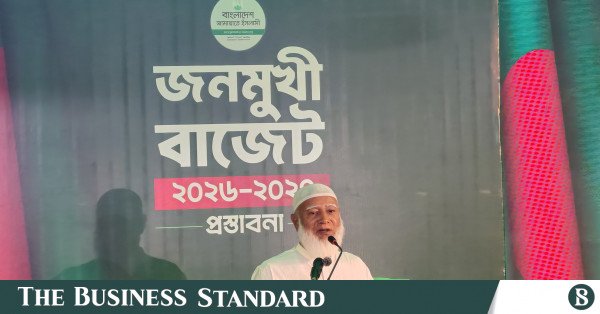
Jamaat Ameer Shafiqur Rahman unveils the proposed alternative budget at a press conference in Dhaka today (9 June). Photo: TBS
“>

Jamaat Ameer Shafiqur Rahman unveils the proposed alternative budget at a press conference in Dhaka today (9 June). Photo: TBS
The Bangladesh Jamaat-e-Islami has proposed a Tk8.39 lakh crore shadow budget for the fiscal year 2026-27, proposing major tax and institutional reforms and a shift in the country’s fiscal year from July-June to January-December to improve development spending and curb financial irregularities.
The proposed alternative budget, equivalent to 12.14% of the country’s Gross Domestic Product (GDP), was unveiled today (9 June) at a press conference in Dhaka by Jamaat ameer and Opposition Leader Shafiqur Rahman and the party’s budget formulation team leader Saiful Alam Khan Milon.
Focusing on human resource development and social safety nets, the party proposed a total revenue target of Tk6,65,926 crore, representing 9.63% of the GDP. This includes Tk5,73,926 crore to be collected through the National Board of Revenue (NBR), Tk22,000 crore from non-NBR tax sources, and Tk70,000 crore from non-tax revenues.

The proposal projects a budget deficit of Tk1,68,329 crore, which stands at 2.43% of the GDP. To finance this deficit, the party suggested securing Tk67,000 crore from foreign sources, while the remaining Tk1,01,329 crore would be sourced internally from domestic banks and savings certificates.
Jamaat ameer criticised the existing tax collection system, saying businesses effectively pay three layers of taxes – one to the treasury, one to corrupt collectors, and one to extortionists – and argued that reforming the system would boost revenue without increasing tax rates.
One of the key structural changes advocated by Jamaat is shifting the current fiscal year (July–June) to align with the calendar year (January–December).
Shafiqur argued that the current timeline forces government agencies to rush ADP implementation during the monsoon season, leading to systemic waste and financial leakage. “Aligning the fiscal year with the calendar year will ensure more disciplined development spending before the heavy rains begin,” he said.
To alleviate inflationary pressures on low- and middle-income groups, the shadow budget proposes increasing the individual tax-free income threshold to Tk4.5 lakh from the existing Tk3.5 lakh, with plans to raise it to Tk5 lakh in the subsequent year. It also suggests keeping the minimum tax rate at 5%, while proposing a phased reduction of corporate tax rates from the current 37.5%.
For public servants, Jamaat proposed implementing 100% of the pay commission’s recommended new scale for grade 10 to 20 employees in the first year, and 80% for grades 1 through 9.
In terms of sectoral allocations, Education and Technology received the highest priority with Tk1,25,575 crore, or 14.96% of the total budget. This is followed by Healthcare at Tk45,240 crore (5.39%) and Social Security at Tk48,150 crore (5.74%).
The shadow budget also addresses agricultural sustainability, proposing solar-powered cold storage facilities in every upazila to protect farmers from seasonal price drops. To stabilize volatile commodity markets, the party proposed strict measures to dismantle trade syndicates and the implementation of automatic price-stabilization policies.
The shadow budget also proposed gradually raising all social safety net allowances – including old-age, widow, disability, and mother-child benefits – to Tk3,000 per month from current levels ranging between Tk650 and Tk900.
Addressing the broader economic crisis, Shafiqur noted that past financial mismanagement, massive money laundering, and banking sector volatility have left the economy fragile.
He said, viability of any budget ultimately hinges on systemic transparency, anti-corruption measures, and the thorough restructuring of regulatory bodies like the NBR and the Anti-Corruption Commission.
About The Author