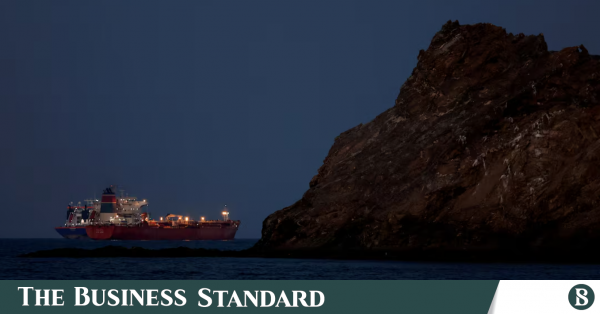
The Iranian government today (1 April) approved safe passage for six fuel-carrying ships through the Strait of Hormuz as per the details provided by Bangladesh but the five of the shipments were found to have already been cancelled by global suppliers.
Petrobangla officials said that the list provided to Tehran was based on outdated planning documents.
These documents failed to take into consideration the force majeure declarations by QatarEnergy and Oman’s OQ Trading, which suspended all supplies in early March soon after the start of the Iran war on 28 February.

‘Non-existent’ shipments
The list forwarded by the Energy Division included five LNG cargoes – four from QatarEnergy and one from Excelerate Energy – intended for April delivery. However, Petrobangla Chairman Arfanul Hoque confirmed that these deliveries are void, as the suppliers have extended their suspensions until at least 8 May.
“We have no idea why a list of ships was sent to Iran, whose deliveries were cancelled immediately after the outbreak of war,” Arfanul told TBS yesterday. “Due to force majeure, there are no LNG cargoes from QatarEnergy in April. The ships listed are effectively non-existent.”
An Energy Division official, speaking on condition of anonymity, admitted that the division had mistakenly forwarded a pre-war import plan because they were unaware of the duration of the force majeure. He, however, declined to comment further on the record.
Replying to a question why the Energy Division forwarded the list of ships that are under force majeure, Monir Hossain Chowdhury, joint secretary of Energy Division (operation), insisted that some of the ships are under force majeure but the crude ship is not.
“However, we have instructed Petrobangla to look into whether the ships could be brought after discussion with LNG suppliers.”
Iran’s approval
In a press conference held in Dhaka yesterday, Iranian Ambassador to Bangladesh Jalil Rahimi Jahanabadi said Iran’s National Security Council has approved safe passage for Bangladesh’s six fuel-carrying ships waiting to cross the Strait of Hormuz.
“Bangladesh is a friend and a Muslim country. Iran does not want Bangladeshis to face hardships and will provide all necessary assistance for transporting fuel through Hormuz,” he said.
Earlier on 15 March, the Energy Division sought diplomatic assistance from Iran through the foreign ministry to ensure the safe passage of a crude oil tanker bound for the country through the strait amid global energy price volatility.
In that letter, the Energy Division mentioned three crude oil shipments carrying a combined 3,00,000 tonnes, which have become uncertain due to the closure of the strait, a key chokepoint for global oil trade.
After the letter, Iran sought details of ships on 24 March that were being stuck due to Hormuz problem and the next day on 25 March the Energy Division sent a detailed list of six ships for safe passage with nearly 5 lakh tonnes of liquefied natural gas (LNG) and approximately 79,000 tonnes of crude oil.
The list included detailed vessel data such as loading dates, capacity, origin ports and IMO identification numbers – suggesting it was prepared using standard planning documents rather than real-time supply confirmations.
In the face of LNG delivery uncertainty resulting in force majeure, Bangladesh bought eight LNG cargoes from the spot market out of nine cargoes for April.
The list Energy Division forwarded was mainly April consumption and only one cargo was scheduled to arrive in May. All LNG deliveries were tied to QatarEnergy, Bangladesh’s largest LNG supplier.
QatarEnergy invoked force majeure on 2 March, followed by Oman-based OQ Trading Limited on 5 March. The suspensions have since been extended until 8 May and 10 May, respectively.
LNG cargoes secured for April
AKM Mizanur Rahman, director (finance) at Petrobangla, said Bangladesh has already arranged alternative supplies to manage the shortfall.
“We have secured nine LNG cargoes for April. Eight are being procured from the spot market, and one will come from a long-term supplier, likely sourced from Angola.”
With long-term LNG supplies disrupted, Bangladesh has turned heavily to the spot market – often at significantly higher prices – adding pressure on foreign exchange reserves and subsidy burdens.
Mizanur added that if those listed cargoes were actually available after Iran’s assurance, Bangladesh would not have needed to rely heavily on the spot market.
Petrobangla officials, however, emphasised that ongoing purchases are already locked in.
“We have issued standby letters of credit and completed contractual formalities. There is no room to cancel these spot deals now,” said Mizanur.
Bangladesh seeks US waiver to import Russian fuel
Meanwhile, Foreign Minister Khalilur Rahman has requested the United States to grant Bangladesh a special waiver to import refined diesel and other petroleum products from Russian sources to ease energy pressures.
The request was made during a meeting with US Energy Secretary Chris Wright at the Department of Energy in Washington, DC, on Tuesday, according to a message received in Dhaka yesterday.
During the talks, the foreign minister highlighted Bangladesh’s ongoing energy challenges stemming from global supply chain disruptions, particularly ahead of the critical planting season, and stressed the need to ensure an uninterrupted fuel supply for farmers and safeguard food security.
The US energy secretary acknowledged the energy challenges Bangladesh is facing and expressed his country’s commitment to support Bangladesh during these difficult times to help ensure its energy security.
Khalilur explained that Bangladesh could not take advantage of the earlier limited worldwide waiver by the US on Russian oil at sea since none of the tankers were bound for Bangladesh at that time.
The government on Wednesday approved the procurement of 1,00,000 tonnes of refined diesel from Kazakhstan at a competitive rate of $76.41 per barrel.
The procurement from ExxonMobil Kazakhstan INC comes as Bangladesh secures a strategic diplomatic opening with the United States. During a high-level meeting on 11 March at the Secretariat, Finance Minister Amir Khosru Mahmud Chowdhury urged US Ambassador Brent T Christensen to grant Bangladesh temporary waivers for Russian oil imports, similar to the exemptions currently enjoyed by India.
A senior Energy Division official told TBS that the US government has responded positively to the proposal by Bangladesh to purchase oil from Kazakhstan.
Washington is now providing feedback on a “case-by-case” basis, allowing Bangladesh to import from specific suppliers and ports that may have Russian associations without breaching international sanctions, he said.
About The Author