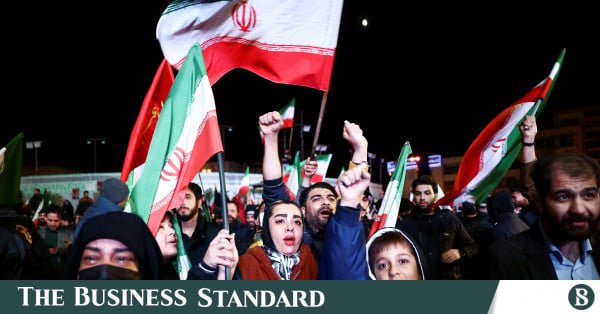
The announcement of a two-week ceasefire in the US-Israel war on Iran war came as a welcome respite for Bangladesh, easing fears of prolonged disruption in energy supply chains and bringing a sharp fall in oil prices.
For Bangladesh – heavily reliant on Middle Eastern fuel – the reopening of the Strait of Hormuz, a critical maritime choke point, has provided immediate operational relief.
With the enforcement of the ceasefire, an Energy Division official said, a crude tanker loaded with 1 lakh tonnes of fuel is now en route to Bangladesh after being stranded since 3 March at a Saudi port.

The development comes after weeks of heightened tension that had stalled shipments, driven up freight costs, and inflicted uncertainty in the domestic energy market.
The global oil market reacted swiftly. Brent crude prices dropped by more than 16%, falling to as low as $91.70 per barrel in early Asian trading on Wednesday (8 April), down from $109.27 the previous day.
Shipments resume as Hormuz reopens
The most immediate benefit for Bangladesh is the resumption of delayed fuel shipments.
Speaking to TBS, officials at the Energy Division said efforts are underway to fast-track the arrival of delayed shipments and restore normal supply lines.
“The ceasefire brought a sigh of relief for us as our energy imports are largely dependent on the Strait of Hormuz,” said Monir Hossen Chowdhury, joint secretary (operation wing) of the Energy Division.
“We are reaching out to long-term fuel and LNG suppliers to resume supply at the earliest.”
Another tanker carrying a similar volume of crude is expected to arrive by the last week of April. However, uncertainty still surrounds a third shipment, after its supplier invoked force majeure amid the earlier disruption.
Eastern Refinery Limited, which processes around 1.25 lakh tonnes of crude per month, had been facing the risk of partial shutdown due to feedstock shortages.
The refinery produces petrol, octane, diesel, furnace oil, and naphtha, meeting a significant portion of the country’s fuel demand.
“The arrival of one lakh tonnes of Arabian light crude will keep Eastern Refinery functional and help stabilise the supply-demand situation,” said Monir Hossen Chowdhury.
Typically, each 1,00,000 tonnes of crude processed at ERL yields 15-20% octane and petrol and around 30-35% diesel, making such shipments vital for maintaining market stability.
Fiscal pressure to ease
The government had earlier earmarked an additional Tk24,000 crore in subsidies to manage rising import costs of LNG and petroleum products amid soaring global prices.
The recent drop in oil prices is expected to provide some breathing space in managing this subsidy burden.
“The impact is substantial, but its sustainability depends on how long the ceasefire holds and how the global market responds,” an Energy Division official said.
Due to force majeure by long-term LNG suppliers, Petrobangla had to spend an additional Tk9,500 crore to import 22 cargoes for April and May.
LNG market relief to lag behind
Despite the positive developments in oil markets, Petrobangla does not expect immediate relief in LNG costs due to structural pricing mechanisms and ongoing contractual constraints.
Chairman Md Arfanul Hoque said long-term LNG suppliers have enforced force majeure until 18 May, meaning no cargoes will arrive under these contracts until then.
“Even after supplies resume, we may incur financial losses due to lagged pricing mechanisms embedded in both long- and short-term contracts,” he said.
“If we receive cargo for April, the price would still reflect March, when the market was significantly higher,” Arfanul explained.
The situation is more complex for long-term LNG contracts, which are indexed to the three-month average of Brent crude prices.
This means LNG imports scheduled for June and July will be priced based on the average of March, April, and May – months during which oil prices remained elevated.
“Even if spot LNG prices decline in the coming weeks, the high Brent averages from March and April will continue to influence long-term contract prices,” he added.
This creates a potential mismatch where spot market LNG could become cheaper than contracted supplies, limiting the financial benefits of declining global prices in the short term.
Shipping and logistics pressures to ease
The ceasefire has also brought relief to the shipping and logistics sector, which had been under severe strain due to the conflict.
Khairul Alam Suzan, vice-president of the Bangladesh Freight Forwarders Association, said the war had significantly increased risks for vessels operating in the region, leading to higher insurance premiums and freight charges.
“Due to the war, the logistics and shipping sectors were facing severe risks. Insurance costs surged, and freight rates increased sharply,” he said.
Freight charges for covered vans on the Dhaka-Chattogram route nearly doubled in recent weeks, rising from Tk18,000-20,000 per trip to over Tk37,000.
The easing of tensions is expected to gradually normalise these costs, although a full recovery may take time.
The business community has welcomed the ceasefire as a positive development but remains cautious about its long-term implications.
LPG Operators Association of Bangladesh President Mohammad Amirul Haque said, “The war has created an LPG crisis in the spot market. The price has already increased by more than 30% in the world market. The 14-day ceasefire will ease this crisis to some extent.”
Inamul Haque Khan Bablu, senior vice-president of the Bangladesh Garment Manufacturers and Exporters Association (BGMEA), said it would take time for industries to recover from the recent disruptions.
“If stability continues, our export market will also improve,” he said.
Tipu Sultan, president of the Bangladesh Finished Leather, Leather Goods and Footwear Manufacturers and Exporters Association, said the decline in fuel prices is encouraging but uncertainty persists.
“This is a good sign, as fuel prices have already started to fall. But it is difficult to say how long this situation will last,” he said, noting the unpredictable nature of global geopolitics.
MA Salam, managing director of Asian & Daf Group and a former BGMEA leader, described the ceasefire as a transition from uncertainty to cautious stability.
Md Arfan Ali, former managing director of Bank Asia, said that the ceasefire has removed a major cloud of uncertainty and fear from the Bangladesh economy.
“The cost of imports will be significantly reduced as the price of petroleum in the international market falls. It will reduce the negative pressure on our ‘balance of payments’ or balance of transactions and the foreign exchange reserves,” he said.
Shawkat Ali Khan, managing director and CEO of Sonali Bank, said, “The major concerns about the balance of payments, energy crisis and pressure on the dollar due to the war will be mitigated to a large extent as a result of the ceasefire.”
PRAN-RFL Group, which imports raw materials via the Strait of Hormuz, said many of its cargo-loaded ships are floating at sea, unable to unload their products.
Ahsan Khan, chairman of PRAN-RFL Group, said, “We hope to be able to unload several Middle East-bound export ships, which had remained stuck, during the 14-day ceasefire.”
S Kaiser Kabir, CEO and managing director of Renata PLC, said, “In the current situation, the ceasefire of about two weeks is acting as a temporary relief for us. We have taken steps to quickly send our export consignments and efforts are being made to quickly bring in the raw materials.”
Mohammad Zakir Hossain, secretary general of the Bangladesh Association of Pharmaceutical Industries, said, “We are optimistic about the ceasefire even in the current situation. Due to the upward fuel prices, the prices of pharmaceutical raw materials have increased by 10-25% in the global market in the last few weeks.”
About The Author