Only one skater in history has landed the quad axel in competition. Ilia Malinin, a 20-year-old American, first executed this difficult and seemingly impossible jump two and half years ago and has landed it in front of judges more than a dozen times since. None of the skaters that he will be up against at the Olympics have attempted the jump in competition.
In August, Malinin, nicknamed the “Quad God,” performed the quad axel for The New York Times’s high-speed camera. Here is why it’s so hard and why it sets him apart as the clear gold medal favorite in men’s figure skating.
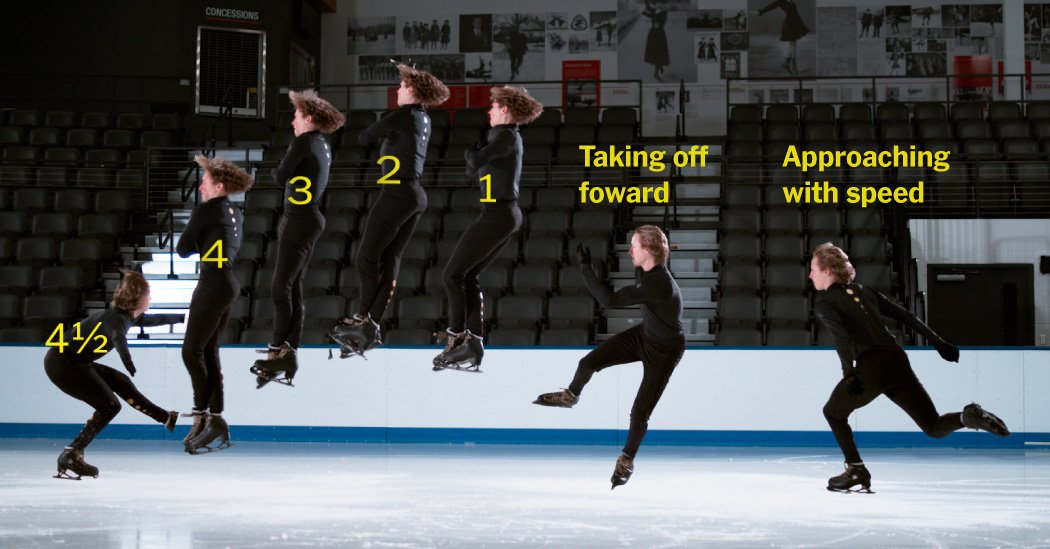
The quad axel, with its forward takeoff and an extra half-turn, requires Malinin to execute multiple difficult maneuvers in fractions of a second.
Below is a comparison of the different parts of Malinin’s quad axel and triple lutz.
The takeoff
Malinin skates faster into the quad axel than he does with other jumps, like the triple lutz, to create enough energy for the jump’s extra half-rotation. The axel is the only jump that takes off facing forward, making the quad axel actually a quad and a half.
Taking off while facing forward increases the sense of fear, adding to the psychological challenge.
With more speed, Malinin can jump higher, giving him more time to complete the extra half-rotation.
But the extra speed and trickiness of the takeoff can also disorient skaters.
“What a skater really is scared of is getting lost in the air, and landing earlier than you think or expect,” Brian Boitano, the 1988 Olympic gold medalist, said.
In the triple lutz, skaters use the toe pick — with its jagged teeth at the front of the blade — to dig into the ice for leverage to launch into the air. But with the quad axel, he enters the jump on the outside edge of his blade, which can make it more difficult to convert the speed of the approach into a powerful leap.
Malinin exerts a lot of downward force to propel himself upward, which you can see in the amount of ice he kicks up on the takeoff. “It was like he was braking suddenly,” said Seiji Hirosawa, a senior lecturer of sports science at Toin University of Yokohama in Japan, who has done extensive research on figure skating jumps.
The rotations
In his quad axel, the height of Malinin’s jump is a key component, allowing him to complete the four and a half rotations.
Malinin jumped nearly three feet high on this quad axel. On the less difficult triple lutz, he reached a little more than two feet.
The axel takeoff also means that Malinin has to work harder to get into the optimal spinning position.
On the lutz, it takes Malinin half a turn to lengthen his legs and feet into a needle-like pose. On the axel, it takes him a full turn.
The tighter and narrower he can make his body in the air, the faster he spins.
“If you imagine it, something like chopsticks can spin very easily. On the other hand, if the chopsticks were thicker, they wouldn’t spin as easily even with the same force,” Dr. Hirosawa said.
The landing
The extra height needed for Malinin’s quad axel causes him to land with a force of as much as 8-to-10 times his body weight, or more than half a ton. That could be double the force from the height of this triple lutz. Malinin’s landing leg must absorb these forces while maintaining his balance, making the quad axel harder to land cleanly.
From takeoff to landing, the quad axel presents unique challenges at every step.
“Some skaters may find a quintuple toe loop easier than a quad axel,” said Deborah King, a professor of biomechanics at Ithaca College.
The singular jump
Malinin, the reigning world champion, is undefeated in his last 15 competitions entering the Games, and he landed a record seven quadruple jumps — including the quad axel — in his long program at the Grand Prix final in December.
Two decades ago, a program that included even a single quad jump was relatively rare, but today’s skaters perform increasingly difficult programs filled with them.
The quad revolution has been driven by the scoring system: Harder jumps are rewarded with higher base values. Quadruple toe loop, salchow, loop and flip jumps earn more than double the points of their triple counterparts. This means that even executed imperfectly, a quadruple jump can score as many points, if not more, as a flawlessly landed triple.
The quad toe loop and salchow are now standard in men’s figure skating and have been performed frequently in recent years. Quad lutzes, flips and loops are increasingly within reach.
The quad axel, however, offers only a marginal scoring advantage over a triple axel – and only three more points than a quad toe loop, the most common quad. Given its extreme difficulty and limited return, the quad axel remains the singular domain of Malinin.
The quad axel is the last to be conquered and only by Malinin
Quads performed in men’s figure skating programs
In the past, when a jump had been conquered, it often did not take long for other skaters to master it too. Not so for the quad axel. Aside from Malinin’s successes, it has only been tried in competition by two other skaters. Artur Dmitriev Jr. was the first to attempt the jump in competition, in 2018, but he fell. Japan’s Yuzuru Hanyu attempted the jump at the 2022 Beijing Olympics before retiring, but he did not land it either. It has been more than three years since Malinin’s first quad axel, and no one appears poised to match him.
About The Author