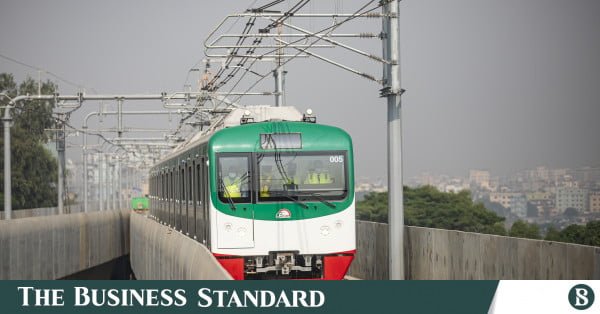
The government has begun discussions with the Japan International Cooperation Agency (Jica) to resolve the deadlock surrounding the MRT Line-1 project from the airport to Kamalapur, which is being implemented with Japanese loans.
The project has remained largely stalled for more than a year and a half due to disagreements between the implementing agency, Dhaka Mass Transit Company Limited (DMTCL), and Jica over unusually high tender prices.
To break the stalemate and restart project implementation quickly, a meeting with Jica was held at the Economic Relations Division (ERD) yesterday (10 March), chaired by ERD Additional Secretary Dr Mohammad Mizanur Rahman. Representatives from ERD, Jica, DMTCL and the road transport and bridges ministry attended the meeting.

Md Sarwar Uddin Khan, project director (additional charge) of MRT-1, told The Business Standard that discussions have begun regarding the difference between the approved project costs and the higher bids submitted by contractors for various packages of MRT Line-1.
“Further discussions will take place to determine how much the contractors’ bids can be reduced. Decisions on MRT Line-1 will be taken based on the outcomes of these talks,” he said.
A senior ERD official, speaking on condition of anonymity, said the scope for extensive bargaining is limited since the loan agreement with Jica has already been signed.
“However, we will try to reduce costs as much as possible through discussion. The government wants the project work to start quickly,” the official said.
Sources said DMTCL had recommended cancelling the existing tenders and calling for fresh international tenders because the bids received for constructing MRT Line-1 from the airport to Kamalapur were far higher than expected. Jica, however, has not yet agreed to the proposal.
According to DMTCL’s evaluation report, the government had approved a total project cost of Tk52,561.43 crore in the original Development Project Proposal (DPP). But Japanese consultants and contractors have proposed a revised cost of Tk96,422.70 crore, an increase of about 83%.
The cost for contract packages – including depot, underground and elevated tunnel stations, electrical and mechanical works, and rolling stock – was initially estimated at Tk37,655.66 crore (including contingency). It has now been proposed at Tk80,099.79 crore.
DMTCL officials said there are three packages for constructing underground rail lines from Aminbazar: Package-4 (Aminbazar to Mirpur-1), Package-5 (east of Mirpur-1 station to Kochuket station), and Package-6 (Kochuket station to the transition section of Vatara). The project proposal estimated the combined cost of these three packages at Tk13,966.2 crore, but contractor bids have raised the estimated cost to Tk30,865 crore.
Stakeholders say that under the conditions of Japanese loans, consultants must be appointed from Japan. These consultants prepare the tender documents, often in a way that effectively restricts participation to Japanese contractors.
Although the tenders are formally described as open, in practice the same two or three companies repeatedly secure the top positions in the bidding process. As a result, despite being labelled an open tender, the process functions more like a limited competition, leaving little room for new or alternative qualified firms to enter the market.
DMTCL had also proposed revising the project’s scope – while preserving its core objectives – after consulting experts, in order to improve efficiency.
Officials said tensions between DMTCL and Jica over the issue have continued for several months. Bangladesh’s side supports cancelling the current tenders and calling fresh international competitive bids. Jica, however, argues that the tender evaluation process followed its procurement guidelines and that higher costs are expected due to global inflation and the risks associated with underground construction.
To increase competition among international contractors, DMTCL also proposed amendments to the Jica loan agreement. The proposal recommended opening the bidding process more widely by reconsidering provisions such as strategic loan conditions, tax exemptions for Japanese contractors and suppliers, tax-free income for project staff, and duty exemptions for project-related imports and re-exports.
DMTCL also recommended adopting a “one-stage, two-envelope without prequalification” tendering method to ensure broader participation among qualified contractors.
Dr Md Shamsul Hoque of the Department of Civil Engineering at Bangladesh University of Engineering and Technology (Buet) said that if a project is overpriced, reassessment is justified.
“We are taking these funds as loans using public money. Therefore, implementing the project at a reasonable cost is our legitimate right. Bangladesh has a development partnership with Japan, but reviewing overpriced projects to protect public interest is reasonable,” he said.
He added that the government is already reviewing what it considers unreasonable agreements signed during the previous administration in the power sector.
“Many metro rail projects financed by Jica in other countries cost much less than ours. If we implement an overpriced project, the benefits will be limited, while our debt burden will increase,” he said.
About The Author