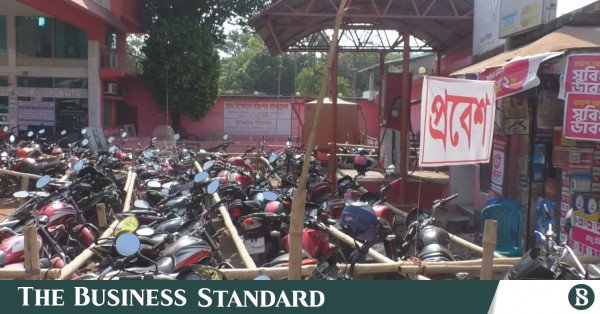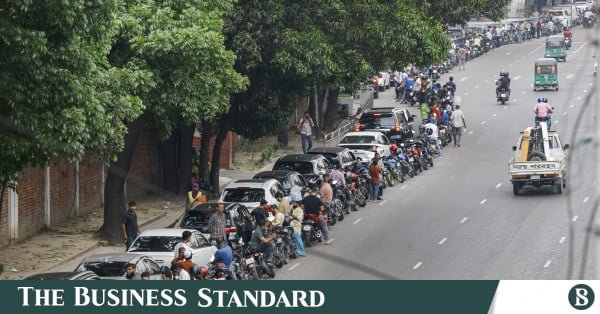
Despite a steady increase in fuel supply in recent days – surpassing average daily consumption levels of the past two fiscal years – motorists across the country continue to endure long waits at filling stations.
Industry insiders said this mismatch between rising demand and uneven distribution, compounded by consumer behaviour, is at the heart of the persistent queues now visible at fuel pumps nationwide.
According to BPC’s data on 2 April, diesel sales stood at 12,248 tonnes per day – about 1.52% higher than the March-June 2025 average of 12,065 tonnes, indicating steady demand in transport and agriculture.

Octane sales also inched up to 1,222 tonnes per day, a marginal 0.41% increase, suggesting sustained pressure from private vehicles, particularly motorcycles.
However, petrol sales dipped slightly to 1,411 tonnes per day, around 1.12% lower than the earlier average of 1,427 tonnes.
BPC data shows that the overall fuel consumption is rising, demand is unevenly distributed, contributing to localised shortages and operational stress at filling stations.
Upward fuel sale trend
Year-on year comparison shows that fuel sales have increased across all major categories.
Octane sales rose from 387,256 tonnes in FY24 to 415,653 tonnes in FY25 – an increase of about 7.34%. Daily sales also climbed from around 1,061 tonnes to 1,139 tonnes.
Petrol sales increased from 430,952 tonnes to 462,475 tonnes, marking a growth of approximately 7.32%, while daily consumption jumped significantly from 1,061 tonnes to over 1,267 tonnes.
Diesel, the backbone of the economy, recorded a more modest rise – from 4.25 million tonnes to 4.35 million tonnes – an increase of 2.24%. Daily diesel supply also grew from 11,657 tonnes to 11,918 tonnes.
BPC data shows total petroleum supply reached around 6.835 million tonnes in FY25.
Yet queues persist across the country
On the ground, however, the reality appears starkly different.
In Chattogram, filling stations are either operating under rationing systems or shutting down intermittently, despite scheduled fuel deliveries from depots. Consumers are forced to queue for hours, with many returning empty-handed.
A depot official said fuel supply is being maintained as per schedule, but “the quantity is not always sufficient to meet surging demand, forcing pumps to ration sales.”
At several stations, limits have been imposed – Tk500 worth of fuel for motorcycles and Tk2,000 for cars – despite the government officially lifting rationing.
Mohammad Mainuddin, a leader of the dealers’ association in Chattogram, told TBS that there is no absolute shortage of fuel. “But people are buying more fuel than they need and stockpiling it – that is the main problem.”
Panic buying and stockpiling
Sector insiders point to panic buying and illegal stockpiling as major drivers behind the sudden surge in demand.
An energy division official explained that an average motorcycle consumes around 60 litres of octane per month. “If users start storing 20-30 litres extra at home, it effectively pulls forward 10-15 days’ worth of demand,” he said.
This behaviour creates an artificial spike in consumption, putting immediate pressure on filling stations. “Supply chains are designed for steady demand, not sudden hoarding,” the official added.
Demand shock overwhelming supply chain
Saiful Islam, manager of a filling station in Motijheel, said, “Where previously 13,000 litres of octane were sold in a full day, now 9,000 litres are being exhausted within just five hours.”
At another station in Banglamotor, fuel sales had to be suspended due to delayed tanker arrivals. “The fuel tanker has not arrived yet, so sales are temporarily suspended,” said its manager.
Even at relatively well-supplied stations, demand has surged dramatically.
Ahmad Rushd, assistant manager of a filling station near Hotel InterContinental Dhaka, said, “Where previously around 500-700 motorcycles would come each day, now nearly 5,000 motorcycles are lining up.”
He added, “Although rationing has officially been withdrawn, it is not fully possible to implement that in practice. Our goal is to ensure that as many customers as possible can get fuel.”
Distribution bottlenecks and supply gaps
Beyond demand-side pressures, logistical challenges are also contributing to the queues.
Filling stations report that they receive fuel every few days instead of daily, leading to intermittent shortages. When supply arrives, it is quickly exhausted due to accumulated demand.
In Chattogram, for instance, one station received 13,000 litres of octane and 9,000 litres of diesel in a single delivery – but the stock ran out rapidly due to double the usual demand.
Meanwhile, domestic condensate production – a supplementary fuel source – has declined. Production dropped from 247.10 tonnes in FY25 to 195.98 tonnes in FY26. In the first six months (July-December), output fell by 20.69%, further tightening supply resulted in less octane production.
About The Author