Bangladesh’s exporters are increasingly concerned that the ongoing war in the Middle East could slow new export orders as rising fuel prices push up living costs in major consumer markets.
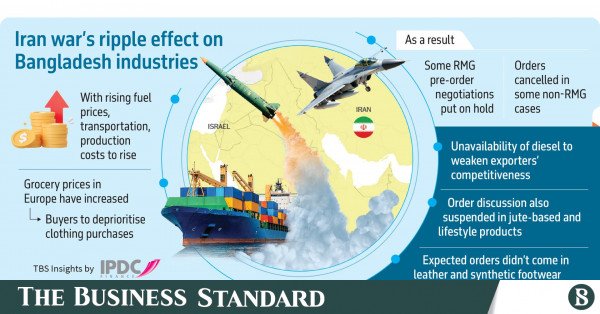
Industry leaders say higher energy costs are already driving up prices of essential goods such as groceries and transport in key destinations including Europe, the United States and Australia. As households spend more on necessities, exporters fear demand for non-essential products such as ready-made garments (RMG) may weaken, potentially leading to fewer purchase orders.
Some European buyers have already postponed order plans, while others have cancelled orders, exporters said.

“We expected orders to increase after the national election, but that has not happened, largely because the war has begun,” said Mohammad Hatem, president of the Bangladesh Knitwear Manufacturers and Exporters Association (BKMEA).
He said some buyers have recently put pre-order negotiations on hold.
Concerns spread beyond garments
The worries extend beyond the country’s largest export sector, the RMG industry, which accounts for around 85% of Bangladesh’s export earnings.
Exporters from other sectors say they are also seeing early signs of hesitation from overseas buyers.
Officials at Creations Private Limited, a major exporter of jute-based lifestyle products, said they had expected to finalise new orders with international buyers after attending the Ambiente consumer goods fair in Frankfurt two weeks ago.
Md Rashedul Karim Munna, managing director of the company, said several buyers discussed potential orders during the fair and negotiations were scheduled for this week.
“But after the war began, they suspended those discussions,” he told The Business Standard.
“Not only have order plans been postponed, in some cases orders that had already been placed were cancelled.”
Munna said rising energy costs across Europe are forcing buyers to reallocate budgets.
“As transportation and grocery prices rise, buyers are allocating more of their budgets to those sectors. As a result, demand for our exported products may decline,” he said, warning that a prolonged conflict could significantly affect exports.
Footwear exporters also cautious
Exporters in the leather and synthetic footwear sector are also reporting uncertainty.
Tipu Sultan, managing director of Bengal Leather Complex Limited and the newly elected president of the Bangladesh Tanners Association, said negotiations for new orders were expected to begin in April.
“But after the war started, those discussions have been temporarily suspended,” he said.
“If the war drags on, we may fail to secure export orders.”
Exporters had hoped that although 2025 was a difficult year, the formation of a new government following the national election would create a more favourable environment for trade and investment.
However, industry leaders say global uncertainty is now overshadowing those expectations.
Freight delays and rising shipping costs
Exporters say logistics are also becoming more complicated as the conflict disrupts global energy supply routes.
Mohammad Hatem said freight costs have already started to rise and shipping times are getting longer.
Although buyers typically bear freight costs under most export contracts, he said some of the increased expenses are eventually passed back to suppliers indirectly.
Officials at DBL Group, one of Bangladesh’s largest exporters, also expressed concern.
MA Rahim Feroz, vice chairman of DBL Group, said grocery prices in Europe are already increasing.
“With rising fuel prices, transportation costs will also increase,” he said.
“Since incomes cannot easily increase, consumers will prioritise spending on groceries and transport, pushing clothing purchases further down their list of priorities.”
However, he added that buyers in Europe and the US have not yet sent any formal negative signals.
Export slump continues
Bangladesh’s export performance has already been weakening in recent months.
According to the Export Promotion Bureau (EPB), the country’s exports have declined for seven consecutive months.
During the first eight months of the current 2025-26 fiscal year – from July to February – exports fell by 3.15% compared with the same period a year earlier. In February alone, exports dropped by more than 12%.
Exporters and analysts say the slowdown has been partly driven by reciprocal tariffs imposed by the Trump administration in mid-2025.
Diesel shortages raise fresh concerns
At the same time, industrialists warn that domestic fuel supply problems are emerging as the conflict disrupts oil shipments through the Strait of Hormuz.
Some factories have already reported difficulty obtaining diesel.
Minhazul Hoque, a director of BKMEA, said three member factories have reported shortages.
“If they cannot get diesel, it will be difficult to run factories, which could disrupt export shipments,” he said.
Bangladesh’s industries rely heavily on gas-based electricity generation, but declining gas pressure and frequent power outages in recent years have forced many factories to rely on diesel-powered generators.
Spinning mills – a key backward linkage industry for garments – are particularly energy-intensive.
“Diesel is not available,” Mohammad Hatem said.
Nafis-Ud-Doula, a director of the Bangladesh Garment Manufacturers and Exporters Association (BGMEA), said the issue has already been raised with the power, energy and mineral resources ministry.
“We have requested that a quota be allocated for industries in diesel distribution,” he said.
Supply chain risks emerging
SM Khaled, managing director of Snowtex Group, said shipping schedules at ports have already become more complicated.
“Some buyers are asking suppliers to send goods to the port ahead of schedule,” he said.
He added that rising oil prices could also increase the cost of fuel-based yarn and fabric, raising production costs for exporters.
Kazy Mohammad Iqbal Hossain, South Asia sustainability manager of Lindex HK Ltd, an EU-based brand, said the impact on Bangladesh’s supply chain has so far been limited.
“However, if this war continues for two to three weeks, it will have a significant impact,” he said, adding that vessel schedules could face disruptions.
Inflation risk for export markets
Economists say prolonged conflict could trigger inflation in Bangladesh’s export destinations, further weakening demand.
Dr Mohammad Abdur Razzaque, chairman of Research and Policy Integration for Development (RAPID), said rising energy prices would increase inflation in importing countries.
“As inflation rises, demand for the products Bangladesh mainly exports will decline,” he said.
“At the same time, disruptions in supply chains and higher oil prices will increase the cost of doing business.”
About The Author