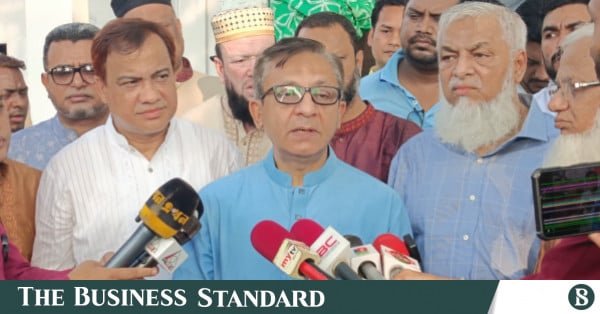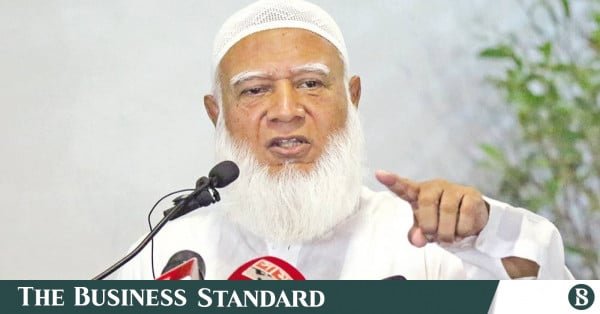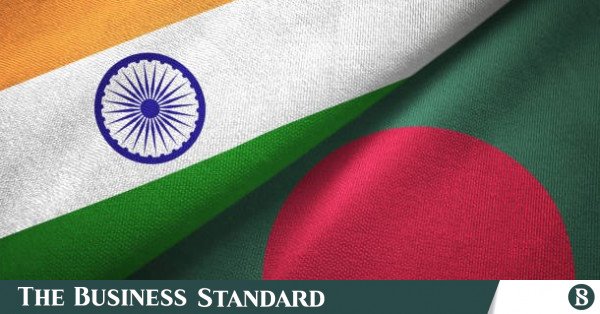
Amid increased engagement from both sides to retune bilateral relations, Foreign Minister Dr Khalilur Rahman and his Indian counterpart Dr S Jaishankar are set to meet in New Delhi next week, a move that could usher in a new phase of cooperation on a range of issues important to both Dhaka and Delhi and lend genuine momentum to the relationship, officials said.
This will mark the first high-level visit to India since the BNP government, led by Prime Minister Tarique Rahman, assumed office, following a period of significant strain in bilateral relations.
However, the Ministry of Foreign Affairs has yet to make any official announcement regarding the planned brief visit.

“The meeting between the two foreign ministers will be held in New Delhi on 8 April,” a senior official told UNB, without elaborating further on his arrival and departure information.
The Indian side usually does not announce incoming visits but officially announces outgoing visits.
Bangladesh and India share deep-rooted bonds of history, language, culture, and multitude of other commonalities, said an official, noting that in any bilateral meeting all issues of mutual interest comes up for discussion. .
The two Foreign Ministers are likely to discuss cooperation in the areas of energy, water sharing, border management, visa, people-to-people ties, he said, adding that a future visit of Prime Minister Tarique Rahman to India may also come up for discussion at the meeting.
Indian Prime Minister Narendra Modi has already invited Prime Minister Tarique, his wife Dr Zubaida Rahman, their daughter Barrister Zaima Rahman to pay a visit to India at a convenient time.
“I take this opportunity to invite you, along with Dr Zubaida Rahman and your daughter Zaima, on a visit to India at a mutually convenient time. A warm welcome awaits you in India,” Modi said in his letter handed over to PM Tarique by Speaker of the Indian Lok Sabha Om Birla, who represented the government of India at the swearing-in ceremony of the newly elected government of Bangladesh.
Prime Minister Modi said he looks forward to working closely with Prime Minister Tarique to strengthen their multifaceted bilateral relations, enhance regional cooperation, and advance their common goals in wide-ranging areas of connectivity, trade, technology, education, skill development, energy, healthcare, as well as cultural and people-to-people exchanges.
Asked whether the Prime Minister would consider India for his first bilateral visit, a diplomatic source told UNB that Bangladesh would take a decision “creatively” on the matter.
Water Sharing Issues
The subject of water is widely seen as a sensitive issue, and Bangladesh always keeps talking about its long-pending request for concluding the agreement on the sharing of the waters of the Teesta River, the draft of which was finalised in 2011.
The two countries share 54 common rivers, including the Teesta.
In India’s federal scheme of things, nothing is done without consultations with the State Government and any agreement that they conclude will have to be acceptable to the State Government of India; at the same time, it would also have to be acceptable to Bangladesh, officials said.
The Bangladesh-India Ganga/Ganges Water Treaty was signed on 12 December 1996 and is expiring in December this year.
As discussions for its renewal are yet to commence between the two countries, officials said this might be one of the issues to be discussed this time.
In July 2024, the governments of Bangladesh and India had decided to begin discussions on the renewal of the Ganga Water Treaty.
The discussions are yet to commence in this regard, and no fresh agreement has been ratified between the two countries.
The Indian side had offered to renew it in 2024, but the interim government did not pursue it at that time, a diplomatic source in New Delhi told UNB.
Inputs on drinking water and industrial water requirements have also been received from all stakeholders, including the government of West Bengal, which have been taken into account while formulating the Indian government’s views.
Visa Issues
Indian High Commissioner to Bangladesh Pranay Verma, in his recent meetings with the Ministers in Dhaka, explored new areas for future collaboration in people-centric domains aligned with the respective developmental priorities of the two countries based on mutual interest and mutual benefit.
The two sides also discussed various aspects of Bangladesh-India economic cooperation, including ways to strengthen transport, energy and digital connectivity between the two countries.
At the foreign minister–level meeting, the Bangladesh side is expected to raise the visa issue, as tourist visas for Bangladeshis have remained suspended since July 2024 on security grounds.
Indian visa centres in Bangladesh are still understaffed, suggesting that a full resumption of services may take time, a diplomatic source said, adding that the restart will be announced once finalised.
India thinks the two countries can truly become catalysts for each other’s sustainable growth, work for each other’s security and enable mutual prosperity as two fast-growing economies and aspiring societies.
Bangladesh and India on Thursday discussed ways to enhance bilateral defence cooperation, including joint training initiatives.
The issues were discussed when Bangladesh High Commissioner to India M Riaz Hamidullah met Indian Chief of Army Staff General Upendra Dwivedi at the South Block.
They also explored opportunities for deeper collaboration aimed at promoting regional peace and security.
The envoy said he was pleased to meet General Upendra Dwivedi and reflect on Bangladesh-India ties, including defence cooperation.
About The Author