The interim government has completely failed to observe International Clean Energy Day, Iftekharuzzaman said
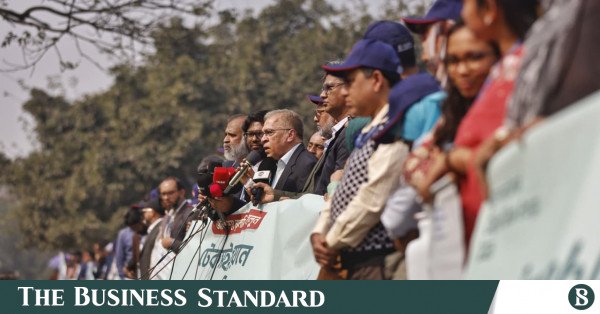
Transparency International Bangladesh Executive Director Dr Iftekharuzzaman speaking as the chief guest at a human chain organised by TIB in front of parliament on 26 January 2026. Photo: Rajib Dhar/TBS
“>

Transparency International Bangladesh Executive Director Dr Iftekharuzzaman speaking as the chief guest at a human chain organised by TIB in front of parliament on 26 January 2026. Photo: Rajib Dhar/TBS
Although Chief Adviser Muhammad Yunus’s ‘Three Zeros’ theory to achieve the Sustainable Development Goals is discussed internationally, no effective steps have been taken to implement it in Bangladesh, Transparency International Bangladesh Executive Director Dr Iftekharuzzaman has said.
The interim government has completely failed to observe International Clean Energy Day, Iftekharuzzaman said this morning (26 January) while speaking as the chief guest at a human chain organised by TIB in front of parliament.
He said the main purpose of the day is to raise awareness and make citizens, especially those in positions of state power, more active and conscious, but the government has failed to achieve that goal.
Referring to the interim government, he noted that it is led by a globally recognised leader, Yunus, whose key message is “Three Zeros”. It refers to zero poverty, zero unemployment and zero emissions, meaning zero carbon emissions, he added.

The TIB chief added that although these goals are promoted abroad, they have not been highlighted inside the country, questioning why government representatives who are aware of the issue did not mention the day or inform the public.
Turning to energy policy, he said its theoretical foundation still depends entirely on fossil fuels and offers no clear direction for a transition to clean energy. He described this as a matter of national existence for Bangladesh.
He also pointed out that the plan announced in 2025 has not yet been approved, adding that even if it were approved, it should be rejected.
According to him, the plan was prepared without stakeholder participation and reflects a lack of transparency.
He urged the government to reformulate the plan and called on future governments to prepare an effective action plan and master plan through a participatory process.
Such a plan should consider Bangladesh’s future, sustainable development, public safety and national existence, and help move the country towards zero emissions, he remarked.
He also called on the government to publish a white paper at the end of its term so that national and international discussions can assess how much responsibility it fulfilled regarding the three zero goals.
At the event, TIB presented nine recommendations, which include reducing fossil fuel use, prioritising renewable energy, setting unified targets in all policies including the Renewable Energy Policy 2025, preparing a realistic roadmap for power generation from renewable sources, and improving investment frameworks.
The other recommendations are ensuring transparency in environmental clearance and pollution monitoring, publishing all energy sector project proposals and contracts, implementing renewable projects on land acquired for cancelled coal and LNG plants, simplifying net metering, enforcing feed-in tariffs and incentives, avoiding conflicts of interest, and ensuring governance, transparency and public participation.
About The Author