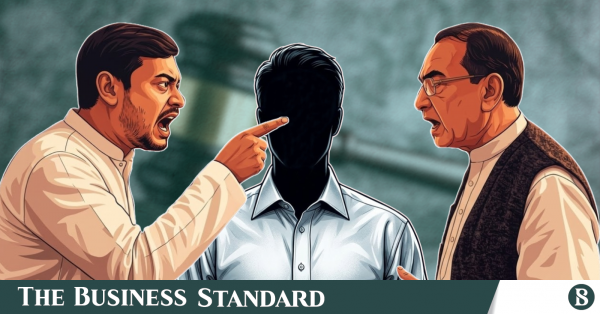
The filing of a defamation case against National Citizens Party’s Chief Coordinator Nasiruddin Patwary by a city BNP leader — and the subsequent court summons — represents a clear textbook example of the weaponisation of defamation law, a common phenomenon during the fallen Sheikh Hasina regime.
Also, the case constitutes a blatant abuse of process. Why? The defamation law grants the BNP leader no standing to file the suit, and the magistrate lacked the legal authority to take cognisance and issue a summons. But both happened.
Let’s summarise the case first.

Ashraful Islam, president of Ramna Thana BNP, filed the case with the Dhaka Metropolitan Magistrate’s Court that recorded the plaintiff’s statement and issued the summons directing Patwary to appear before the court on 21 April, the next date for hearing of the case.
In the BNP leader’s application, it is alleged that Patwary made false and defamatory statements at various times against Mirza Abbas, now the prime minister’s political adviser, during the campaign of the February parliamentary election, in which he had lost.

Ashraful further claims that after losing the election, Patwary continued to “spread defamatory remarks and threats through social media platforms and online news outlets.”
The petitioner said he recently saw posts on Facebook on 5 March in which Patwary’s alleged remarks were quoted by several online news portals.
“Therefore, the reputation and image of Mirza Abbas have been severely tarnished,” he said, claiming that his “reputation and image have also been undermined.”
He claimed that Patwary “committed offences under sections 500/5003/5004 of the Penal Code.”

Let’s have a look at these three sections.
Section 500 of the Penal Code deals with the punishment for defamation. It says, “Whoever defames another shall be punished with simple imprisonment for a term which may extend to two years, or with fine, or with both.”
The two other sections, 503 and 504, deal with criminal intimidation and intentional insult with intent to provoke breach of the peace.
In his petition, the plaintiff said nothing about alleged offences—intimidation or intentional insult with intent to provoke breach of the peace—committed by Patwary.

The entire petition focused on defamation. He prayed to the court to put Patwary behind bars.
But the crux of the matter lies here.
Both litigants and the magistrate overlooked Section 198 of the Code of Criminal Procedure that bars them from filing such cases and taking into cognisance the alleged offence: defaming Mirza Abbas by Patwary.
This provision allows only persons aggrieved by alleged defamatory remarks to file a case. Mirza Abbas himself could file the case if he felt aggrieved by the remarks made by Patwary about him.

So, from the legal point of view, there is no scope for filing a defamation case by a third party.
In this defamation case, the Ramna Thana BNP leader is the third party here. And he has no right to feel defamed and seek a remedy from the court.
Similarly, the magistrate was not authorised by the law to record the cases. He did not even examine the narrow exception criteria that could have allowed a third party, here the BNP leader, to file such a case.
The provision clearly says: “Where the person so aggrieved is a woman who, according to the customs and manners of the country, ought not to be compelled to appear in public, or where such person is under the age of eighteen years or is an idiot or lunatic, or is from sickness or infirmity unable to make a complaint, some other person may, with the leave of the Court, make a complaint on his or her behalf.”

None of the above criteria endorsed the actions of the BNP leader and the magistrate.
During the fallen Hasina regime, the weaponisation of defamation laws—under both the Penal Code and the Digital Security Act (DSA)—became a rampant tool for suppressing dissent.
These legal frameworks were systematically deployed against political rivals, particularly opposition leaders, with the primary objective of calculated harassment rather than the pursuit of justice. Many incidents triggered a huge public outcry. But nothing could stop the abuse of the defamation laws.
When his attention was drawn to section 198 of the Code of Criminal Procedure, the plaintiff’s lawyer, Amirul Islam Amir, argued that emotional proximity grants legal standing.

“If someone considers the victim to be a close associate or has walked alongside them for a long time, then one person’s insult can be felt as another’s. In such cases, there is no legal bar to one person filing a defamation case on behalf of another.’
Citing incidents during the past Hasina regime, he said, “We have seen many past examples of this, such as AB Siddique, president of the Bangladesh Jananetri Parishad, filing numerous defamation cases against BNP Chairperson Begum Khaleda Zia on behalf of Sheikh Hasina. When a leader is insulted, a supporter can step forward to file a case. There is no legal obstacle to this.”
The defamation cases filed against late prime minister Khaleda and other opposition leaders have been quashed by the courts after the fall of the Hasina regime.
Latest, the filing of the defamation case against NCP leader Patwary is the same old wine in a new bottle.
The filing of the defamation case against NCP leader Nasiruddin Patwary is a classic case of old wine in a new bottle. The tactics remain identical despite the change in the political landscape. It’s needless to say that such tactics are against the rule of law.
About The Author