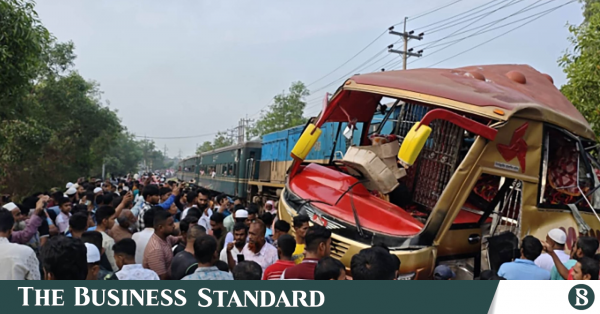
When a speeding train slammed into a bus at Padua Bazar in Cumilla, killing 12 people recently, it was not just another accident-it was a stark reminder of a long-ignored danger along Cumilla’s railway tracks.
Unprotected and poorly managed level crossings across Cumilla have turned into deadly traps.
Over 350 lives in the past five years and leaving over a thousand others injured, said Md Jashim Uddin, Laksham railway police station Officer-in-Charge.

The tragedy was not an isolated incident; it was yet another reminder of a long-standing crisis.
Spread across a 102-kilometre rail network, the district has more than 150 authorised and unauthorised crossings.
Many of them lack basic safety systems, making accidents, both minor and fatal, a frequent occurrence and posing constant risks to pedestrians and commuters.
The Padua Bazar crash has once again brought the issue into sharp focus.
A pattern of recurring tragedies
The latest accident fits into a disturbing pattern.
In 2024, seven passengers of an autorickshaw were killed after being hit by a train at an illegal crossing in Kalikapur under Burichang. In 2023, five people died in a similar accident in the Tuguria area of Monohorgonj.
In 2022, three schoolgirls were killed after being run over by a train near a railway gate in Bijoypur under Cumilla Sadar South. Earlier, in 2011, eight people lost their lives in a train-bus collision on an unauthorised level crossing in Shashidal of Brahmanpara.
According to railway data, at least 347 people were officially recorded killed in train accidents in the Cumilla region over the past five years.
However, the actual figure is believed to be significantly higher, as many incidents go unreported or are not formally documented.
A network riddled with risks
Data from railway sources highlight the scale of the problem, as on the Laksam-Noakhali route (22 km), there are 14 authorised and 17 unauthorised crossings, and on the Laksam-Chandpur route (14 km), there are 4 authorised and 13 unauthorised crossings.
Besides, along the Dhaka-Chattogram corridor within Cumilla (66 km), there are 66 authorised and 74 unauthorised crossings.
Experts say the large number of illegal crossings significantly increases the likelihood of accidents, as most lack gates, signals, or personnel.
Encroachment along railway tracks, nearby markets and settlements, reckless driving, and a lack of public awareness further compound the risks.
Allegations of negligence by gatekeepers also surface after many incidents.
Calls for accountability and urgent action
Local rights activists say the problem has been ignored for years.
Abdul Halim Majumder, general secretary of Cumilla Dakshin unit of Cumilla Bachao Manch, stressed the need to bring illegal crossings under strict control.
He also called for extending the railway overpass at Padua Bazar and constructing another overpass on the Laksam–Noakhali road.
OC Jasim Uddin said, “Without greater awareness and caution, it is difficult to prevent railway accidents.”
Steps are underway, but concerns remain
Railway officials say initiatives have been taken to reduce the number of illegal crossings and improve monitoring of gatekeepers.
Sub-assistant engineers Md Anisuzzaman and Golam Sarwar said efforts are ongoing to enhance the safety system and minimise risks.
Yet for residents who cross the tracks every day, the danger remains immediate and real.
About The Author