The Bangladesh Forest Department has also been assisting the initiative.
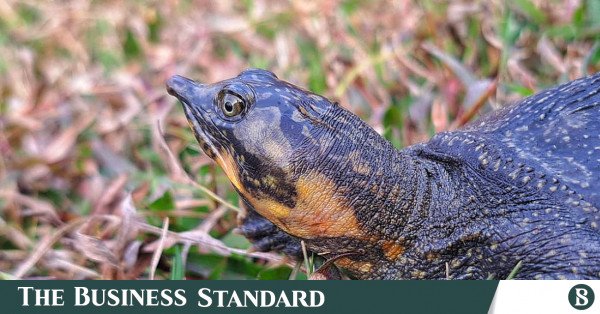
A close-up of a critically endangered Bostami turtle (Nilssonia nigricans), a rare freshwater species found in Bangladesh, seen resting on grass after being released into its natural habitat. Photo: Courtesy
“>

A close-up of a critically endangered Bostami turtle (Nilssonia nigricans), a rare freshwater species found in Bangladesh, seen resting on grass after being released into its natural habitat. Photo: Courtesy
After being reared for several months, 32 critically endangered Bostami turtles (Nilssonia nigricans) hatchlings were released at the Bayezid Bostami Shrine’s main pond in Chattogram on 15 January.
This is a significant step in the conservation of the critically endangered turtle species.
The hatchlings were produced through a joint conservation initiative by the Bayezid Bostami Shrine authorities and the Creative Conservation Alliance (CCA).

CCA has been supporting the shrine authorities in conserving the Bostami turtles for several years, aiming to protect and gradually increase the population living in the historic pond.
The Bangladesh Forest Department has also been assisting the initiative.
CCA Director of Animal Management Alliance Fahim Zaman said the organisation has been working with the shrine authorities since 2019, after learning that turtle hatchlings were rarely seen in the pond.
That year, 38 hatchlings were produced from 50 collected eggs using incubators.
In subsequent years, the project expanded, with 206 hatchlings produced from 700 eggs in 2020 and 67 from 400 eggs in 2021.

During the breeding season, turtle eggs face high risks from other predatory animals and natural hazards.
To reduce losses, volunteers identify nesting sites each year and relocate eggs to secure nesting boxes. This process known as nest translocation and it has significantly improved hatching success.
After hatching, the baby turtles are not released immediately into the main pond. Instead, they are raised in a separate hatchling pond for five to six months to reduce predation risks.
CCA’s Fahim said this step was introduced in 2020 after observing that hatchlings released directly into the main pond soon disappeared.
Species status
Wildlife experts say the Bostami turtle is found in limited locations in Bangladesh, India and Myanmar’s Arakan region.
The International Union for Conservation of Nature (IUCN) listed the species as endangered in 1998, while Bangladesh began formal conservation efforts in 2012.
The species is currently classified as Critically Endangered on the IUCN Red List.
Although the species typically grows to 50–60cm in natural habitats, turtles in the Bostami pond have been observed reaching lengths of 90cm to one metre.
Shrine authority’s role
Bayezid Bostami Shrine Committee General Secretary Mohammad Habibur Rahman said conservation efforts intensified after an attempted poisoning incident in 2004.
At the time, around 600 turtles were recorded in the pond.
He noted that devotees sometimes release predatory fish into the pond as part of religious offerings, posing a threat to hatchlings—another reason why young turtles are now reared separately before release.
About The Author