Addressing the challenges facing the newly elected government, he described managing the bureaucracy as a massive task.
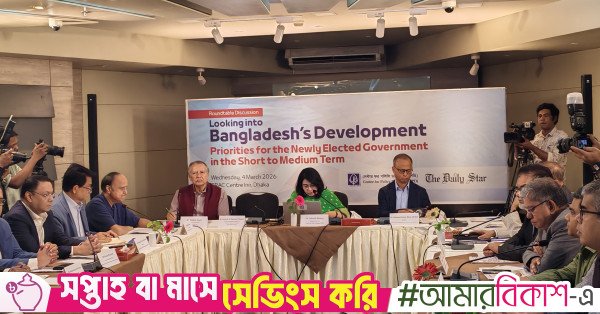
A roundtable titled “Looking into Bangladesh’s Development: Priorities for the Newly Elected Government in the Short to Medium Term” held today at the capital’s Brac Centre Inn. Photo: TBS
“>

A roundtable titled “Looking into Bangladesh’s Development: Priorities for the Newly Elected Government in the Short to Medium Term” held today at the capital’s Brac Centre Inn. Photo: TBS
Mahfuz Anam, editor and publisher of The Daily Star said the ultimate success of any government policy depends on its implementation, which is frequently obstructed by a bureaucracy still operating with a “colonial mindset”.
Speaking at a roundtable titled “Looking into Bangladesh’s Development: Priorities for the Newly Elected Government in the Short to Medium Term” today (4 March), he strongly advocated for the complete digitalisation of the administrative system to enhance efficiency and curb systemic waste.
The event was jointly organised by the Centre for Policy Dialogue (CPD) and The Daily Star at the capital’s Brac Centre Inn.

Drawing on decades of journalistic experience, Mahfuz Anam said that while successive governments have formulated commendable policies, the key challenge has consistently been implementation.
“Implementation is carried out through government agencies. While our bureaucracy is strong in many aspects, there are also obstructionists. Their working methods remain rooted in the colonial era, creating barriers instead of facilitating progress,” he said.
Addressing the challenges facing the newly elected government, he described managing the bureaucracy as a massive task.
“You cannot move forward by simply offending the bureaucracy; if they become rigid, they can stall everything. Dealing with them requires innovation, persuasion, and modernization,” he said.
Mahfuz Anam proposed two major steps to ensure improved governance.
Digitalisation of administration: Urging the government to pursue full digitalisation across all ministries, he said, “This is not just a financial matter. If we can digitalise the administrative structure, it will yield two immediate results, efficiency will increase, and wastage will significantly decrease.”
Sector-wise advisory groups: He also recommended forming expert advisory groups in key ministries such as Education, Health, and Telecommunications.
“These advisory groups, formed at the government’s invitation, could meet every three months alongside government officials and bureaucrats to provide expert input and monitor progress. In this way, the government can harness the intellectual capacity and professional expertise of the nation,” he added.
The veteran journalist further reflected on the historical trend of intellectuals joining the government.
“I have seen brilliant academics become part of the government. Our hope was always that they would positively influence governance. However, the opposite often happened, they were influenced by the system and acted like it,” he observed, expressing hope that the new administration would chart a different course.
About The Author