The discussion highlighted how climate-induced displacement is pushing vulnerable families into urban poverty, increasing children’s exposure to dangerous forms of work.
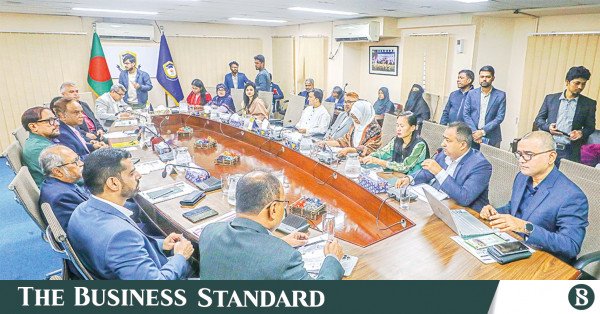
Panelists exchange views at a roundtable on climate action to protect affected families, jointly organised by YPSA and The Business Standard and supported by Solidar Suisse and the Swiss Agency for Development and Cooperation (SDC) in Chattogram on 23 December 2025 at Independent University recently. PHOTO: MOHAMMAD MINHAJ UDDIN
“>

Panelists exchange views at a roundtable on climate action to protect affected families, jointly organised by YPSA and The Business Standard and supported by Solidar Suisse and the Swiss Agency for Development and Cooperation (SDC) in Chattogram on 23 December 2025 at Independent University recently. PHOTO: MOHAMMAD MINHAJ UDDIN
A roundtable discussion on the growing links between climate change and hazardous child labour underscored the urgent need for targeted protection of climate-displaced families and children.
Titled “Climate Action for Climate-Induced Families and Children Engaged in Hazardous Work,” the event was jointly organised by Young Power in Social Action (YPSA) and The Business Standard at Chittagong Independent University.
Supported by Solidar Suisse under the Climate Action at Local Level (CALL) programme and the Swiss Agency for Development and Cooperation (SDC), the discussion highlighted how climate-induced displacement is pushing vulnerable families into urban poverty, increasing children’s exposure to dangerous forms of work.

Speakers stressed the importance of coordinated, rights-based climate action to safeguard children and build long-term community resilience.
Shamsuddin Illius, Bureau Chief, The Business Standard, Chattogram. Photo: TBS
“>

Shamsuddin Illius, Bureau Chief, The Business Standard, Chattogram. Photo: TBS
Shamsuddin Illius
Bureau Chief, The Business Standard, Chattogram
Bangladesh stands at the frontline of the global climate crisis. Every year, climate-induced disasters such as cyclones, floods and river erosion force thousands of families to leave their homes in search of survival.
Many end up in urban centres like Chattogram, where limited opportunities and fragile living conditions expose children to hazardous labour and exploitation. Eliminating hazardous child labour and building long-term resilience must be at the centre of our climate response.
We believe that meaningful change can only be achieved through collaboration—between government institutions, civil society organisations, academia, the private sector, development partners, and the media.
Muhammad Ali Shahin, Head of Advocacy, YPSA. Photo: TBS
“>

Muhammad Ali Shahin, Head of Advocacy, YPSA. Photo: TBS
Muhammad Ali Shahin
Head of Advocacy, YPSA
Bangladesh is among the world’s top 10 climate-vulnerable countries, with floods, cyclones and river erosion displacing nearly 700,000 people every year.
After migrating to cities, these families are pushed into informal and risky work, leading to rising child labour. About 3.5 million children are engaged in child labour, with 1 to 1.2 million in hazardous work.
Child labour elimination programmes should target sector-wise removal of child labour, not area-wise.
The approach should include awareness and providing education support, livelihood support to the families and also vocational training to children of the climate induced families engaged in hazardous jobs.
Dr Md Arifur Rahman, Founder and Chief Executive, YPSA. Photo: TBS
“>

Dr Md Arifur Rahman, Founder and Chief Executive, YPSA. Photo: TBS
Dr Md Arifur Rahman
Founder and Chief Executive, YPSA
People who are forced to migrate to cities due to climate change suffer not only severe economic losses but also profound non-economic losses that are often invisible and irreversible.
Families lose ancestral land, social bonds, cultural practices, identity and dignity. Although Bangladesh contributes little to global emissions, climate support often comes as loans, pushing future generations into debt. Climate finance must not deepen
inequality.
Children are the most affected, facing disrupted education, health risks and trauma. Ensuring a safe, dignified, and resilient future for children from climate-affected and displaced families must be a collective responsibility of governments, development partners and civil society.
Dr Shahadat Hossain, Mayor, Chattogram City Corporation. Photo: TBS
“>

Dr Shahadat Hossain, Mayor, Chattogram City Corporation. Photo: TBS
Dr Shahadat Hossain
Mayor, Chattogram City Corporation
Chattogram already accommodates nearly six million people and does not have the capacity to absorb another one million climate-displaced migrants. Thousands of families live on pavements and in informal settlements without basic services, pushing children into hazardous labour and crime. Adequate funding and targeted support are urgently needed.
Bangladesh has failed to secure sufficient climate finance from countries responsible for greenhouse gas emissions. Either we are falling short in global advocacy, or when funds are mobilised, corruption and weak accountability prevent them from reaching the affected people. This must change.
Professor MM Nurul Absar, Vice Chancellor, Chittagong Independent University. Photo: TBS
“>

Professor MM Nurul Absar, Vice Chancellor, Chittagong Independent University. Photo: TBS
Professor MM Nurul Absar
Vice Chancellor Chittagong Independent University
We welcome climate-related initiatives that contribute to a sustainable and resilient future for Bangladesh. Universities must play a proactive role in addressing the climate crisis through education, research, and innovation.
From next year, CIU will introduce two mandatory courses on Climate Change and Artificial Intelligence to equip students with skills and ethical understanding for future challenges. Addressing climate change requires collective responsibility. If policymakers, academics, and civil society act sincerely from their positions, we can protect vulnerable communities and build a climate-resilient Bangladesh.
Noman Ullah Bahar, President, SDG Youth Forum. Photo: TBS
“>

Noman Ullah Bahar, President, SDG Youth Forum. Photo: TBS
Noman Ullah Bahar
President, SDG Youth Forum
Government funds for social protection, education and climate response must be closely and transparently monitored to ensure they reach intended beneficiaries. Strong accountability and public oversight are essential to prevent misuse and corruption. Our highest priority must be bringing children out of hazardous work and back into formal education.
Education is the most powerful and sustainable pathway out of poverty and exploitation. However, education alone is not enough. These children and their families also require improved socio-economic conditions, including stable livelihoods, and access to skills development opportunities.
Sadia Rahman, Deputy Director, Ghashful. Photo: TBS
“>

Sadia Rahman, Deputy Director, Ghashful. Photo: TBS
Sadia Rahman
Deputy Director, Ghashful
After climate disasters, the first pressure falls on children. To survive, families send them to work, and school dropout rates double. Another major problem is post-disaster relocation. Mental health must be addressed alongside skill and knowledge development.
Ensuring access to healthcare, nutrition and psychosocial support is critical for children exposed to hazardous work. Equally important is shaping children into climate-aware citizens by integrating environmental education and sustainability values into formal and non-formal learning.
Julia Parveen, Associate Professor, Premier University. Photo: TBS
“>

Julia Parveen, Associate Professor, Premier University. Photo: TBS
Julia Parveen
Associate Professor, Premier University
To address child labour, we must focus on families. Most child labourers in Chattogram come from other districts after repeated
disasters force them to migrate. Without
stable urban employment, children are pushed into labour.
Eliminating child labour requires supporting families so they can become
self-reliant in their own areas and are not forced to migrate.
Only through a comprehensive, child-centred, and well-coordinated approach—combining transparent governance, education, social protection, healthcare, and environmental awareness—can we break the cycle of hazardous child labour and build a more just, resilient, and sustainable future.
Md Shamsuddoha, Chief Executive, Center for Participatory Research and Development. Photo: TBS
“>

Md Shamsuddoha, Chief Executive, Center for Participatory Research and Development. Photo: TBS
Md Shamsuddoha
Chief Executive, Center for Participatory Research and Development
In our planning and response mechanisms, we tend to focus primarily on immediate risk reduction—early warning systems, emergency response, evacuation, and relief.
While these measures are essential, far less attention is given to the secondary and long-term impacts of disasters. Without sustained recovery support, affected families are forced to migrate to cities, increasing urban pressure.
The absence of integrated, people-centred recovery strategies means that disaster-affected families are left vulnerable long after the emergency phase ends.
Climate-induced displacement leads to school dropouts, child labour and hazardous work, causing intergenerational losses. When children leave school, their development is compromised. Addressing climate change must go beyond emergency response and include long-term investment in human development, social protection and resilience.
Saleh Noman, Secretary General, Metropolitan Journalists Union. Photo: TBS
“>

Saleh Noman, Secretary General, Metropolitan Journalists Union. Photo: TBS
Saleh Noman
Secretary General, Metropolitan Journalists Union
Every year, around 30,000 people are displaced and come to Chattogram, based on earlier estimates. The current number is likely much higher. Most health and education facilities in the city are concentrated in a few specific areas.
In distant areas, there are still no strong initiatives in education and healthcare, and opportunities remain very limited. These gaps are making life increasingly difficult for displaced families and their children.
Omar Kaiser, Joint Editor, Prothom Alo. Photo: TBS
“>

Omar Kaiser, Joint Editor, Prothom Alo. Photo: TBS
Omar Kaiser
Joint Editor, Prothom Alo
Young Power in Social Action has shown how environmental work can be done differently. Chattogram City Corporation can scale up this model, and with NGO support, education arrangements can be made for working children in city institutions. Integrating education, skills development and social protection can be an effective model. Pushing displaced children into hazardous labour is a grave injustice. Sector-specific interventions, strong social protection and international cooperation are essential.
Mohammad Mahbubul Hasan, Deputy Inspector General, Department of Inspection for Factories and Establishment, Chattogram. Photo: TBS
“>

Mohammad Mahbubul Hasan, Deputy Inspector General, Department of Inspection for Factories and Establishment, Chattogram. Photo: TBS
Mohammad Mahbubul Hasan
Deputy Inspector General, Department of Inspection for Factories and Establishment, Chattogram
Eliminating child labour in Chattogram is 100% achievable with coordinated action, commitment and accountability. Bangladesh already has legal frameworks and action plans; what is missing is strong enforcement and coordination.
Awareness is also critical. Families, employers and communities must understand the long-term harm of child labour. At the same time, NGOs and community-based organisations are essential for outreach, case identification, rehabilitation, and follow-up at the grassroots level. If responsibilities are clearly defined, resources are adequately allocated, and efforts are properly distributed and monitored, it is entirely possible to make Chattogram a child-labour-free city.
Prof Mohammed Al-Amin, Dean, Faculty of Science, University of Chittagong. Photo: TBS
“>

Prof Mohammed Al-Amin, Dean, Faculty of Science, University of Chittagong. Photo: TBS
Prof Mohammed Al-Amin
Dean, Faculty of Science, University of Chittagong
In the past, few people thought seriously about climate change. Now this shift in thinking is encouraging. Climate change has multiple dimensions, one of which is the rise in child labour. Thanks to IPSA for identifying these children. Motivating them and bringing them back into the mainstream is our moral responsibility as a nation. With political will, this problem can be solved in Chattogram.
Md Mosleh Uddin, Director, Bangladesh Shishu Academy, Chattogram. Photo: TBS
“>

Md Mosleh Uddin, Director, Bangladesh Shishu Academy, Chattogram. Photo: TBS
Md Mosleh Uddin
Director, Bangladesh Shishu Academy, Chattogram
The Shishu Academy does not have the authority to work beyond cultural activities, yet it is essential for children’s development. Across Bangladesh, the academy operates with only Tk10 crore for child development. Earthquakes will be one of the most severe impacts of climate change, and even a moderate earthquake could devastate Chattogram. There is also no proper data in Bangladesh on how many children are becoming homeless due to climate change.
Ripa Chakma, World Vision, Chattogram. Photo: TBS
“>

Ripa Chakma, World Vision, Chattogram. Photo: TBS
Ripa Chakma
World Vision, Chattogram
We work on children’s education, health, child labour, child marriage and the environment. In Chattogram, we conduct ward-based climate change awareness activities. Every month, we collect plastic and offer gifts in exchange. We have 4,500 registered children. Our goal is to remove children from child labour and bring them back into education.
Nazrul Islam Muzumdar, Divisional Manager, BRAC, Chattogram. Photo: TBS
“>

Nazrul Islam Muzumdar, Divisional Manager, BRAC, Chattogram. Photo: TBS
Nazrul Islam Muzumdar
Divisional Manager, BRAC, Chattogram
We must address the root of the problem. We need to focus on what our National Plan of Action is, how much progress has been made, and how much more needs to be done.
Every year, nearly 700,000 people become vulnerable citizens. Where will we stand in ten years? If people engaged in hazardous work are given better skills, they can be integrated into the formal sector. With cooperation, we can move steadily toward our goals.
Afra Nawar Rahman, President, AUW Student Government. Photo: TBS
“>

Afra Nawar Rahman, President, AUW Student Government. Photo: TBS
Afra Nawar Rahman
President, AUW Student Government
Climate impacts are never equal. Displacement and recurring disasters push families into survival at the cost of dignity and childhood. Women take on insecure work, children enter hazardous labour, and persons with disabilities are overlooked. Decisions are often made without those most affected. Climate action must be rooted in justice and inclusion—recognising women as leaders, ensuring accessibility, and creating real space for youth participation beyond consultation.
Mahima,Youth Leader, Chattogram. Photo: TBS
“>

Mahima,Youth Leader, Chattogram. Photo: TBS
Mahima
Youth Leader, Chattogram
As a young person, I speak for a generation that will inherit the consequences of climate change. Youth can be advocates, innovators and change-makers—raising awareness, supporting community solutions and holding authorities accountable. Climate action is inseparable from social justice. Children forced into hazardous work deserve dignity and protection. With commitment and collaboration, we can build a Bangladesh where no child is exploited and displaced families live with security and hope.
About The Author