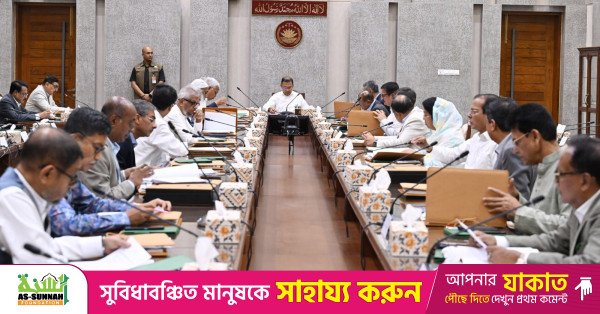
At a Cabinet meeting today (17 March) at the Secretariat, chaired by Prime Minister Tarique Rahman. Photo: PID
“>

At a Cabinet meeting today (17 March) at the Secretariat, chaired by Prime Minister Tarique Rahman. Photo: PID
In its third meeting, the Cabinet Division has approved proposals to convert two key ordinances – the supplementary budget for 2024-25 and the main budget for 2025-26 – into law.
The approval came during a Cabinet meeting today (17 March) at the Secretariat, chaired by Prime Minister Tarique Rahman.
Following the meeting, Cabinet Secretary Nasimul Gani briefed reporters on the decision.

Normally, the parliament approves the supplementary budget for the current fiscal year and the main budget for the next fiscal year during the annual budget session.
However, after the ouster of the Awami League government on 5 August 2024, the interim government presented the 2025-26 budget when the parliament was not in session.
As a result, both the 2024-25 supplementary budget and the 2025-26 main budget did not receive parliamentary approval.
With the formation of the 13th parliament through the 12 February elections, the government has now moved to convert these ordinances into law.
Cabinet Secretary Nasimul said the Appropriation (Supplementary) Ordinance, 2025, related to the 2024-25 supplementary budget, has been approved for conversion into law.
He explained that, under Article 91 of the Constitution, a supplementary financial statement must be presented to Parliament if expenditures exceed approved limits. This was not possible earlier because parliament had been dissolved.
He added that the interim government had issued the ordinance under Article 93 of the constitution, and it has now received final approval to become law.
The cabinet secretary also confirmed that the ordinance, covering the 2025-26 main budget, will similarly be converted into law.
According to Article 87 of the constitution, annual income and expenditure statements must be presented to parliament, but this was delayed due to the absence of a sitting parliament.
The ordinance, issued under Article 93, will now be formally enacted.
About The Author