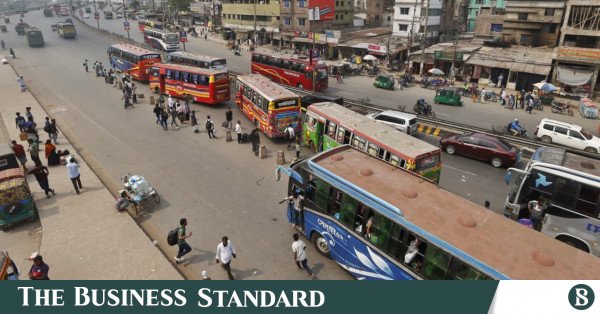
Whether holidaymakers or homebound, passengers travelling in buses over the Eid ul Fitr holidays are slated to shell out an eye-watering Tk 148 crore in excess fares, despite the government’s claims of strict monitoring, according to the Bangladesh Jatri Kalyan Samity (JKS), a passengers’ safety advocacy group.
In a statement issued yesterday (18 March), JKS accused bus operators of ‘holding passengers hostage’ and charging inflated fares. It even observed that Bangladesh was on the verge of breaking a 20-year record of irregularities in Eid travel.
JKS said that although the government, in coordination with transport owners’ associations, publicly claims that fares remain under control, the ground reality is ‘completely opposite.’

Quoting its observations, JKS secretary-general Mozammel Haque Chowdhury said around 4 million trips are expected on inter-district and long-route buses during Eid, while another 6 million trips may take place on city services across the country.
The report, based on monitoring between 14-18 March, covering passenger movement, advance ticketing, and regulatory activities, found that 87 percent of buses and minibuses are charging excess fares, ignoring official directives.
According to the organisation, fares on several key routes have more than doubled. For instance, Dhaka-Pabna fares rose from Tk550–600 to Tk1,200, Dhaka-Natore from Tk550–580 to Tk1,200, and Dhaka-Rangpur from Tk500 to Tk1,500.
Similar complaints were reported on routes to Noakhali, Lakshmipur, Ramganj, Khulna, and others.
It also noted that local buses on routes like Dhaka-Mymensingh are charging up to Tk 600 instead of Tk 250, while passengers are even being transported in trucks and pickups at inflated rates.
The Samity further alleged that transport operators are forcing passengers to buy tickets for farther destinations when tickets to their intended stops are unavailable, such as selling tickets up to the Cox’s Bazar region instead of Chattogram, or Rangpur instead of Bogura.
It also accused operators of charging uniform inflated fares regardless of differences in seating capacity or fuel type, exploiting passenger unawareness.
Mozammel said fare structures already include provisions for salaries, allowances, and Eid bonuses for transport workers, but many owners fail to pay those, instead passing on additional costs to passengers.
He cited rising commodity prices, extortion in the transport sector, operational costs, and profit motives as key drivers behind the fare hikes, adding that the absence of passenger representatives in monitoring teams has worsened the situation.
According to the organisation’s estimates, excess fare collection on long-distance routes alone could reach around Tk 122 crore, with passengers paying an average extra Tk 350 per trip. Meanwhile, excess fares in city services could amount to around Tk 26 crore, assuming an average of Tk 50 extra per trip.
No extra fares being charged on trains, say Rail authorities
The Samity warned that such irregularities could trigger price hikes in essential commodities, increase extortion, and lead to social instability, corruption, and road accidents.
To address the issue, it recommended introducing digital fare collection systems, eliminating cash transactions, installing CCTV-based enforcement on highways, and ensuring strict rule of law in the transport sector.
About The Author