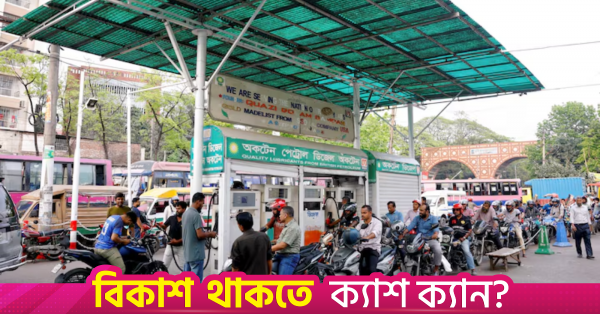
Bangladesh has requested several African countries to export petroleum products, as the country faces growing energy challenges due to the ongoing Middle East war and aims to diversify its energy sources.
Last month, Bangladesh High Commissioner to Nigeria Miah Md Mainul Kabir met with Nigerian Minister of State for Petroleum Resources (Gas) Ekperikpe Ekpo in Abuja to request the export of petroleum products to Bangladesh, sources said.
As of early 2026, Ekperikpe Ekpo serves as Nigeria’s minister of state for Petroleum Resources (Gas), appointed by President Bola Tinubu, overseeing the nation’s gas sector, including the Nigerian Gas Master Plan 2026 and local content transformations.

The conflict, which began on 28 February 2026, when the USA and Israel attacked Iran in violation of international law, has triggered a global energy crisis.
Bangladesh maintains nine diplomatic missions across Africa: Algiers (Algeria), Cairo (Egypt), Addis Ababa (Ethiopia), Nairobi (Kenya), Tripoli (Libya), Port Louis (Mauritius), Rabat (Morocco), Abuja (Nigeria), and Pretoria (South Africa).
The Ministry of Foreign Affairs sent letters to these missions last month, instructing them to start negotiations for importing petroleum products.
The Ministry of Foreign Affairs, Bangladesh Petroleum Corporation (BPC), and Bangladesh’s African missions plan to hold a Zoom meeting with stakeholders on petroleum imports later this month.
Meanwhile, Bangladesh Ambassador to Algeria Md Najmul Huda will meet with stakeholders in Algeria on petroleum imports.
Ambassador Sadia Faizunnesa in Morocco is also exploring new avenues for petroleum supply.
Currently, Saudi Arabia, UAE, Qatar, Kuwait, and Oman are the major exporters of petroleum products to Bangladesh, primarily through government-to-government (G2G) deals. The government is also considering expanding Eastern Refinery Limited (ERL) to reduce reliance on imported refined fuel.
African oil production capacities are as follows: Nigeria 1,500,000–1,600,000 barrels per day (BPD), Libya 1,200,000–1,300,000 BPD, Angola 1,000,000–1,100,000 BPD, Algeria 900,000–1,000,000 BPD, Egypt 500,000–600,000 BPD, Republic of the Congo 250,000–300,000 BPD, Gabon 200,000–230,000 BPD, Ghana 170,000–200,000 BPD, South Sudan 150,000–170,000 BPD, Equatorial Guinea 90,000–120,000 BPD, Chad 80,000–100,000 BPD, Sudan 60,000–70,000 BPD, Cameroon 60,000–80,000 BPD, Senegal 30,000–40,000 BPD, and Mauritania 5,000–10,000 BPD.
Notably, African countries have not exported petroleum products to Bangladesh in the past 55 years.
Major investors in African energy sectors, including France, Italy, Spain, and China, have limited the availability of oil for export beyond these stakeholders.
In a related development, Italian Prime Minister Giorgia Meloni visited Algeria on March 25, 2026, to secure expanded energy partnerships amid disruptions linked to the Iran war and tensions in the Strait of Hormuz.
Both nations agreed to strengthen cooperation through offshore exploration and increased gas supply via the TransMed (Mattei) pipeline, which has connected them since the 1980s.
During the visit, Meloni also highlighted concerns over military escalation in Lebanon, urging the international community to work toward regional stability and a two-state solution.
Meanwhile, Bangladesh’s Minister for Power, Energy, and Mineral Resources Iqbal Hassan Mahmood assured the nation that the country currently has no energy deficit, as supply has increased this year compared to last year.
About The Author