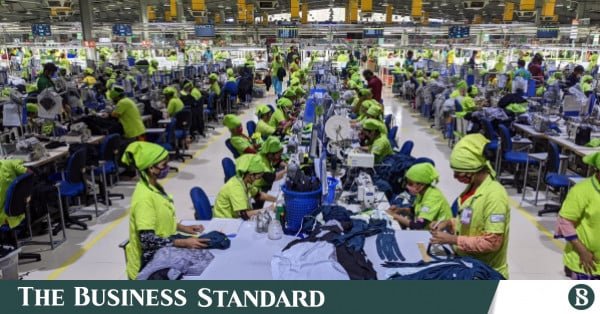
Bangladesh’s apparel exporters receive, on average, 10% lower prices in the United States market than in the European Union market for exported products, according to a recent study.
The report identifies the lack of duty-free access in the US market as one of the main reasons behind this difference.
The report was presented today (14 March) at a consultation event held in the Department of Development Studies conference room.

The study also finds that large exporting firms receive more than 30% higher prices than small exporters in both markets, mainly due to stronger bargaining power and better product quality.
The research organization Research and Policy Integration for Development (RAPID) analysed 25 million export data entries from the Customs ASYCUDA World system, covering the period from 2010 to 2023.
“On average, firms charge more than 10% lower prices in the US market than in the EU,” said Jillur Rahman, deputy director of RAPID, while presenting the keynote.
He also noted that high tariffs force exporters without preferential access to absorb a large portion of the tariff burden within their own profit margins in order to remain price-competitive at the border.
“More favorable trade regimes may support better price realization at the firm level,” he added.
According to the analysis of 10 apparel products, prices in the EU market were found to be 5% to 18% higher than those in the US market.
Citing an example, he said exporters receive around 20% to 27% higher prices for T-shirts in Germany than in the US, while trousers fetch 9% to 15% higher prices in the German market.
Bangladesh enjoys duty-free export access to the EU market under the Everything But Arms (EBA) scheme as a least developed country (LDC).
The EU also offers relatively flexible rules of origin, including single-stage transformation requirements for garments.
In contrast, Bangladeshi apparel exports to the US face tariffs ranging from 12% to 15%.
About 66% of Bangladesh’s total apparel exports are destined for the markets of the 27 EU countries and the United States.
The report also finds that large firms set prices 30% to 35% higher than small and medium-sized firms across both the EU and US markets, largely due to stronger bargaining power, higher product quality, and access to more lucrative buyers.
“Firm size is more strongly associated with price-setting advantages in the US than in the EU,” the report noted.
It also adds that firms concentrated on knitwear apparel exports receive 10% to 13% lower average prices, suggesting relatively lower prices for knitwear items.
About The Author