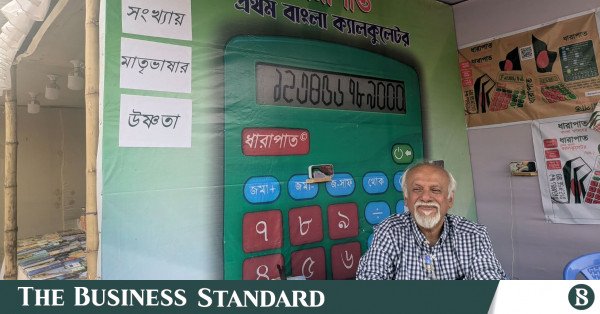
At the bustling Amar Ekushey Book Fair, visitors browsing books are stopping at one unusual stall – not for a book, but for a calculator with Bangla digits, symbols and instructions.
The device, called Dharapat (basic arithmetic primer), is designed to help farmers, small traders and marginalised people perform everyday calculations in Bangla. The calculator has drawn curious visitors eager to see how a simple tool can make accounting easier for those who struggle with English-based devices.
Inventor Dr Mahmud Hasan conceived the idea more than three decades ago to solve a common problem. In the 1980s, most calculators available in the market used English commands, making them difficult for many farmers and small traders in rural areas to use.

Hasan therefore set out to create a calculator where numbers and instructions appear in Bangla, allowing users to calculate in the language they think and work in.
The calculator features Bangla digits, Bangla symbols and a simplified interface suitable for everyday calculations such as measuring crop sales or market transactions. According to the inventor, the design enables people with little formal education to use the device easily.
“I wanted farmers to understand the real value of their crops,” Hasan said. “If they can calculate costs and profits themselves, their lives become a little easier.”
Children were also part of his inspiration. Hasan believes that using a calculator with Bangla numbers can help students in their early years of schooling learn mathematics better.
Developing the device, however, was not easy. With limited technological support in the late 1980s, Hasan carried out extensive research to design a calculator capable of displaying Bangla numerals and simple commands.
The idea of integrating Bangla numerals into electronic devices led him to conduct research at Bangla Academy in 1988 and 1989. Under a project titled “Development and Electrification of Bangla Typewriting Machine,” he worked on creating Bangla fonts and improving the Bangla keyboard layout developed by linguist Munier Chowdhury.
He also contributed to efforts to standardise Bangla characters in computing through the Bangla Academy Standard Code for Information Interchange (BASCII) project, which aimed to make Bangla easier to use in information technology.
Hasan expects the calculator to cost between Tk400 and Tk500 if it is produced commercially.
“My goal is to put this device into the hands of farmers, small traders and marginalised people,” he said, adding that technology should be accessible to everyone.
About The Author