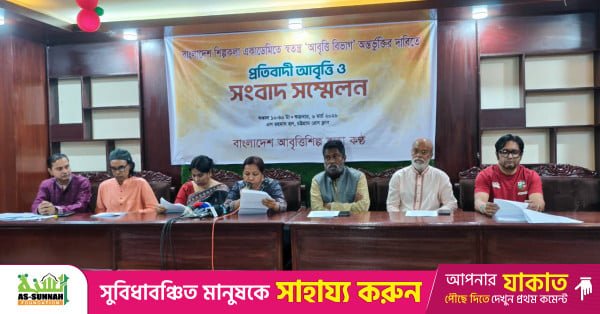
They demanded that the Bangladesh Shilpakala Academy (Amendment) Ordinance, 2026 be reconsidered to include a separate recitation department.
Recitation artists expressed concern that despite an increase in the number of departments in the Bangladesh Shilpakala Academy under a recently amended ordinance, the art of recitation has been excluded. Photo: TBS
“>

Recitation artists expressed concern that despite an increase in the number of departments in the Bangladesh Shilpakala Academy under a recently amended ordinance, the art of recitation has been excluded. Photo: TBS
Recitation artists staged a protest and held a press conference in Chattogram today (6 March), demanding the inclusion of a separate recitation department at the Bangladesh Shilpakala Academy.
They expressed concern that despite an increase in the number of departments in the academy under a recently amended ordinance, the art of recitation has been excluded.
The protest recitation and press conference were held at 10:30am at the S Rahman Hall of the Chattogram Press Club under the banner of the “Bangladesh Abritti Shilpi Rokkha Kontho”. Artists and cultural activists gathered there to call for the establishment of an independent recitation department within the academy.

Speakers said that under the Bangladesh Shilpakala Academy (Amendment) Ordinance, 2026, the number of departments has been increased from six to nine.
New departments such as photography, performing arts, new media, and cultural branding have been added. The former “Theatre and Film Department” has been split into two separate departments, while the previous “Music, Dance and Recitation Department” has been divided into separate music and dance departments. However, the word “recitation” has not been included anywhere in the ordinance, which they described as disappointing for the country’s cultural community.
They emphasised that recitation is not merely the reading of poetry but a distinct vocal art form that brings literature to audiences through expression and sound. Historically, recitation and rhetoric were important elements of cultural life in ancient Greek and Roman civilizations. In Bengali culture, the practice also has deep roots through traditions such as puthi recitation, kabigan, and other forms of folk storytelling, they added.
Speakers also highlighted that recitation played a significant role in Bangladesh’s Language Movement, the Liberation War, and various democratic struggles. Poetry recitation has often been used to inspire protest, raise awareness, and spread cultural consciousness among the people. They added that the practice of proper and standard pronunciation in recitation contributes significantly to preserving and promoting the Bangla language.
According to the speakers, more than 500 recitation organisations are currently active across Bangladesh. These organisations regularly conduct training workshops and attract new learners each year. Recitation training is also provided at district-level Shilpakala academies, and speakers claimed that lakhs of people across the country are involved in recitation activities.
They further noted that the importance of recitation has grown in the digital era, as voice-based content such as audiobooks, podcasts, and online performances is becoming increasingly popular. As a result, recitation artists are finding new opportunities on digital platforms.
From the press conference, participants demanded that the Bangladesh Shilpakala Academy (Amendment) Ordinance, 2026 be reconsidered to include a separate recitation department. They also announced a plan to submit a memorandum to the cultural affairs minister through the deputy commissioner.
The written statement was read by Jerin Mili on behalf of the ‘Bangladesh Abritti Shilpi Rokkha Kontho’. The programme was moderated by recitation artist Nazmul Alim Sadeki, while protest recitations were performed by ‘Notun Kuri’ champion Sabila Sultan Bani and recitation artist ATM Saifur Rahman.
Among others present were theatre activist Khaled Helal, poet Yusuf Muhammad, publisher Md Sahab Uddin Babu, Rabindra Sangeet artist Laki Das, recitation organiser Mishfaq Russell, and recitation artists Debashish Rudra, Selim Reza Sagar, and Bishwajit Pal.
About The Author