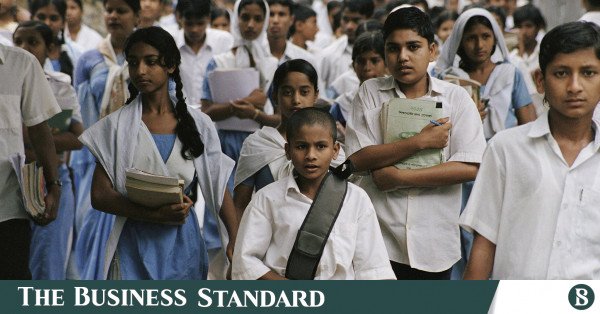
The government has decided to hold last year’s primary scholarship examination in the first week of April after it was delayed due to legal complications, raising concerns among students, parents and teachers as many candidates have already been promoted to Class 6.
According to the Ministry of Primary and Mass Education, the exam is likely to take place before Eid-ul-Azha.
Under the plan, 80% of scholarships will go to students from government primary schools, while the remaining 20% will be allocated to students from private schools.

Students face syllabus clash
However, the decision has created confusion as the new academic year began nearly three months ago and most candidates are already studying in Class 6.
Students selected for the scholarship exam must now prepare the Class 5 syllabus in Bangla, English, mathematics, science and social science – a 400-mark test – alongside their current Class 6 studies.
The shortage of textbooks has become a major concern, forcing many students to rely on photocopies or guidebooks to prepare for the exam.
Bijoy Malo, a student of Munshipur High School in Faridpur, told TBS that he and many of his classmates had already sold their Class 5 textbooks.
“After finishing Class 5, many students sell their old books by weight or give them away. Now we are unsure whether we can even sit for the exam,” he said.
Teachers, parents warn of academic pressure
Teachers say the sudden decision may create unnecessary pressure on students. Nazmun Nahar, a teacher at Tilai Joychandi High School, said the earlier decision was not to hold the exam this year.
“That decision should have remained in place. If necessary, the exam could have been restarted from the next batch. Because of the policy change, many students are now unprepared,” she said.
Parents have raised similar concerns.
Israt Jahan, a parent at Motijheel Ideal School and College, said students are already busy with their new curriculum.
“My child is now fully focused on Class 6 studies. Revising the Class 5 syllabus again is creating extra mental pressure,” she said.
Educationists question quota system
The decision to hold the test months after the academic year began and to maintain the quota system has drawn criticism from educationists as well.
Rasheda K Chowdhury, former adviser to a caretaker government and executive director of the Campaign for Popular Education (CAMPE), questioned the quota policy.
“There is a provision to allocate 20% of scholarships to private school students. The quota system for which our children sacrificed their lives has returned again – this raises serious questions,” she said.
According to her, separating a fixed percentage of students for scholarships creates unhealthy competition among schools, teachers and students.
“At such a young age, putting children under intense competition does not produce positive outcomes,” she added.
She also warned that scholarship-based competition may encourage dependence on guidebooks, coaching and memorisation rather than real learning.
“We are turning our children into guinea pigs by experimenting with different policies,” she said.
Govt says scholarships meant to motivate students
Responding to the criticism, State Minister for Primary and Mass Education Bobby Hajjaj said scholarships are intended to motivate students.
“Scholarships or stipends are meant to encourage students. Even if resources such as books are limited, recognising the top students helps motivate them,” he told TBS.
He said the scholarship programme had originally been planned last year but could not be implemented due to various factors, including the political situation.
“That is why we have reconsidered the issue and decided to restart the programme,” he added.
The minister also said the government aims to reduce reliance on private coaching.
“Stopping coaching does not mean simply banning it. We want to strengthen schools and teachers so that students can receive additional academic support within the school,” he said.
According to education stakeholders, authorities must ensure that students preparing for the 400-mark scholarship exam do not fall behind in their current studies.
They also warn that unless the shortage of textbooks is resolved quickly, many talented students may miss the opportunity to sit for the competitive test.
About The Author