The press secretary said that members of the advisory council also individually expressed their appreciation
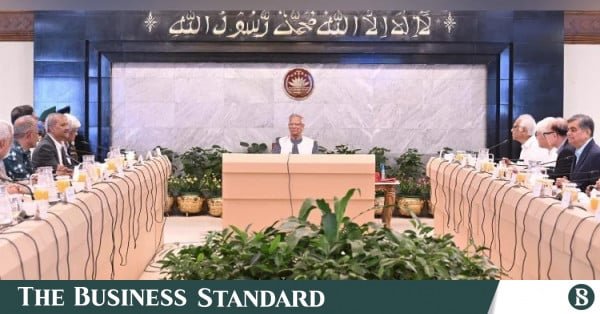
61st weekly meeting at the Chief Adviser’s Office (CAO) with Chief Adviser Professor Muhammad Yunus in the chair. Photo: PID
“>

61st weekly meeting at the Chief Adviser’s Office (CAO) with Chief Adviser Professor Muhammad Yunus in the chair. Photo: PID
The Council of Advisers today (15 February) adopted a formal resolution expressing gratitude to all concerned for their outstanding contribution in holding a successful, historic and festive national election.
The advisers approved the resolution at its 61st weekly meeting at the Chief Adviser’s Office (CAO) , with Chief Adviser Professor Muhammad Yunus in the chair.
Later, Chief Adviser’s Press Secretary Shafiqul Alam briefed the media at the Foreign Service Academy here this afternoon to share the outcomes of the meeting.

He said during the meeting, the advisers described the 13th parliamentary elections as “a successful and historic festive election,” while the Chief Adviser thanked all concerned for their outstanding performance in holding the polls.
The press secretary said that members of the advisory council also individually expressed their appreciation.
He said the Council of Advisers extended special thanks to Home Affairs Adviser Lieutenant General (Retd) Md Jahangir Alam Chowdhury for his ministry’s role in holding the elections, observing that Bangladesh might not have ever witnessed such a better election.
The advisers also extended thanks to all law enforcement agencies under the Home Ministry, including the police, Border Guard Bangladesh (BGB), Coast Guard and Ansar, and the Armed Forces for their praiseworthy performance in making the election successful and historic.
Shafiqul Alam said that the Council of Advisers also approved a vote of thanks to immediate past Cabinet Secretary Dr Sheikh Abdur Rashid for his contribution to holding the elections in a free, fair, peaceful and festive manner by successfully managing the administration.
Information and Broadcasting Adviser Syeda Rizwana Hasan moved the thanksgiving motion, which the Council approved.
The advisory council also observed that this election achieved unprecedented success in many respects.
One major point highlighted was that, for the first time, a strong opposition will be visible in parliament—comprising individuals who were victims of enforced disappearance and killings, as well as those who were on the front lines of the July Revolution—ensuring broad-based representation of Bangladeshi society.
The advisers also highlighted the representation of people who were victims of enforced disappearance and killings on the treasury bench in parliament.
The Council of Advisers also noted that, unlike in previous elections when post-election violence against minorities had been reported, no such incidents have been heard this time.
Religious minority communities and female voters were seen voting in a festive mood, without reports of attacks on their homes or properties, they observed.
The advisory council praised the extensive use of technology, including body-worn cameras, the ‘Surokkha App’ and CCTV cameras, in managing the election for the first time, noting that the Chief Adviser personally observed live feeds from Police Headquarters and spoke with officials at 17 polling centres in real time through body-worn cameras.
The council termed this use of technology unprecedented and expressed hope that expanded deployment in future elections would yield even better results.
Prof Yunus observed that body-worn cameras will now become a key component of election management in Bangladesh, enabling real-time monitoring of voting processes.
The advisory council also hailed the interim government’s initiative to introduce postal ballots to involve the Bangladeshi diaspora in the elections.
The advisers also praised the Election Commission’s firm and independent role in making the election a successful, free, fair and festive one.
They noted that this was the least violent election in Bangladesh’s history. By comparison, the 1991 election following the fall of Ershad—often considered the best to date—saw violence in 87 polling centres, whereas this election witnessed only marginal incidents, the advisers observed.
During the meeting, Home Affairs Adviser Lt Gen (retd) Md Jahangir Alam Chowdhury informed the council that, although the deaths of four people were reported during the election period, only one was genuinely related to election violence.
Regarding the post-election incident involving a girl in Hatiya, he informed the council that a probe committee has been formed to investigate the matter thoroughly.
Referring to international election observers, the Council of Advisers observed that all foreign observers, including the European Union (EU) Election Observer Mission, the Commonwealth, the International Republican Institute (IRI) and ANFREL, highly praised the polls management.
During the meeting, Foreign Adviser Md Touhid Hossain informed the council that foreign ministers from SAARC countries have been invited, along with the foreign minister of Qatar, to join the oath-taking ceremony of the Members of Parliament and cabinet members of the incoming government on Tuesday.
Shafiqul Alam said the meeting concluded with the Chief Adviser’s remarks: “We are lucky people who got the opportunity to serve the nation.”
About The Author