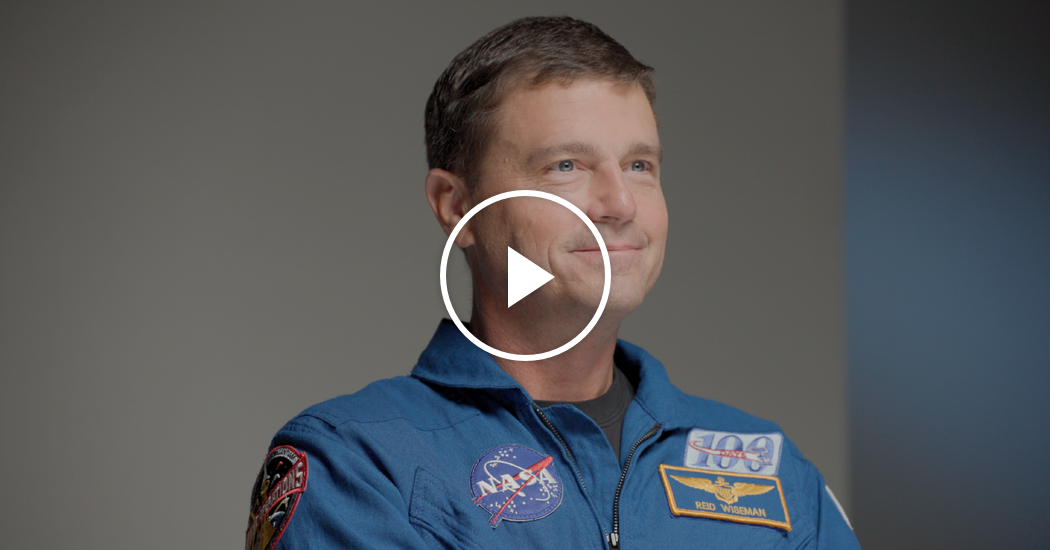
– You obviously traveled more than a quarter million miles away from people that you love and your home. And we got a lot of questions from kids about what that distance might have felt like. This one is from Aiden. He’s 8 years old, and he lives in Santa Cruz Mountains, California. – My question is for Reid, Victor, Christina and Jeremy. How did you feel when you were that far away from Earth? Was it lonely? – It was obvious to us how far away we were. But I still felt the same connection with everything back home. So whether that, you know, whether that’s how we’re intertwined together. But it didn’t feel lonely at all. But what I did get this new sense of is how everything is, sort of, distributed in our galaxy. You know, when you look up in the night sky, every star you see is in our galaxy. This is one galaxy in the entire universe. And we were looking out from our spacecraft and we were just seeing these other stars in our galaxy. But I was seeing them in a three dimensional — three-dimensional space. Like one — some of them looked closer than others. And the Earth and the moon, and seeing them and just seeing how they’re juxtaposed, I have such a hard time explaining it to people, but it was very different than I expected. Every time I would look out and I would see that, sort of, three dimensionality of things, I would sort of see our place in this galaxy, if you will. That was pretty profound for me. And I kept having the same sense of being very insignificant as an individual yet extraordinarily powerful as a human race, and what we can do. – When we would let our eyes adjust, you can look to the left and see a tiny Earth. We would call it tiny Earth, and we really — – You nicknamed the Earth? – We called it tiny Earth. It is tiny. I mean, at some points it’s like a fingernail just sitting out there. But you can let your eyes adjust and you can see a lot of the cosmos. If you look at the crescent moon, it’s rounded and it stops where the sun goes to shadow. But when you look at a crescent Earth, the same thing happens, but the edge of the Earth just extends a little bit longer. And if you look at it, you realize the extension right there, this tiny — it’s like two little tiny whiskers coming off the edge of Earth, it’s the whole atmosphere. It’s everything that keeps us alive. You can just tell You really sense fragility. You just sense such a special little tiny thing right there, that atmosphere. That looks different than the moon. You can just tell the moon cannot sustain life, but Earth can. And when you put those two things next to each other, the thing that enables us to live here is so tiny, it’s impossible to even rationalize in your mind. – The Earth looked as if you put a high-definition computer graphic into an original movie, like when we started, you know, “Steamboat Willie,” the first black-and-white moving pictures. It just stood out. It was so different. The colors, the shapes. Our planet looks alive. Even though we can’t see human structures and boats and roads, it looks alive because the swirls change. And, it just — it demands your attention. When you see it out the window, you have to stare at it.
About The Author