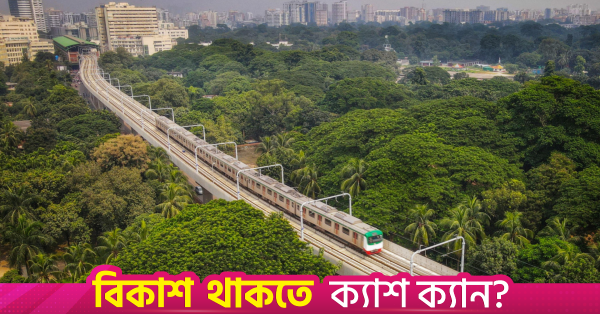
The government has taken an initiative to introduce a multimodal commuter network combining rail, bus and waterways to reduce Dhaka’s growing population pressure.
Officials said the system would allow people to live in nearby districts and travel to Dhaka for work, education and healthcare, reducing the need for permanent relocation to the capital.
The initiative aims to introduce affordable commuter services connecting surrounding districts with Dhaka, according to Planning Commission sources.

Like other megacities, Dhaka needs an effective commuter system to shift part of its population to surrounding towns.
Kabir Ahamed, head of Physical Infrastructure Division, Planning Commission
The decision was taken at an inter-ministerial meeting held on 7 April at the Nazia-Salma building in the capital, organised by the Planning Commission’s Physical Infrastructure Division.
Pressure on Dhaka rising
A densely populated city like Dhaka cannot take further population pressure, said Kabir Ahamed, head of the Physical Infrastructure Division of the Planning Commission, who chaired the inter-ministerial meeting.
“Every day, a large number of people come to Dhaka for business, jobs, education and healthcare,” he said, adding that ensuring housing, drinking water and sanitation is becoming increasingly difficult.
He said that, like other megacities, Dhaka needs to build an effective commuter system to shift part of its population to surrounding towns.
“All relevant agencies must play an active role in this effort,” he added.
Integrated commuter network planned
Planning officials said the initiative aligns with the government’s election manifesto to make Dhaka liveable and improve public transport.
The Physical Infrastructure Division sources said Dhaka currently has rail links with Gazipur, Mymensingh, Tangail, Faridpur, Narail, Narsingdi, Narayanganj and Brahmanbaria.
More commuter train services will be introduced on these routes.
Commuter services will also be expanded through bus connections with Manikganj, Munshiganj and Cumilla, and by waterways with Shariatpur, Chandpur and Munshiganj.
Bangladesh Railway, Bangladesh Road Transport Corporation (BRTC), Bangladesh Inland Water Transport Corporation (BIWTC), Bangladesh Inland Water Transport Authority (BIWTA), the Roads and Highways Department and Dhaka Mass Transit Company Limited (DMTCL) will prepare separate commuter service plans to be submitted through their ministries to the Planning Commission by 16 May.
Officials said necessary steps will be taken quickly based on these plans to implement the commuter service system.
Potential impact on Dhaka and surrounding regions
Officials of the Planning Commission say an integrated commuter system could bring multiple benefits if implemented effectively.
Improved connectivity would allow people to live in nearby districts while travelling to Dhaka for work, reducing the need to stay in congested areas of the capital and easing population pressure.
Rail and water transport are generally more affordable than road travel, and regular commuter services with weekly or monthly passes could lower travel costs while reducing time lost in congestion.
The system could also improve the supply of goods to Dhaka. Large volumes of vegetables, fish and agricultural products enter the capital daily from surrounding districts, and better transport links could help these reach markets faster and at lower cost, supporting fair pricing and supply stability.
Easier connectivity may also encourage economic activity outside Dhaka, with potential growth in industries, shopping centres and educational institutions in nearby districts, helping spread development beyond the capital.
From an environmental perspective, increased use of waterways and electric rail systems could reduce air and noise pollution, while easing congestion-related stress and supporting efforts to keep rivers free from encroachment and pollution.
Rail to play key role, capacity expansion needed
According to the meeting proceedings, Bangladesh Railway Director General Md Afzal Hossain said introducing commuter services with districts surrounding Dhaka could improve the quality of passenger transport services.
Bangladesh Railway is currently operating commuter services on two routes, which he said is insufficient compared to demand.
“Two commuter trains run on the Dhaka-Tongi-Joydebpur route,” he said, adding that services could also be introduced on the Dhaka-Narayanganj route if the line is made double.
Bangladesh Railway Additional Director General Mohammad Nazmul Islam said expanding commuter services would require improved infrastructure.
“Commuter trains must enter Dhaka before 9am,” he said, adding that intercity trains arrive at the same time, creating constraints for operating more services without adequate platform capacity.
Bus services await fleet expansion
BRTC Chairman Abdul Latif Mollah said commuter services cannot be introduced immediately due to a shortage of buses but could begin after new vehicles are procured.
He said increasing the BRTC fleet would make it possible to operate services with surrounding districts.
“Several bus purchases are underway,” he said, adding that routes can be determined by identifying key districts around Dhaka.
Waterways seen as low-cost option
In terms of waterways, a BIWTA representative emphasised the need to restart circular routes around Dhaka.
“This can ensure low-cost travel,” the representative said.
“If this circular route can be run through BIWTC and private initiatives, and if connectivity with surrounding river-linked towns is expanded, low-cost commuter services can be provided,” he added.
Metro and road links to support network
Md Abdul Baki Mia, director (planning and development) at Dhaka Mass Transit Company Limited, said the ongoing Diabari-Kamalapur metro rail (MRT-6), along with future MRT-1 (Airport-Kamalapur) and MRT-5 North (Hemayetpur-Bhatara) extensions, can further strengthen the commuter system.
Experts stress integrated planning
Transport expert and Buet civil engineering professor Md Hadiuzzaman told TBS that commuter services should not be viewed only as an improvement in transport, stressing the need to align them with civic services such as healthcare, education, housing and utilities.
“In other words, land use policy and commuter systems must be planned together,” he said.
He said introducing commuter services in isolation will not yield the desired results and emphasised the need to integrate all transport modes into a multimodal system linked with land use planning to achieve decentralisation.
“Only then can we move towards building Dhaka as a truly liveable city,” he said.
He added that while rail and road connectivity have improved in recent years, waterways remain underutilised.
“We have focused more on roads, but waterways have not received adequate attention. Now is the time to give greater priority to waterways,” he added.
About The Author