Significant share of reallocated funds expected to go to energy sector
Infographics: TBS
“>

Infographics: TBS
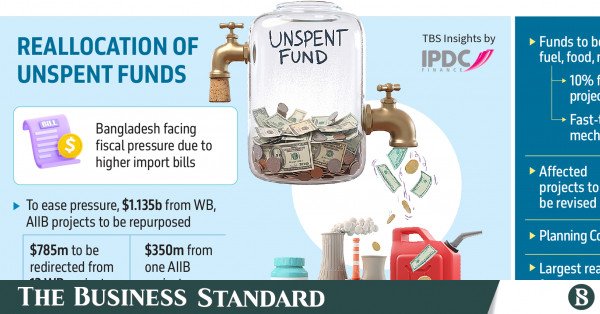
The government has decided to reallocate $1.135b from ongoing World Bank and Asian Infrastructure Investment Bank projects to bolster energy and food security amid rising fuel, gas and fertiliser prices linked to the Middle East war.
The decision was taken at a high-level meeting held on 27 April at the Ministry of Finance, chaired by Finance Minister Amir Khosru Mahmud Chowdhury, according to Economic Relations Division (ERD) officials.
They said Bangladesh formally requested the activation of the World Bank’s Rapid Response Option (RRO) on 5 April. The RRO allows up to 10% of unutilised funds from ongoing projects to be swiftly redirected to emergency needs.
Officials added that this is the first time Bangladesh is accessing the facility. Under the arrangement, the government will channel funds through the Contingent Emergency Response Project (CERP) framework to finance urgent imports of food, fuel, and medicines.

CERP enables activation of emergency components without new approvals, allowing rapid fund reallocation through amendments to existing agreements. The facility remains active up to six years, while interventions are implemented within shorter timeframes.
Experts said reallocating funds to critical sectors may be more effective than new borrowing. With revenue strained, use of existing resources are a more practical response to the crisis.
Zahid Hossain, former lead economist at World Bank’s Dhaka office, said the move is a timely step as financing from investment projects is largely concessional, while budget support and other borrowings are relatively more expensive and could raise long-term debt burden.
However, he said effective utilisation remains constrained by limited preparedness. “To speed up disbursement, several steps must be completed within a short timeframe.”
These processes require coordination across multiple ministries as well as the finance ministry, and any delay could slow down overall implementation, said the economist.
$785m from WB, $350m from AIIB
A total of $785 million from 12 World Bank-financed projects and $350 million from one AIIB project will be repurposed under the decision. ERD officials said the move aims to create a fast-track financing mechanism for urgent imports for fuel, food and medicines.
The government has made a preliminary assessment of funds available for reallocation from ongoing projects. A CERP will be established as an umbrella framework with sector-specific components.
Several steps are required to operationalise the arrangement. Project proposals linked to reallocated funds must be revised through the DPP process, which follows formal administrative procedures and could affect disbursement timelines.
An integrated “Omnibus Financing Agreement” will also be prepared to amend existing financing arrangements, enabling multiple project changes under a single framework.
Officials said the process must be completed within a fixed timeframe. For projects with loan agreements expiring in the current fiscal, CERP operations must be launched by May 2026.
M Masrur Reaz, chairman and founder of Policy Exchange Bangladesh, said the country was already facing a gas shortage, rising power sector subsidy pressure and slower-than-expected progress in renewable energy before the Middle East crisis.
He said the energy sector affects nearly all areas of the economy, including transport, industry, agriculture and fertiliser production, making it a top priority.
However, he cautioned that raising electricity prices during high inflation would further strain low- and lower-middle-income households and small businesses. “In the short term, subsidies may need to be maintained or only partially adjusted,” he said.
Rationale for the move
Amid rising fuel, gas and fertiliser prices driven by conflict in the Middle East, the Finance Division has written to the ERD seeking urgent budget support.
A 12 April letter from the macroeconomic wing warned that subsidy pressure in energy and agriculture could reach Tk38,000 crore in FY26 due to supply instability.
The letter further noted that higher global prices would require about $3.2 billion in additional foreign exchange for fuel, gas and fertiliser imports, potentially adding pressure on reserves and stoking inflation.
Against this backdrop, the government is seeking urgent external financing to contain inflation, stabilise reserves and maintain macroeconomic stability. A detailed position paper outlining the crisis impact and financing needs has been prepared.
Loans from ADB
ERD sources said Bangladesh is set to receive about $1 billion in budget support from the Asian Development Bank (ADB) in the current fiscal year. A further $750 million in support is also expected to help ease ongoing economic pressures.
The $450 million loan is non-concessional. It carries an interest rate of SOFR plus 0.50%, which, based on the 20 April 2026 SOFR rate of 3.63%, amounts to about 4.13%. A 0.15% commitment charge will apply on the undrawn balance.
The loan has a 15-year tenor, including a three-year grace period. Its grant element is estimated at 6.61%, indicating relatively hard terms, according to an ERD assessment.
The government is also securing $500 million in budget support from Japan at a relatively higher cost. The loan carries an indicative 3.05% interest rate, with a 30-year maturity and a 10-year grace period. Its 24.01% grant element classifies it as non-concessional.
Bangladesh is also taking a $250 million budget support loan from the AIIB. The loan is non-concessional. AIIB is acting as a co-financier alongside ADB, and the overall package is currently under processing.
The loan carries an interest rate of SOFR plus 1.45%, which, based on the 20 April 2026 SOFR rate of 3.63%, comes to around 5.08%. It has a 35-year maturity, including a 5-year grace period. A 0.25% front-end fee will also apply.
About The Author