Families struggle as early education becomes increasingly costly
Infographics: TBS
“>

Infographics: TBS
Highlight
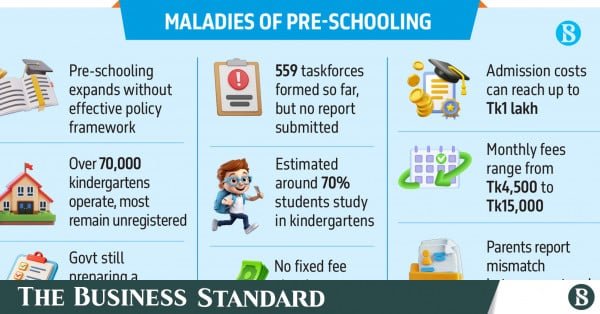
- Pre-schooling expands without effective policy framework
- Over 70,000 kindergartens operate, most remain unregistered
- Govt still preparing a comprehensive institutional list
- 559 taskforces formed, but no report submitted
- Around 70% students study in kindergartens (estimate)
- Parents report mismatch between cost and learning outcomes
- Monthly fees range from Tk4,500 to Tk15,000
- Admission costs can reach up to Tk1 lakh
- No fixed fee structure across the sector
Admitting her four-year-old child to an English-medium school in Dhaka’s Shekertek, Seema Akter faced an unfamiliar situation. Instead of the usual playgroup, she was advised to enrol her child in a “pre-play” class – a term she had never heard before.
Seema said her family earns around Tk40,000 a month. In a five-member household, paying Tk4,500 in monthly school fees for one child, along with additional expenses, is becoming difficult. Although she followed the teachers’ advice, she is now struggling to manage the costs.
Pre-schooling has long been considered the first step in a child’s education. However, in the absence of an effective policy framework, the sector has become largely unregulated, raising concerns over costs, quality and accountability. This lack of oversight has allowed private institutions to expand with little standardisation, contributing to rising expenses and uneven access.

Parents say costs now include admission fees, tuition, uniforms and transport – all making pre-schooling a growing burden. At the same time, many feel early enrolment is necessary to stay competitive, prepare for admission into reputed schools and ensure a safe environment for children.
What pre-schooling is and why it matters
Sadia Jafrin, CEO of the non-profit education research organisation Grow Your Readers, said pre-schooling, or pre-primary education, is a preparatory stage before formal schooling.
“Levels such as ‘pre-play’ are not part of the formal structure and are often introduced by private institutions without a standard framework,” she said.
She said pre-primary education generally serves children aged three to six and focuses on play-based learning and basic literacy and numeracy alongside physical, mental, and social development, with the stage typically divided into nursery or playgroup for ages three to five and kindergarten for ages five to six.
“The aim is to prepare children for primary education, help them socialise and build confidence through activities such as storytelling, drawing, and play,” she added.
Lack of policy creates challenges
According to the Directorate of Primary Education, a one-year pre-primary programme was introduced on a limited scale in 2010 and expanded nationwide in 2013 for children aged above five.
However, many parents do not rely on this system, leading to the rapid growth of private kindergartens. In the absence of effective regulation, these institutions operate with little control over fees or quality.
Various sources estimate that more than 70,000 kindergartens operate across Bangladesh, most of which remain unregistered, officials said, while the government is still preparing a comprehensive list.
In 2016, 559 taskforces were formed to gather data and recommend policy measures. Led by upazila nirbahi officers, they were tasked with assessing curriculum, teacher recruitment, and textbook use. However, no report has yet been submitted, officials said.
Officials said kindergartens will not be shut down, as many students cannot be accommodated in public schools. Private estimates suggest around 70% of students study in kindergartens, though no official data is available.
State Minister for Primary and Mass Education Bobby Hajjaj said all institutions would gradually be brought under regulation and action taken against unethical practices.
Field observations
At a pre-school in Sutrapur, classes were conducted in a small rented room with educational posters on the walls but no clear teaching structure. Children were engaged in playing and drawing, with little organised supervision.
A similar situation was seen in another school in Shekertek. The classrooms appeared colourful and equipped with play materials. Parent Mim Akter said she paid Tk15,000 as an admission fee and Tk4,500 monthly.
“I expected a good learning environment through play, but in reality, I am not getting that. Instead, it is creating pressure,” she said.
In contrast, a school in Mohammadpur charges around Tk1 lakh as a one-time admission fee, with monthly fees between Tk12,000 and Tk15,000, offering structured play-based learning.
Overall, monthly fees range from Tk4,500 to Tk15,000, with admission costs reaching up to Tk1 lakh. With no fixed fee structure, costs vary widely, placing pressure on many families.
Concerns over commercialisation and inequality
Experts say quality pre-primary education is essential for child development, but the lack of policy, training, and monitoring has left the sector largely unregulated. As a result, many children face academic pressure instead of play-based learning.
Professor Ahsan Habib of Dhaka University said many middle- and upper-middle-income families avoid government schools and choose private institutions, often based on infrastructure or social perception rather than educational quality.
“This creates opportunities for commercially driven institutions without qualified teachers, proper curriculum, or structured programmes,” he said, adding that the core objective of early education is often not met.
As costs rise without regulation, access to early education is increasingly shaped by a family’s financial capacity.
Rasheda K Choudhury of the Campaign for Popular Education said excessive commercialisation is excluding those who cannot afford it. “Education is a fundamental right, but many are being left out,” she said.
However, some parents said pre-schooling helps working families manage responsibilities. Parent Akramul Haque Shiplu said it allows them to focus on work while children remain in a safe environment.
BRAC University Emeritus Professor Manzoor Ahmed said not all private pre-schools are the same, but problems arise when education is treated as a commercial product. He said the introduction of “pre-play” classes is often driven by business motives and lacks quality control.
Child rights activists said costly systems benefit only certain groups, leaving many children excluded.
Salma Akter Urmi of Pother School said underprivileged children remain outside education, while wealthier families can secure preferred schooling through money.
Sadia Jahan of Grow Your Readers said structural weaknesses and parental perceptions are driving this trend. Many families avoid government schools, while high costs in quality private schools push lower-middle-income families towards cheaper but lower-quality options.
She added that competition and fear of falling behind are forcing parents to accept higher costs, even though early education should focus on social and developmental growth.
Experts said a clear policy framework is needed to regulate registration, fees, quality and accountability. Without it, the sector will continue to move towards greater commercialisation and inequality.
About The Author