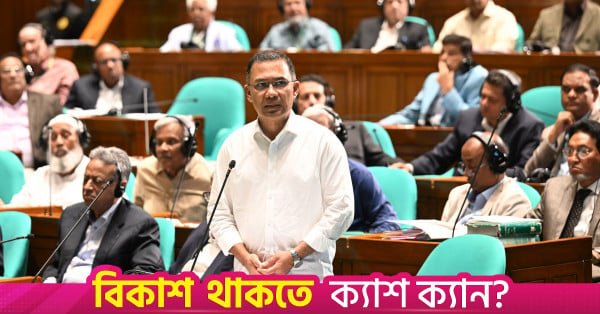
Prime Minister Tarique Rahman has reaffirmed his government’s commitment to building a democratic and prosperous Bangladesh, saying it is guided by the sacrifices of martyrs and the aspirations of ordinary people.
He said the current administration, elected by public mandate, remains accountable to citizens, making it its foremost duty to ease people’s hardships and improve living standards.
The prime minister made the remarks today (30 April) while delivering his closing speech in the parliament during discussions on a motion of thanks on the president’s address.

Seeking cooperation from the opposition, he warned that failure on either side would ultimately harm the country. “If you fail, I fail – and if any of us fails, Bangladesh fails,” he said.
“All sides must work together rather than compete to undermine one another. We must not allow this parliament to fail under any circumstances.”
Addressing the opposition, the premier said both sides share the same goal – building a prosperous and self-reliant Bangladesh.
He stressed the importance of dialogue, noting that disagreements are natural but should not derail cooperation.
“We may agree or disagree, but we will sit together, hold discussions, and make decisions in the national interest,” he said, adding that the government does not want to engage in debate over the July Charter.
The prime minister also emphasised the need to prioritise sound policymaking over popularity and called on lawmakers to focus future parliamentary sessions on pressing national issues, including power shortages, employment generation, challenges in educational institutions, and problems in the healthcare sector.
Referring to remarks by the opposition leader, Tarique said the entire nation – and Bangladeshis around the world – are closely watching parliament with hope and expectation. He stressed that paying tribute to martyrs alone is not enough. “Fulfilling the people’s aspirations is the real responsibility.”
Highlighting government initiatives for farmers, he said steps have already been taken in line with the election manifesto. The distribution of “Farmer’s Card” has begun and will gradually reach all farmers, including those involved in fisheries and livestock.
“With the grace of Almighty Allah, this parliament and its elected representatives have begun the work of transforming farmers’ lives,” he added.
Meanwhile, the month-and-a-half-long first session of the 13th parliament today ended through political debate, walkouts, and heated exchanges.
Compared to previous parliaments, this time the opposition has appeared more assertive and better positioned.
In closing remarks, Speaker Hafiz Uddin Ahmed said the session had shown a level of harmony, cooperation, and mutual respect rarely seen before, urging lawmakers to further strengthen parliamentary democracy through constructive engagement.
From the very beginning of the session on 12 March, the government and opposition debated over issues such as implementing the July Charter, forming a constitutional reform council, and executing the mandate for a referendum.
During the session, five committees were formed, including a special committee to address the country’s energy crisis. Proposals were also placed to form two committees related to constitutional amendments.
Following opposition proposals, 50 hours were allocated for debate on the president’s speech. However, the full time was not utilised across the 25 working days. A total of 256 notices were raised on various issues. The premier answered 35 questions, while ministers responded to 1,778 questions.
Record bills pass
A total of 133 ordinances issued by the interim government were required to be approved within 30 days of parliament sitting. A 14-member committee was formed to review these ordinances.

On 2 April, the committee submitted its report recommending approval of 98 ordinances without change, modification of 15, rejection of four, and reintroduction of 16 as stronger bills.
Finally, 113 ordinances were approved through 87 bills. Seven ordinances were scrapped through four bills, while 13 automatically lapsed. On the final day alone, 24 bills were passed.
Condolence motion
At the start of the session, a condolence motion was placed for 31 former MPs, including former prime minister Khaleda Zia and six former Jamaat leaders.
NCP’s stance on liberation war
On the final day, NCP Convener and Opposition Chief Whip Nahid Islam said it is not desirable for parliament, even 54 years after independence, to remain divided over “pro- and anti-liberation” labels.
He said political parties must resolve such divisions, adding that labels like “ally” or “extremist” depending on political alignment are being misused.
About The Author