The Bangladesh Bank has lifted the requirement for banks and financial institutions to maintain provisions against funds stuck in five merged Shariah-based banks, offering short-term relief to affected institutions.
The decision was communicated yesterday by the central bank’s relevant department.
A senior Bangladesh Bank official said large amounts of deposits from various banks and financial institutions remain tied up in the merged entities. As these funds are treated as investments of those institutions, the obligation to maintain provisions against them has now been withdrawn.

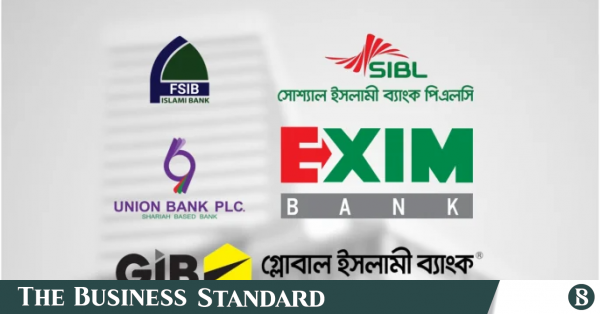
The five banks brought under the merger are First Security Islami Bank, Global Islami Bank, Union Bank, Social Islami Bank, and EXIM Bank. Facing acute financial stress, they were consolidated under a unified Islamic banking structure – Sammilito Islami Bank PLC.
According to officials, EXIM Bank had been under the control of Nazrul Islam Mazumder, former chairman of the Bangladesh Association of Banks, during the tenure of the ousted Awami League government. The other four banks were controlled by Saiful Alam, head of the Chattogram-based S Alam Group.
During that period, allegations of widespread irregularities and large-scale embezzlement surfaced, with thousands of crores of taka reportedly siphoned off. The banks subsequently fell into severe liquidity crises, failing to return deposits and loans owed to customers, as well as to other banks and financial institutions.
A central bank official said the Bangladesh Bank’s Banking Supervision Department and the Department of Financial Institutions and Markets had initially instructed institutions to maintain provisions against the stuck funds.
However, the Bank Resolution Department later ruled that such provisioning was not necessary.
The official explained that the funds are part of a specific scheme under which the affected institutions are expected to recover their money.
“In the future, the concerned banks will either receive the funds directly or be compensated with equivalent value through long-term fixed deposits or shares,” the official said, adding that the funds are not considered fully lost.
The Bank Resolution Department has also assured that the institutions may receive shares after a certain period or recover their money with profit after five years. “There is no logical basis to keep provisions against such funds,” the official added.
Sector insiders said the move would ease pressure on the affected institutions in the short term. However, they cautioned that recovering the stuck funds remains a major challenge over the longer term.
About The Author