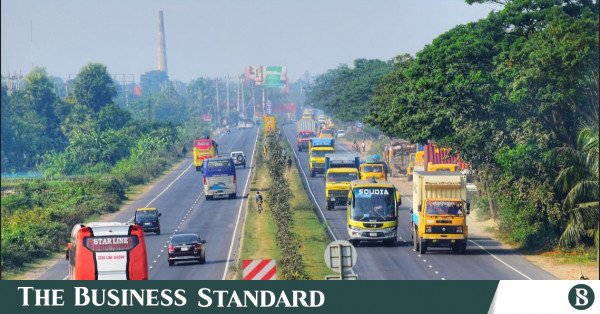
The Roads and Highways Department (RHD) has finalised a plan to expand the existing four-lane highway into a 10-lane facility
File photo of Dhaka-Chittagong highway/Collected
“>

File photo of Dhaka-Chittagong highway/Collected
Highlights:
- Agencies propose 10-lane highway versus elevated expressway plan
- RHD estimates $5.5 billion, seeks foreign financing support
- Dhaka–Chattogram corridor faces severe and rising traffic pressure
- RHD plan includes service roads, flyovers, partial elevated sections
- Experts argue elevated expressway ensures long-term efficiency and resilience
- Feasibility disputes and agency rivalry delay final decision
A deep policy divide has emerged over the future of Bangladesh’s most critical economic artery as two state agencies are pursuing competing visions for the 231km Dhaka-Chattogram corridor.
The Roads and Highways Department (RHD) has finalised a plan to expand the existing four-lane highway into a 10-lane facility. On the other hand, the Bangladesh Bridge Authority (BBA) is working on a plan to build a fully elevated expressway along the same route.

ASM Elyas Shah, additional chief engineer of RHD, said the detailed design of the highway has already been completed. According to the design, the construction cost of the entire road will be $5.5 billion.
“However, additional costs such as land acquisition, rehabilitation, utility relocation, consultancy and management will be added. The RHD is currently working to determine these costs,” he said.
He added that after finalising other costs, a preliminary development project proposal will be sent this month to the Planning Commission for policy approval and later to the ERD to secure foreign financing.
Infograph: TBS
“>

Infograph: TBS
Meanwhile, Mohammad Abdur Rouf, secretary of the Bridges Division, said they aim to build a continuous elevated expressway that ensures seamless connectivity.
“Traffic on the route has increased, making a high-speed elevated expressway essential. The Bridges Division is working towards this goal and is preparing to initiate the initial study,” he added.
Referring to RHD’s proposal, he said the project is essential regardless of which agency implements it.
Expressing support for the elevated option, experts say any decision based solely on cost would fail to reflect the corridor’s strategic importance and long-term value.
They say whatever decision is taken, it should be based on extensive evaluation: whether to expand the existing road at lower cost or invest in a high-speed, uninterrupted corridor to ensure long-term efficiency.
What’s in RHD design
Under the RHD proposal, the highway would be upgraded into a six-lane tolled main carriageway, flanked by four-lane service roads on both sides. Vehicles unwilling to pay tolls would be able to use the service lanes, allowing a dual system of paid and free movement.
RHD officials said their design includes an elevated section of about 13.5km from Jatrabari to Madanpur, and another 8km elevated section from Salimpur to Sagarika at the entrance to Chattogram city.
Additionally, six flyovers at key intersections are included in the design. These are planned at Signboard and Shimrail in Narayanganj, Madanpur and Baraiyarhat, Abutorab Bazar, and Salimpur in Chattogram. Access between the main road and service lanes will be limited to reduce congestion.
Regarding the elevated expressway plan from the Bridge Authority, one official said no such long elevated expressway exists anywhere in the world, describing it as a flawed plan. “It would be highly expensive and beyond the capacity of the Bangladesh Bridge Authority to construct such a long elevated expressway.”
Financing plan
RHD officials said discussions have already been held with the Asian Development Bank, which has agreed to finance the project. Talks are also ongoing with other partners. The Asian Infrastructure Investment Bank has shown interest as a co-financier, and discussions are also underway with the World Bank.
To reduce financing pressure, the elevated sections from Jatrabari to Madanpur and Salimpur to Sagarika may be developed under public-private partnership (PPP) or asset monetisation.
RHD officials said that once the foreign financing process is completed, the project proposal will be placed before the Executive Committee of the National Economic Council for approval. The target is to complete construction within five years of commencement.
From earlier plan to revised design
RHD and planning officials said an initial development project proposal for upgrading the Dhaka-Chattogram highway was submitted in January 2023. The national highway was divided into three sections, with separate proposals sent by the Road Transport and Highways Division.
These covered a 38km stretch through Dhaka, Narayanganj and Munshiganj, a 125km section from Cumilla to Feni, and a 69km portion in Chattogram. The plan proposed widening different stretches to four or six lanes, with an estimated cost of Tk73,150 crore.
However, the Planning Commission returned the proposal, citing the absence of a recent feasibility study and detailed design for upgrading the corridor to eight lanes. Subsequently, consultants were appointed to conduct studies and prepare a comprehensive design, which has now been completed. A revised project proposal will be prepared based on this updated design.
Highway under rising pressure
The Dhaka-Chattogram highway is one of the country’s busiest and most strategic corridors, serving as the backbone of both trade and passenger movement. An estimated 30,000 vehicles use the route daily, with projections suggesting traffic could reach around 66,000 by 2030 and exceed 119,000 by 2040.
Freight vehicles, including trucks and covered vans, account for roughly 30%-40% of traffic, playing a critical role in moving goods from Chattogram port to industrial and commercial hubs. At the same time, large numbers of passenger buses operate on the route, making it equally vital for public transport.
However, mounting traffic pressure, roadside truck parking and frequent accidents often trigger severe congestion stretching for several kilometres. This causes time and financial losses for both passengers and businesses. The situation worsens further during major holidays, when travel demand peaks.
‘Not about cost but necessity’: Prof Hoque
Md Shamsul Hoque, civil engineering professor at Buet, said investment in an elevated expressway would be recovered over time, making cost less significant than its long-term value.
He said keeping the highway at ground level would expose the corridor to major risks, including accidents, congestion, shutdowns due to protests, labour intrusion and flood disruption.
He also said feasibility studies for the 10-lane plan underestimate costs by excluding key factors such as disruption losses, accident impacts, social fragmentation and flood-related economic damage.
“These have not been properly considered,” he said, adding that weak analysis could lead to serious national consequences if traditional planning approaches continue.
He added that toll enforcement would be difficult in practice. “The issue is not cost but necessity. Infrastructure decisions should reflect long-term resilience rather than short-term expenditure concerns.”
The highway was expanded to four lanes before, and even if it is upgraded to 10 lanes now, it will never become a continuous expressway if most of it remains at ground level. “If there is a problem in any section, that small segment will determine the capacity of the entire road – that is the reality.”
Hinting at rivalry between government agencies, he said a feasibility study was carried out in 2015, but the elevated option was later dropped because an elevated structure would place it under the Bridge Division. “A country cannot be managed in this way,” he said.
Whether implemented by the Bridge Division or the Roads and Highways Department should not be a point of contention, he added, stressing that it is a matter of national survival.
‘Low-cost solutions don’t ensure productivity’: Prof Hadiuzzaman
Md Hadiuzzaman, also a civil engineering professor at Buet, said the elevated option would require less land and could ensure productivity for up to 100 years in the long term.
“If such an approach is followed, the Dhaka-Chattogram highway could function as a continuous and efficient long-term economic corridor for the country,” he said.
“Although the initial investment would be higher, it would deliver value for money,” he said. “Past experience shows that low-cost solutions alone have not ensured productivity or long-term effectiveness.”
He added that only after proper assessment should a decision be taken on whether the corridor should be fully elevated or expanded into a 10-lane highway.
About The Author