They also expressed concern that infections are now occurring even among previously vaccinated children and infants under nine months – groups typically considered less vulnerable.
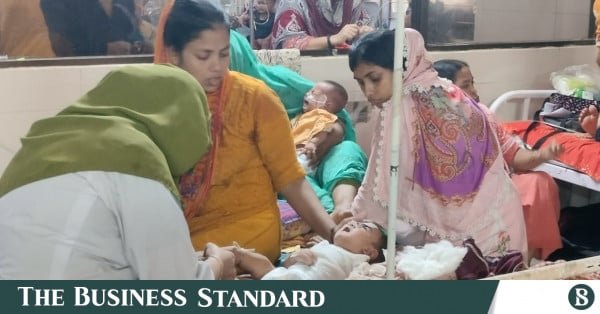
A child being treated at measles corner of Chattogram Medical College Hospital (CMCH). Photo: TBS
“>

A child being treated at measles corner of Chattogram Medical College Hospital (CMCH). Photo: TBS
Public health experts have urged the government to declare a public health emergency as measles continues to spread rapidly across the country and the death toll keeps rising.
The call came at a press conference titled “Child deaths from measles: What to do in a public health emergency”, held today (18 April) at the Dhaka Reporters Unity (DRU) auditorium, organised by the Doctors’ Platform for People’s Health (DPPH).
Participants in the event said a public health emergency is declared when a disease spreads abnormally across time, place, and population, leading to a sharp rise in infections and deaths and overwhelming the healthcare system. They warned that the current measles situation has reached that threshold and called for an official declaration.

Public health expert Dr Mushtaq Hossain said the government has already taken several measures, including cancelling doctors’ leave, ensuring uninterrupted services, and recruiting additional physicians. However, a formal emergency declaration is still pending, he added.
DPPH leaders noted that measles, though highly contagious, is preventable. They attributed the worsening situation to weaknesses in the vaccination programme, delays in vaccine procurement, bureaucratic hurdles, and inadequate attention to public health.
They also expressed concern that infections are now occurring even among previously vaccinated children and infants under nine months – groups typically considered less vulnerable.
According to the speakers, measles is extremely contagious, with a single infected person capable of transmitting the virus to 12-18 others on average. The virus can spread up to four days before symptoms appear, making containment difficult.
Experts alleged that during the interim government period, both vaccination efforts and preventive measures against post-measles complications – such as night blindness – were neglected.
To contain the outbreak, the organisation called for an immediate nationwide mass vaccination campaign, prioritising children in densely populated areas, remote regions, and marginalised communities, alongside ensuring an adequate vaccine supply.
Experts also stressed strengthening healthcare services from the upazila to the central level, including setting up dedicated infectious disease units in hospitals, ensuring the supply of essential medicines and vitamin A, and providing support for children from low-income families.
They urged authorities to combat misinformation about vaccines by engaging the media, religious leaders, and local representatives to boost public awareness.
The speakers warned that the high number of child deaths from a preventable disease is unacceptable and that the situation may deteriorate further without urgent, coordinated action.
About The Author