Fashion
Agrafe
“The French word for ‘staple.’ In fashion it refers to a small hook-and-eye fastening. A classic couture detail to close something so perfectly that you don’t see any fastenings.”
Appliqué, Intarsia and Jacquard
“Three different ways to create designs on fabric. Appliqué, the French word for ‘applied,’ is a technique where you layer one fabric over another. Intarsia is a knitting technique that allows you to integrate blocks of color directly into a textile. It comes from the Italian word for ‘inlaid woodwork’ because each color block is perceived as a tiny piece of mosaic. Jacquard, named after the 18th-century French inventor of the programmable loom, Joseph-Marie Jacquard, is also woven directly into the fabric. It’s normally reserved for smaller repeating patterns — for example, a sweater with a snowflake motif.”
Bias Cut
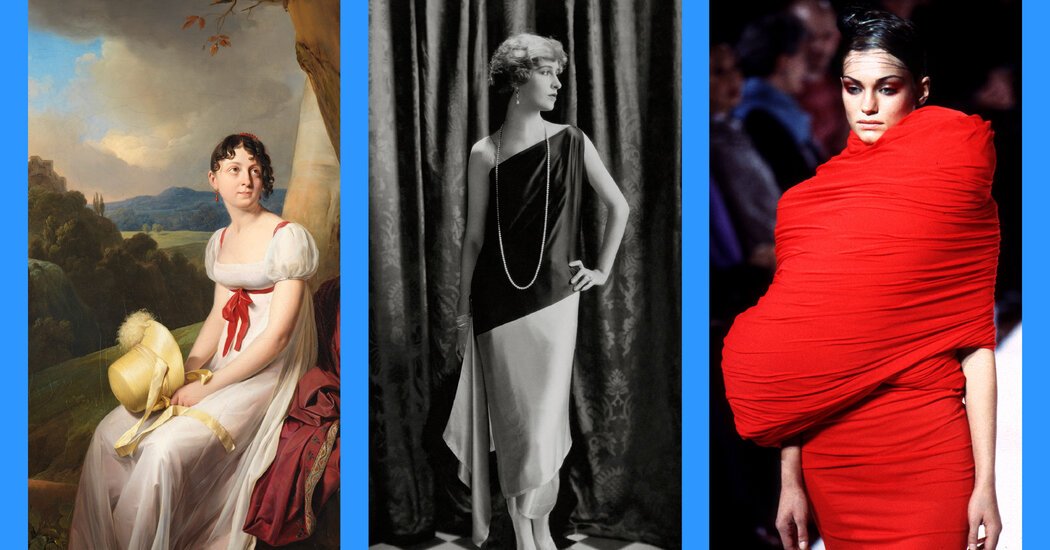
“Fabric cut diagonally across the grain, rather than along the warp (vertical threads) or weft (horizontal threads woven over and under the warp), making it stretchier and accentuating its drape. Until the 20th century, such a cut was only used in small areas of a garment — under the arms or between the legs for ease of movement — because it’s expensive: When you cut fabric on the bias, you need about one and a half times more than if you’d cut it straight. The French couturier Madeleine Vionnet, who opened her maison in 1912, became known for her bias-cut dresses.”
Denim
“The term ‘denim’ is said to have evolved from ‘toile de Nîmes,’ referring to the French city where the fabric was developed in the 17th century. It was usually dyed blue or indigo. Toile de Gênes, named after Genoa, the Italian city from which a similar fabric originated, emerged in the 16th century. That’s supposedly how we got the name ‘jeans.’”
Empire Waist
“At the beginning of the Napoleonic Empire in 1804, the waistline of a dress was commonly just below the bust. The idea was inspired by classical Greek and Roman garb to create a graceful, elongated silhouette for women.”
Façonnage
“A French term for shaping or forming fabric to the body. There are different structural techniques to turn a two-dimensional piece of fabric into a three-dimensional garment — darts, or V-shaped folds; pleats; seams; padding — and they’re all considered façonnage.”
Five Easy Pieces
“A Yugoslavian-born, New York-based designer we don’t hear much about anymore, Zoran Ladicorbic, known as Zoran, made minimalist garments with luxurious natural fibers. For his first collection in 1976, he espoused the idea of five easy pieces — five one-size-fits-all garments in black or white crepe de Chine, a light silk fabric. In 1985, Donna Karan introduced her Seven Easy Pieces, but her concept was quite different: She created a modular wardrobe, where each piece was intended to be mixed and matched and layered, so that you could have, say, 20 different outfits. It was more of a lifestyle, whereas Zoran’s was seen as a minimalist wardrobe.”
Godet, Gore and Gusset
“They all refer to triangular, trapezoidal or wedge-shaped pieces of fabric, but each serves a very different purpose. A godet is an insert you usually add to a skirt or dress seam, most likely at the hem, to increase volume without changing the waist: the swish of a mermaid skirt, for example, or a ball gown. A gore is a panel sewn from the waist to the hem that helps shape the garment, allowing a gradual opening of the skirt. A gusset is a fabric insert sewn straight into the seam at the underarm or crotch area to increase the wearer’s range of motion. You often find it in gloves or activewear.”
Haute Couture
“A commission organized by the Fédération de la Haute Couture et de la Mode in Paris determines which houses have the legal right to use the term. There are strict parameters: Garments must be made to measure by hand in Parisian ateliers that employ at least 20 technical workers. The couture system originated in the 19th century but wasn’t codified until 1945, when specific rules were established. A couturier must also present two collections a year, each with at least 25 original looks. This is different from pieces that are bespoke, which is to say spoken for, or reserved, by a particular client and describes a level of craftsmanship. Like couture, they’re made from scratch and involve multiple fittings. But ‘bespoke’ isn’t a legal definition; it’s typically used to describe men’s tailoring, specifically on Savile Row in London.”
House of Worth
“Known as the father of couture, Charles Frederick Worth, an Englishman living in Paris in the mid-19th century, invented the idea of fashion seasons [see ‘Seasons’]. More important, he was the first designer to sign his pieces by adding a label in each of his garments. Before he founded his own brand, House of Worth, in 1858, women had local seamstresses make dresses out of their chosen fabrics. And then Worth came around and said, ‘I’ll create something especially for you, as an artist would do if he were to paint your portrait.’ That’s why, particularly in France, fashion is driven by creativity: It upholds Worth’s notion of the designer as an artist.”
Lumps and Bumps
“For the Comme des Garçons spring 1997 collection, officially titled Body Meets Dress, Dress Meets Body, the Japanese designer Rei Kawakubo padded her dresses with bulges and bumps to recreate female silhouettes. She placed them in very unusual areas: at the hips, the back, the stomach — everywhere you might not want to have an extra padded bump. It distorted the natural body shape, rendering it grotesque and challenging preconceived ideas of beauty.”
Obi
“A wide sash or belt inspired by traditional Japanese dress, the obi is a key component of the kimono, used to secure the robe and define the waist. It’s valued for its functional role and aesthetic impact, both on the silhouette and for the color combinations it provides. Most modern designers have done a version of it. Nigo’s recent work at Kenzo, where kimono belts were adapted into skirts, comes to mind.”
Paillettes, Sequins and Spangles
“Shiny decorative disks that are sewn onto fabric. What differentiates them is mainly their size, shape and the type of sparkle they give. Sequins are the smallest. They’re often flat and shiny, sewn or glued onto the fabric and almost always have a single center hole so that they lie flush. Paillettes are larger than sequins. They can be round, oval or irregularly shaped, and they’re sewn, not glued, onto fabric. Their hole is closer to the edge, so they hang freely and create a more dramatic reflective effect. Spangles are usually small and round but can also come in lots of strange shapes.”
Pavlovian Waistband
“An expandable waistband designed by the New York-based English couturier Charles James to be discreetly loosened after a large meal. James was a designer’s designer known for his sculptural approach in the 1940s and ’50s. The Paris-based American designer Rick Owens has said he’s always wanted to be James, admiring the purity of his architectural garments.”
Pleats
“Folds in fabric that add structure, volume and decorative detail. There are many different types of pleats. One example is the sunburst pleat, which narrows at the top and widens at the bottom for a fan effect that creates movement in the silhouette. Watteau pleats, named after the French Rococo painter Jean-Antoine Watteau, flow from the shoulders to the hem, giving ease and volume. They’re seen in several of his paintings, including ‘L’Enseigne de Gersaint’ (1720).”
Queue de Pie
“A men’s fitted waist-length jacket with long tails in the back that reach to the knees, it’s traditionally worn for formal evening and white tie occasions. One step above the tuxedo.”
Rébé
“A French embroidery house, which Réné Bégué inherited from his predecessor, Maurice Vitet, in 1911, and later renamed, that supplied many of the great couture designers of the 20th century: Cristóbal Balenciaga, Christian Dior, Paul Poiret. There are only a few embroidery houses left — Lesage, founded in Paris in 1924, is one of the last — but back then, there were several dozen. Rébé’s specialty wasn’t only his color treatment but also his inventive taste. He once embroidered a piece for the French couturier Jacques Fath using cleaned-out mussel shells.”
Seasons
“When Charles Frederick Worth introduced fashion seasons in the 19th century, showing two collections a year — spring/summer and fall/winter — there was only haute couture. He’d present the fall collection in spring because it took six months to make, the idea being that you saw the show and had your fittings so that your new wardrobe would be ready when the actual season started. Paris was pretty much the only fashion capital until the mid-20th century, when ready-to-wear became what it is today. Now, with fall and spring ready-to-wear for men and women, and two couture seasons, there are at least six so-called fashion weeks a year across the four big cities: Paris, Milan, London and New York. Collections shown on the runway are the main ones, but before and after those presentations, smaller collections such as pre-fall and pre-spring — also called resort or cruise — allow consumers to get pieces while they’re waiting for the main collections to be produced.”
Sportswear
“Unlike Parisian designers, Americans, starting in the 1930s and through the ’50s, focused more on practicality, comfort and affordability. Claire McCardell was one of the designers introducing a more casual, functional wardrobe. Her wrap dresses and tie garments, for example, were made to fit any body, popularizing the notion of one size fits all. After World War II, a new market emerged for clothes worn neither at work nor at home. The idea of sportswear, a uniquely American concept, came to mean not just clothes worn for leisure but comfortable separates.”
Toile
“The French word for ‘cloth’ or ‘canvas.’ To be clear: Canvas is a cloth, but not all cloth is canvas. Canvas is a woven fabric with both a warp and a weft. When toile fabric is in cotton, it’s known as canvas; when it’s in silk, it’s called taffeta. The word ‘toile’ is also used to refer to a blueprint garment, because cotton toile fabric, or muslin, is inexpensive and comes in different weights and transparencies. Nearly every couture garment begins as a toile. Once it’s properly fitted, the final fabric is cut.”
Unisex
“While he’s not well known today, the French designer Jacques Esterel created many iconic dresses. In 1971, he presented a unisex collection called Alice 71 au Pays des Merveilles, inspired by Lewis Carroll’s ‘Alice’s Adventures in Wonderland’ (1865), in which male and female models walked out, sometimes holding hands, in matching outfits. His idea wasn’t to dress men as women but simply to propose dresses for men. He had only a modest following, so it wasn’t until 1984, when Jean Paul Gaultier put men in skirts, that the idea started to catch on.”
Zipper
“Although it originated at the end of the 19th century, the zipper was perfected in 1917 by a Swedish-born engineer living in America. The military helped popularize it during World War I, but it was mostly used for technical purposes like replacing buttons on boots and utility wear. In fashion, Elsa Schiaparelli was one of the first couture designers to make zippers visible in the 1930s. They were more than just purely functional; they were the antithesis of couture at the time, which was all about finding perfection through the handmade. Hers were often oversize, brightly colored and plastic, which was shocking.”
This interview has been edited and condensed.
More in Fashion
See the rest of the issue
About The Author