Theater
‘Richard III’ (circa 1592-94) by William Shakespeare
“Act I, Scene 4: Richard’s brother the Duke of Clarence is in the tower,” says the London-based actor Mark Strong, 62. “He has this speech that begins, ‘O, I have passed a miserable night.’ It’s the best description ever of a terrible dream or a nightmare that I’ve seen because he talks about getting thrown overboard and going down to the bottom of the sea, seeing jewels and skulls there — and then his nightmare continues beyond death. I’ve always thought the most boring thing in life is people telling you their dreams, so this is doubly brilliant.”
‘The Iceman Cometh’ (1939) by Eugene O’Neill
When Hickey, the traveling hardware salesman, “tries to convince all the patrons at the bar that killing his wife was the only solution, and that he did it out of love,” says the New York-based actor Nathan Lane, 70, “he’s telling his entire life story and getting more and more desperate for them to believe him.”
‘The Lisbon Traviata’ (1989) by Terrence McNally
“Mendy, a die-hard opera fanatic,” says Lane, “is desperately trying to get a recording of Maria Callas singing ‘La Traviata’ in Lisbon. When one of the characters finally asks him who Callas is to him, Mendy becomes vulnerable for a moment; he drops everything and admits that her voice has been a solace to him. You suddenly see him as a lonely guy who finds joy at the opera. It’s a beautiful piece of writing.”
‘Angels in America’ (1991-92) by Tony Kushner
“The lawyer Roy Cohn has a scene with the law clerk Joe Pitt,” says Lane, “whom he’s mentored and tried to seduce. Cohn’s sick and it’s becoming more pronounced, and he’s had enough of Joe’s wishy-washy behavior. ‘You want to be nice, or you want to be effective?’ says Roy. Finally, when Joe says, basically, ‘I can’t do what you want me to do,’ Roy unleashes the full force of his venom.”
‘Take Me Out’ (2002) by Richard Greenberg
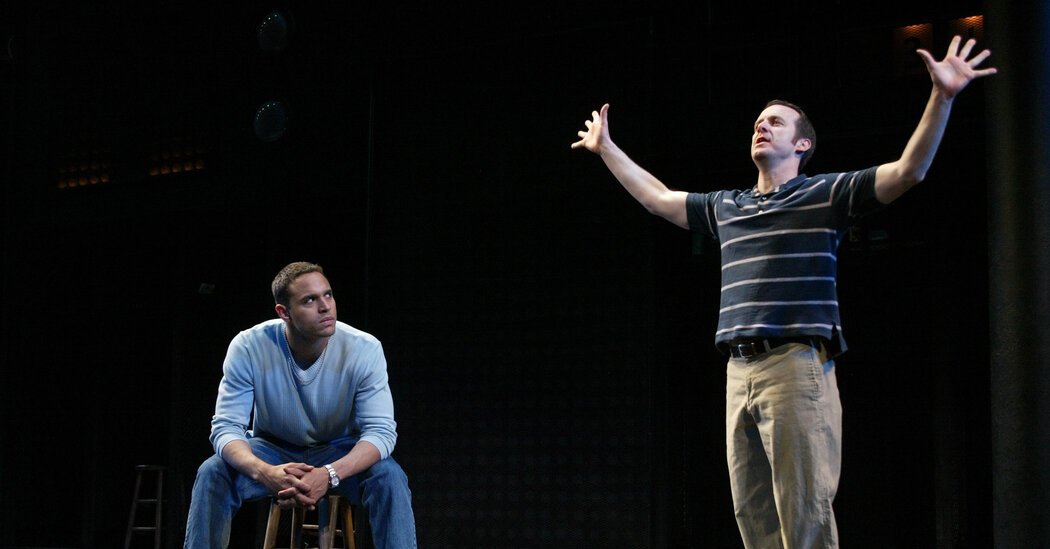
“Sports were never a big part of my life,” says the New York- and Los Angeles-based actor and director Joel Grey, 94, “but, during that last monologue, when the lead’s gay accountant, who never cared about baseball before the play, talks about the truthfulness and democracy of the game, I thought, ‘Oh, this is what sports are about. It’s about people like me too.’ I remember weeping, sitting in the balcony and thinking, ‘How did I not know about this?’ The play really has something important inside of it if it can reach me.”
‘Halfway Bitches Go Straight to Heaven’ (2019) by Stephen Adly Guirgis
“The play opens in a community center, where Lil Melba Diaz is encouraged to share a poem she’s written,” says the New York-based actress Kara Young, “but she’s nervous, so the women at the center offer to turn the lights down. She takes a lighter to read her poem, which starts off a little funny and then cracks open to lay the foundation of her story and of the entire play. It’s a launching pad into this world we’re about to embark upon.”
‘Clyde’s’ (2021) by Lynn Nottage
“It’s about incarcerated people rehabilitating into society at a sandwich shop owned by Clyde, a woman who was also formerly incarcerated,” says Young. “At one point, a white character comes at her in a certain way and she basically tells him he can’t break her because he doesn’t know where she’s from.”
These interviews have been edited and condensed.
More in Theater
See the rest of the issue
About The Author