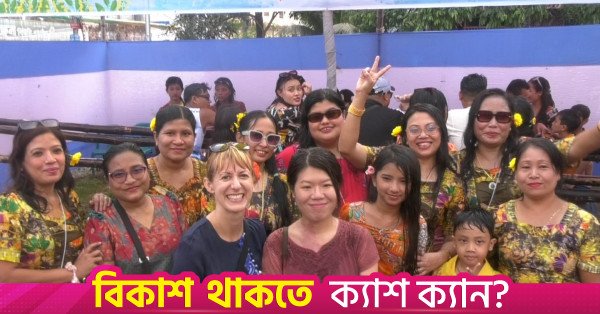
The first day drew people of all religions, turning the event into a celebration of harmony. In the heat, the water festivities created a sense of shared joy across communities.
Photo: TBS
“>

Photo: TBS
The Rakhine community began its traditional water festival in Cox’s Bazar on Friday afternoon (17 April) to welcome the Rakhine year 1388, with celebrations unfolding at Madhyam Tekpara through music, dance and water play.
The festival pavilion resembled artificial rain, as traditional songs played over sound systems. Young men, women and children in traditional attire danced across the grounds. Nearby, young women stood with water pots, while young men engaged in spirited water-throwing contests.
The scene was observed around 5pm at the Rakhine colony in Madhyam Tekpara, where the Cox’s Bazar Cultural Centre arranged the formal opening of the final three-day water festival of the community’s ‘Sangrai Poey’. Through the event, the Rakhine community welcomed the new year in what they describe as the purity of water.

According to the Rakhine calendar, the year 1387 ended on 16 April, and 1388 began on Friday. The community has long observed the seven-day ‘Sangrai’ festival to bid farewell to the old year and welcome the new one. The festival began on 14 April, with the final three days marked by the traditional water celebrations.
Photo: TBS
“>

Photo: TBS
The first day drew people of all religions, turning the event into a celebration of harmony. In the heat, the water festivities created a sense of shared joy across communities.
Rakhine sources said the festival began simultaneously at more than 25 pavilions in Cox’s Bazar city. Celebrations are also underway in Chowfaldandi, Maheshkhali, Teknaf and Ramu.
At the pavilions, rows of water-filled drums were arranged amid decorations of flowers and colourful paper. Young Rakhine women stood ready, while groups of revellers moved from one pavilion to another, dancing and singing to musical instruments. On arrival, young men threw water at their chosen partners, who responded in kind, continuing the exchange in a lively ritual.
Kya Thing Ong, former principal of Cox’s Bazar Government City College and a Rakhine leader, said the festival is a social tradition to forget past sorrows and welcome renewal. “For the Rakhine community, this water symbolises purity and holiness. People from all religions take part every year,” he said, adding that the festival will end on Sunday.
Cox’s Bazar district police media officer and additional superintendent of police (traffic) Debdut Majumdar said police have taken measures to ensure security. Law enforcers are deployed at every pavilion, alongside plainclothes surveillance.
About The Author