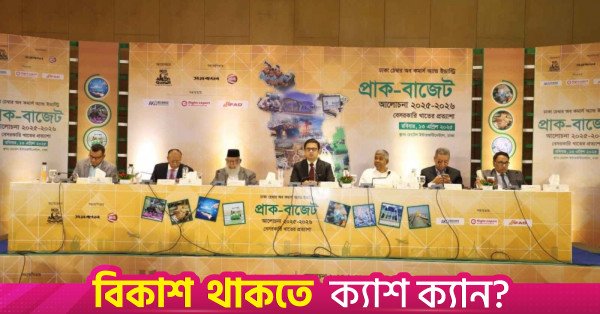
The assurance came during a live pre-budget discussion titled “private sector perspective”, organised by the Dhaka Chamber of Commerce and Industry (DCCI) in collaboration with Channel 24 and Samakal at a city hotel in Dhaka today (13 April)
A live pre-budget discussion titled “private sector perspective”, organised by the Dhaka Chamber of Commerce and Industry (DCCI) in collaboration with Channel 24 and Samakal at a city hotel in Dhaka today (13 April). Pgoto: DCCI
“>

A live pre-budget discussion titled “private sector perspective”, organised by the Dhaka Chamber of Commerce and Industry (DCCI) in collaboration with Channel 24 and Samakal at a city hotel in Dhaka today (13 April). Pgoto: DCCI
Commerce Minister Khandakar Abdul Muktadir has assured that the government will not impose any additional tax burden on businesses in the upcoming national budget despite mounting fiscal pressures.
The assurance came during a live pre-budget discussion titled “private sector perspective”, organised by the Dhaka Chamber of Commerce and Industry (DCCI) in collaboration with Channel 24 and Samakal at a city hotel in Dhaka today (13 April).
Speaking as the chief guest, the minister acknowledged that the government is under significant financial strain due to what he described as “over-ambitious projects” undertaken by the previous administration.

He stressed that reducing the cost of doing business and simplifying access to government services are essential to stimulate private sector investment and trade.
He noted that although Bangladesh’s economy is valued at around $460 billion nearly 7 crore people remain below the poverty line while the number of taxpayers is still relatively low.
Abdul also pointed to the country’s limited energy storage capacity which forces reliance on higher-cost fuel imports from the spot market amid ongoing geopolitical tensions in the Middle East.
In his welcome remarks, DCCI President Taskeen Ahmed emphasised that sustaining economic growth would require automation and simplification of revenue collection systems as well as expansion of the tax net.
He proposed raising the tax-free income threshold to Tk5 lakh, capping the maximum personal income tax rate at 25%, aligning the tax rates of non-listed companies with listed ones and abolishing the advance VAT system.
He also called for modernization of financial sector policies to ensure stability, reduce non-performing loans, stabilise foreign exchange reserves and rationalise policy interest rates to encourage manufacturing investment. He further highlighted the need for uninterrupted energy supply diversification of export products and markets and targeted incentives for promising sectors in the upcoming budget.
Special guest Mahbubur Rahman, president of the International Chamber of Commerce Bangladesh observed that although calls to increase the tax-to-GDP ratio have persisted for years there has been limited effective action.
He said, “High lending rates reduced credit flow to the private sector and ongoing electricity and energy shortages are discouraging both domestic and foreign investment.”
He urged the government to explore alternative energy import sources, reduce reliance on intermediaries and ensure a stable and predictable policy environment.
Another special guest Dr Monzur Hossain, member secretary of the General Economics Division emphasised that reviving sluggish economic growth remains a key priority for the government.
He underscored the importance of promoting the Cottage, Micro, Small, and Medium Enterprises (CMSME)sector and strengthening research activities to expand investment.
During the discussion former DCCI president Rizwan Rahman highlighted that bureaucratic complexities and alleged harassment from tax authorities are severely affecting the private sector.
He noted that the lack of effective initiatives to expand the tax net is increasing pressure on existing taxpayers and called for grassroots-level investment incentives along with higher allocations for healthcare and education.
Former DCCI President Hossain Khaled said, “Only about 30% of transactions occur through formal channels limiting effective revenue collection and suggested that the current VAT system could be replaced with a GST framework.
Chief Economist of Bangladesh Bank Dr Akhand Mohammad Akhtar Hossain emphasised the need to increase foreign investment, ensure accountability in government service delivery and control inflation.
In the energy sector, David Hasanat expressed concern over delays in establishing a land-based LNG terminal and stressed the importance of expanding energy storage capacity and attracting joint and foreign investment.
Meanwhile Imran Karim, vice chairman, Confidence Group pointed to a persistent lack of confidence in the capital market noting that key indices have stagnated over the years.
Participants across four thematic sessions on income tax and VAT, financial sector, industry and trade, and infrastructure said that comprehensive reforms were needed, including automation of the revenue system, realistic tax targets, uninterrupted energy supply, improved infrastructure, stable exchange rates, lower lending rates and stronger governance in the financial sector, the speakers said.
About The Author