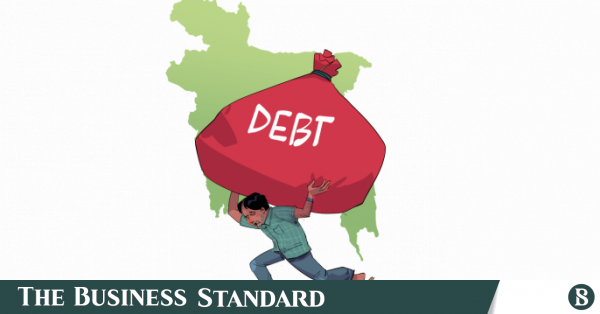
Total external debt stood at $77.28b as of 30 June 2025
Illustration: TBS
“>

Illustration: TBS
Highlights:
- Bangladesh faces $26 billion external debt servicing within five years
- Debt repayments accelerating rapidly compared to historical totals since independence
- Tax-to-GDP ratio below 7%, limiting fiscal capacity significantly
- Mega project loans and delays increasing repayment burdens sharply
- Debt servicing expected to peak at $5.5 billion in FY30
- Economists urge exports, remittances, revenue reforms to avoid crisis
Bangladesh is entering a period of intense fiscal pressure, with external debt servicing set to surge sharply over the next five years, exposing the limits of its already weak revenue base.
According to an Economic Relations Division (ERD) report, the country will need to pay nearly $26 billion in external debt servicing between the current fiscal year and FY30.

The scale of the burden is clearer in historical context.
In the 54 years since independence in 1971, Bangladesh has paid around $40 billion in debt servicing. Now, nearly two-thirds of that amount will be repaid within just five years.
Infograph: TBS
“>

Infograph: TBS
This comes as the tax-to-GDP ratio has slipped below 7%, the lowest among peer economies, constraining the government’s ability to absorb shocks or expand spending.
At the same time, a series of external shocks – including the Covid-19 pandemic, the Ukraine war, domestic political instability, and ongoing tensions in the Middle East – have strained revenue collection, export earnings and remittance flows, further complicating debt servicing pressures.
Total external debt stood at $77.28 billion as of 30 June 2025, up from $68.82 billion a year earlier, according to another ERD report.
Bangladesh paid about $4 billion in the previous fiscal year, which is expected to rise to $4.74 billion in the current year, $4.87 billion in FY27 – peaking at $5.5 billion in FY30.
Economists say the rising obligation will strain public finances at a time of elevated global energy prices. They warn that within five to 10 years, as repayments on new loans begin, the situation could become more complex.
They say avoiding a foreign debt trap requires an urgent push to expand exports, develop skilled manpower, boost remittances, improve investment climate and strengthen revenue.
Why debt pressure is rising
The latest ERD report was prepared ahead of the finance minister’s Washington meetings. The finance minister and governor are now in the United States, seeking fresh budget support from the World Bank and the release of IMF loan tranches to ease fiscal stress.
The report estimates are based on external loans contracted up to FY25. Borrowing in the current fiscal year has not been included.
Officials said Bangladesh has financed a series of mega projects through external borrowing, including the $11.3 billion Rooppur Nuclear Power Plant, Padma Rail Link, Karnaphuli Tunnel, Dhaka Metro Rail, Single Point Mooring with Double Pipeline, Hazrat Shahjalal International Airport expansion and the Jamuna Railway Bridge.
Many of these projects have either completed or are nearing the end of their grace periods, triggering principal repayments and steadily increasing debt servicing pressure.
Principal repayments for the Rooppur plant are set to begin in 2028, with annual payments exceeding $500 million. Budget support loans taken during the post-Covid period are also entering repayment phases, further adding to pressure.
Officials also cited implementation delays as a major concern. Delays have slowed the realisation of economic returns, while some completed projects remain idle due to operational bottlenecks.
For instance, electricity generation from Rooppur was expected two years earlier but has been delayed. The Single Point Mooring project, completed in 2024 with $467.84 million in Chinese financing, has yet to begin operations. The Dhaka airport expansion, financed with nearly $2 billion from Japan, also remains idle due to delays in appointing an operator.
Burden peaks in FY30
The report shows Bangladesh will need to repay $25.99 billion over FY26-FY30, including the current fiscal year. Of this, $18.38 billion is principal and $7.6 billion interest. This burden will nearly double to $51.33 billion between FY26 and FY35.
FY30 is projected as the peak repayment year, when Bangladesh will need to service about $5.5 billion based on the debt stock as of June 2025.
The report notes that, based on average monthly remittances of about $2.03 billion during FY21-FY25, less than three months of inflows would be sufficient to cover annual external debt obligations even at the peak.
Existing debt needs 37 years to clear
Based on borrowings up to June of the last fiscal year, Bangladesh would need 37 years to fully repay its existing external debt stock, according to the ERD.
If no new loans are added, the current stock would be cleared by FY63, meaning today’s liabilities will continue to be serviced over the long term.
Net external borrowing in FY25 was $5.83 billion, with officials estimating annual increases in debt stock of roughly $8-9 billion.
Debt ratios under pressure
According to the latest Flow of External Resources into Bangladesh report by the ERD, the debt-to-GDP ratio, though still low by global standards, is gradually rising.
It reached 18.99% at the end of FY25, up from 17.03% a year earlier, against a 40% benchmark. The debt-to-revenue ratio also edged higher, climbing to 16.92% from 16.53% over the same period, nearing the IMF’s threshold of 18%.
The ERD warned that without stronger revenue growth, Bangladesh could lose its current “comfortable position” in servicing external debt.
Other indicators offer a mixed outlook. The debt-to-exports of goods and services plus remittances ratio improved modestly, falling to 105.87% from 110.09% a year earlier, remaining well below the IMF’s 180% threshold.
‘Exports, remittances must keep pace’
Terming the situation an “unavoidable reality” for Bangladesh, Zahid Hussain, former lead economist at the World Bank’s Dhaka office, said, “If export earnings and remittances fail to keep pace, the economy could slip into distress.”
World Bank and IMF analyses show the shift from “low” to “moderate” debt risk is driven less by GDP and more by worsening debt-to-revenue and debt-to-export ratios.
He warned that weak revenue mobilisation and foreign exchange pressures are already staring the economy. “Without improvement, moderate risk could escalate into high risk.”
He called for stricter “sanity checks” in selecting loan-funded projects, especially in energy, where investments could ease gas shortages, raise industrial output and support exports.
Loan decisions, he said, must focus on repayment capacity through future exports and fiscal space, not just loan size.
Bangladesh has not defaulted so far, he noted, but warned the buffer may not hold amid global slowdown, LDC graduation pressures and geopolitical shocks. “Debt rescheduling or delays in repayment would carry reputational risks and increase future borrowing costs,” he said.
‘Capacity-building imperative’
Mustafa K Mujeri, executive director at the Institute for Inclusive Finance and Development, said the economy is at a critical juncture, with rising repayments alongside fresh borrowing.
He warned that mismanagement could trigger a crisis, calling for urgent capacity building based on four pillars: export expansion, skilled manpower development, improved investment climate and stronger revenue collection.
He said reliance on the ready-made garments sector alone is insufficient and called for diversification into agro-products, leather goods and light engineering.
Remittances, he added, remain a key lifeline, requiring alignment with global labour market demand and expanded training programmes. He also urged easier and more attractive legal remittance channels.
He said Bangladesh’s tax-to-GDP ratio of around 7-8% is a structural weakness. “This narrow revenue base is insufficient to service large-scale debt while sustaining development.”
He called for tax system reforms, anti-evasion measures and broader tax coverage.
He added that energy security is a direct enabler of debt repayment capacity. “Uninterrupted gas and power supply is essential to keep industrial production running.”
About The Author