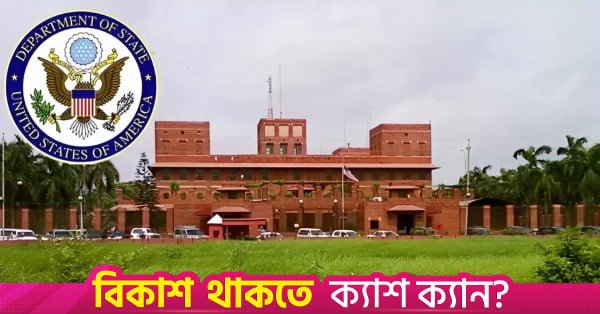
The US Embassy in Dhaka. Photo: Collected
“>

The US Embassy in Dhaka. Photo: Collected
Highlights
- US Embassy requested a 30-member force led by a DIG
- Proposal was previously rejected during interim govt
- Move comes amid Middle East conflicts
- Programme active in multiple high-risk countries across Africa, Mid-East
- Programme involves US training, equipping host-country force
The US Embassy in Dhaka has renewed its request to the newly elected government to form a dedicated police force to provide round-the-clock protection for its officials. Bangladesh Police has primarily agreed to it, which was rejected during the interim government.
A diplomatic security division official told The Business Standard that the request was made in light of heightened tensions in the Middle East, including those involving Iran, and repeated attacks on US diplomatic missions in the region.

A delegation from the US Embassy held a meeting with Inspector General of Police Md Ali Hossain Fakir at Police Headquarters on Tuesday afternoon. Officials from the Counter Terrorism and Transnational Crime unit of Dhaka Metropolitan Police and the Anti-Terrorism Unit were also present, according to multiple sources familiar with the meeting.
Under the proposal, the embassy has requested a 30-member unit led by a deputy inspector general (DIG), exclusively tasked with protecting its diplomats. While the embassy initially proposed its Regional Security Officer (RSO) to lead the unit, it later agreed to a DIG-led structure following objections from Bangladesh Police.
The proposed force would operate under the US State Department’s SPEAR programme, which aims to strengthen the security of US diplomatic missions worldwide by training host-country law enforcement units to respond rapidly to threats and emergencies.
SPEAR quick-response teams are already active in several countries, including Mali, Benin, Burkina Faso, Mauritania, the Central African Republic, Niger, Kenya, Tunisia, Iraq, South Sudan, the Democratic Republic of Congo, Chad and Nigeria.
In 2025, both the home ministry and police declined the request during the interim administration. At the time, the issue was formally reviewed following a letter from the home ministry seeking the police’s opinion.
Then inspector general Baharul Alam had opposed the move, arguing that Bangladesh already maintains a Diplomatic Security Division responsible for safeguarding all foreign missions in Dhaka. “Allocating a separate force to a single embassy would be inequitable,” he said.
Efforts to obtain comments from the current police chief were unsuccessful, while the US Embassy in Dhaka did not respond to repeated requests for comment.
Concerns over preferential treatment
The renewed proposal has raised concerns among diplomats, who warn that assigning a dedicated unit to one embassy could create dissatisfaction among other foreign missions.
Former diplomat Humayun Kabir said that while Bangladesh should address legitimate US security concerns, granting exclusive arrangements could be viewed as preferential treatment. He suggested that, instead, specialised training could be extended to all members of the Diplomatic Security Division.
Previously, ambassadors from the United States, United Kingdom, India and Saudi Arabia were provided with additional police escorts in Bangladesh. These arrangements were withdrawn in May 2023, with the government citing the need to ensure equal security for all diplomatic missions.
What is the SPEAR programme?
The SPEAR programme – run by the US State Department’s Diplomatic Security Service under its Antiterrorism Assistance (ATA) initiative – was launched in 2014 to bolster embassy security in high-risk regions.
Under the programme, specialised quick-response teams are formed from host-country law enforcement agencies and trained to respond to emergencies within minutes. According to US officials, these teams have helped prevent attacks, deter crime and provide emergency assistance in multiple countries.
About The Author