In the short term, the focus is to complete the training, land their first job, and take that initial step towards financial independence. But the long-term conversation goes further: What kind of life do they want? How can they sustain themselves? What does growth look like beyond the first paycheck?
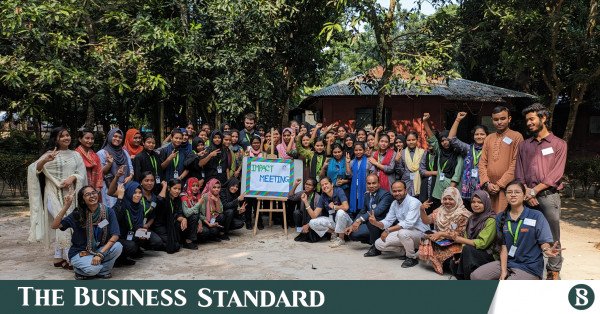
A group of trainees on their graduation day at Green Village Bangladesh. The programme supports marginalised young women in building pathways to sustainable livelihoods. Photos: COURTESY
“>

A group of trainees on their graduation day at Green Village Bangladesh. The programme supports marginalised young women in building pathways to sustainable livelihoods. Photos: COURTESY
Through the maize aisles of Tushbhandar union, in Lalmonirhat’s Kaliganj upazila, several households stand side by side. Among them is Chadni’s, where she grew up with her four siblings. Her father is an electrician who once ran a shop in the local bazaar.
Life was smooth until her mother’s health began to deteriorate. Her father had to forgo the shop to take on full-time household responsibilities alongside other work. As income dropped, hardship followed.
Her mother’s illness altered the structure of the household and, in many ways, the course of Chadni’s life. Her father remained respected for his skill, but respect alone cannot keep a family afloat.

Having completed her HSC in 2020, Chadni realised that despite her father’s efforts, she needed to stand up for herself — and for her family.
She began by tutoring in her area. When that proved insufficient, she started a small cosmetics business, which she ran for two years.
Young girls from the event management group are trained in logistics, coordination, and organisation at the Green Village.
“>

Young girls from the event management group are trained in logistics, coordination, and organisation at the Green Village.
Although it helped cover some household costs, it was not enough. Her three sisters had their own expenses, and her two brothers were growing up. The cost of their education continued to rise.
To expand her business, Chadni needed capital, networks and support. Although her father was supportive towards all of her endeavours, he could not support her with capital and network. No one else did either.
This time Chadni thought a decent job would give her better returns with the limited opportunities she had.
Quite a stir in Tushbhandar union
At some point during this period, Chadni noticed some foreigners roaming around Tushbhandar bazaar. Their presence stood out and created a stir in the Tushbhander community.
The sudden appearance of so many foreigners not only excited the hospitable villagers but stirred their curiosity as well.
That curiosity turned out to be pivotal. Chadni, the local girl, learnt they were connected to a training initiative for female youths.
In Tusbhander, there are many development organisations that work for rural advancement. RDRS Bangladesh, one prominent North Bengal-based NGO, operates in some secluded acres of land, near the Tushbhander Bazaar.
Eco-enterprise group trainees gain knowledge about sustainable production and resource management.
“>

Eco-enterprise group trainees gain knowledge about sustainable production and resource management.
RDRS is situated within its ancient British establishment. From the entrance, first it’s a 100 metre green field with lychee and mango orchards. On the right, there are several small red brick buildings, marking the timeless art of British architecture. On the left, another red brick building. A further 100 metre walk away awaits a British bungalow.
A french organisation named Life Project 4 Youth (LP4Y), rented the site from RDRS.
This whole arrangement is a Green Village, part of the global LP4Y (Life Project 4 Youth) alliance. Here, marginalised young women begin to build a future they once did not know could exist.
The Green Village does not promise instant success. What it offers instead is something more foundational: a starting point. A space where young women can begin to step into with skills, confidence, and a clearer sense of possibility. They learn how to write a CV, how to search for jobs, and how to attend interviews. Even basic things — how to present themselves, how to communicate.
Mohammad Shamsojjoha, Board Member and Treasurer, LP4Y Bangladesh
How Green Village operates
LP4Y works across countries to support young adults who have been pushed to the margins of society. Within this broad framework, the Green Village emerges as one of LP4Y’s most distinctive field solutions.
Unlike LP4Y’s urban training centres, Green Villages are set in rural environments. They are designed for young girls who have dropped out of education, lack access to stable work, and often have little exposure to what “professional life” even looks like.
Within this broader mission, the Green Village offers a three-month residential training programme designed to prepare young women, aged 18 to 24, for employment and leadership.
Each batch brings together 16 trainees, most of whom come from highly vulnerable backgrounds. They however bring a strong desire to support themselves and their families financially, and to change the course of their lives.
Trainees are divided into four professional tracks, each simulating a real-world work environment.
In the restaurant business group, they learn everything from cost calculation and budgeting to customer service training.
In the eco-enterprise group, the focus shifts to small-scale agro-farming, where trainees gain practical knowledge about sustainable production and resource management.
Those in the digital centre are trained in the kinds of services found in local print and photocopy shops.
Chadni (right), a participant from Green Village Bangladesh, now serves as a Community Life Coach leader.
“>

Chadni (right), a participant from Green Village Bangladesh, now serves as a Community Life Coach leader.
Meanwhile, the event management group takes on the challenge of planning and executing events, learning logistics, budgeting, coordination, and organisational skills that mirror professional event work.
Across all four tracks, one element remains constant: basic IT skills.
Throughout the programme, English is used as the primary mode of communication. For many of the trainees, this is unfamiliar and uncomfortable at first. But the goal is to instill confidence. Speaking, even imperfectly, becomes part of their transformation.
Life in the Green Village is immersive. It is not just about technical skills, but about understanding how the professional world works; how to communicate, collaborate, manage time, and take responsibility.
Trainees receive a daily allowance of Tk125, though it is not handed to them immediately. Instead, this support is strategically used at the end of the programme, when they begin searching for jobs independently.
At that stage, funds are allocated to help them cover transportation, appropriate clothing for interviews, and other essential expenses that often stand between them and opportunity.
“The Green Village does not promise instant success. What it offers instead is something more foundational: a starting point. A space where young women can begin to step into with skills, confidence, and a clearer sense of possibility,” Mohammad Shamsojjoha, board member and Treasurer of LP4Y Bangladesh.
“They learn how to write a CV, how to search for jobs, how to attend interviews,” Shamsojjoha says. “Even basic things — how to present themselves, how to communicate.”
But beneath these practical lessons lies a deeper shift. Many of the young women entering the programme have never been asked to think about their future in concrete terms.
So LP4Y introduces a framework that is deceptively simple: short-term and long-term goals.
In the short term, the focus is to complete the training, land their first job, and take that initial step into financial independence.
But the long-term conversation goes further. What kind of life do they want? How can they sustain themselves? What does growth look like beyond the first paycheck?
“For them, these are new questions,” Shamsojjoha says. “No one has guided them like this before.”
Mentorship plays a crucial role in this training process. Each participant is supported by a coach who stays closely involved in rebuilding confidence. Because, for many of these young women, the challenge is not just learning new skills but unlearning years of limitations as well.
“They don’t always know if a job opportunity is real or fake,” Shamsojjoha says. “They don’t know what to expect in an interview, or how to handle a professional environment.”
LP4Y continues to walk alongside them at this stage. Mentors, who are termed as Catalysts here, check and verify job opportunities for the trainees. For each role, interview preparations are tailored differently.
What emerges, gradually, is not just a trained candidate, but a young woman who is beginning to see herself differently. Someone who can navigate a job search, face an interview, and imagine a future that once felt distant.
LP4Y Bangladesh, Shamsojjoha emphasises, is not trying to produce entrepreneurs. The focus is more foundational, and in many ways more radical: to shape individuals into capable, confident professionals.
“Before anything else, they need to become skilled, reliable workers,” he says. “That’s where change begins.”
How the training impacted Chadni
Chadni was one of the participants from Green Village Bangladesh. Here, she encountered something basic yet transformative: structure.
Until then, her dreams had existed mostly as outcomes. She learnt that dreams are not only identities you hope to inhabit someday, but processes you have to build step by step.
After completing the training, she entered the workforce.
In 2023, she joined Robi Axiata as a sales executive. She later worked for a period in call-centre-related tasks. Then she moved to Rangpur Karupannya, and later to Labannya Telecom, which worked with City Bank, where she handled services linked to money transfer and utility bill payment.
Each role added a layer to her skillsets. Computer basics helped in every workplace. “The training enhanced my communication skills. I became more confident than before,” says Chadni.
Then, while preparing for her honours first-year final exams, she noticed a recruitment opportunity from LP4Y. So she applied.
On 5 January 2024, she joined LP4Y as a Community Life Coach (CLC).
In that role, she supports young women staying at the Green Village for training. Her work takes place especially during the informal learning hours, when structure must be maintained not through authority alone but through presence, empathy and guidance.
She helps run activities, supports youth on computers, facilitates discussions and stays beside them through the less visible, but often more difficult, hours of growth.
The role expanded further in 2025, she began working as a CLC Leader, taking on greater responsibility, including support and coordination involving teams from Bangladesh, India and Nepal.
“Previously, when I used to be a trainee, mistakes in my spoken English didn’t matter much. Now that I have to communicate with the mentors from different countries, and I am a trainer here, I always have to be wary,” says Chadni.
She has come a long way from the girl in Tushbhandar whose family could not always afford tuition.
About The Author