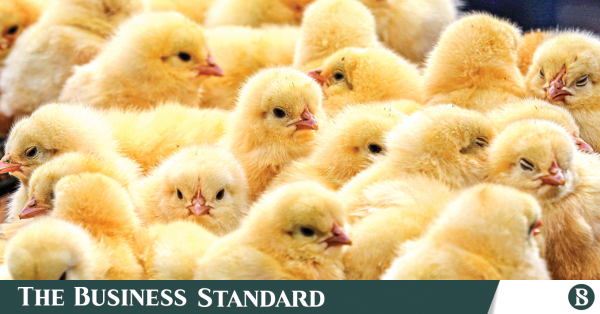
Supply shock exposes fragility of country’s poultry value chain
Photo: Zakir Hossain
“>

Photo: Zakir Hossain
Highlights:
- Seasonal disease surge increases poultry mortality, reducing overall chicken supply
- Sonali chicken prices hit record Tk450 per kg in Dhaka
- Farmers cut production after previous losses and ongoing disease risks
- Chick mortality rates jump sharply, worsening supply shortages nationwide
- Rising fuel, feed, transport costs further drive poultry price increases
- Market imbalance exposes vulnerabilities in Bangladesh’s poultry supply system
A drop in production due to seasonal diseases, along with higher fuel and feed costs, has driven Sonali chicken prices in Dhaka to record highs, revealing weaknesses in the country’s poultry supply system.
Within just two weeks, prices have jumped by nearly Tk100 per kg, with Sonali chicken now selling at Tk440-Tk450 in key retail markets across the capital, while traders call it unprecedented.

A visit to Karwan Bazar, Hatirpool, Rampura, Moghbazar and Mohammadpur’s Krishi Market reveals prices climbing by Tk50-Tk70 within a week, depending on size. The price of native chicken has also jumped by around Tk100 per kg, crossing Tk800.
Traders said the price of Sonali chicken had never exceeded Tk400 per kg before, making the current surge to Tk450 a record high. They blamed a sudden supply shortage from farms for the price hike.
Infograph: TBS
“>

Infograph: TBS
“Enough birds [chickens] are not coming to the market, especially Sonali and native chicken,” said Aminul Islam, a trader at Rokeya Broiler House in Karwan Bazar. “We are forced to sell Sonali at Tk440-Tk450 and native chicken at Tk750-Tk800. Many customers are switching to broilers due to the price hike.”
Echoing Aminul, other traders noted that they usually source directly from producers but are now receiving fewer consignments. Earlier, trucks would arrive regularly. Now, supply has fallen as farmers are producing less
Data from the Breeders Association of Bangladesh shows that weekly production of Sonali and coloured chicks is around 2.5 crore, of which 5 to 8 lakhs typically die due to various causes across the country. However, in the past two weeks, supply to the market has dropped to around 1.5-2 crore.
Shah Fahad Habib, the association’s general secretary, said an oversupply in the market last year pushed prices down, causing losses for farmers and prompting many to scale back production.
“At the same time, bird flu-like diseases have increased mortality rates, further reducing supply. As a result, prices have risen amid a mismatch between demand and supply,” he said.
Seasonal flu at root
Mohammad Asad Ali, owner of Amal Agro Farm in Naogaon, said around 4, 000 Sonali chicks are born in his farm daily. “Earlier, 150-200 chicks would die before maturity. But in the past month, deaths have risen to 1,000-1,200,” he told The Business Standard over mobile phone.
“The birds become weak at the age of 18-20 days and show respiratory symptoms. Even after treatment, many do not recover,” he said.
He added that mortality rates have jumped from 2-3% to as high as 10-15%, forcing farmers to raise prices just to recover part of their costs. “We had to increase prices by Tk30-Tk40 per kg after discussions with traders, but we are still incurring losses.”
Another farmer from Rajshahi, Mohammad Enamul Haque, said he has temporarily halted production due to fear of further losses. “Every year, some disease appears at the end of winter, but this time it is more severe. In some farms, nearly half the birds are dying,” he said, adding that recent days have shown slight improvement.
Leaders of the Bangladesh Poultry Industries Association say the scale of the outbreak has caught even veterinarians off guard.
“We have provided veterinary support at the farm level, but doctors are struggling to identify the exact disease,” said Mosharraf Hossain Chowdhury, president of the association. “This seasonal outbreak happens every year, but this time it is much more intense.”
He noted that more than 90% of Sonali chicken supply comes from small and marginal farmers, making the sector highly vulnerable to shocks. “As Sonali supply declines, pressure is shifting to broiler chicken, pushing up prices across the board.”
When contacted, Director General (acting) of the Department of Livestock Md Abu Sufian told the newspaper that there are reports of chickens dying in some poultry farms across the country.
“However, we are not sure whether it is bird flu or not. Officials have been asked to intensify surveillance activities in chicken farms in the districts and upazilas. If chickens die in any farm, instructions have been given to collect samples and take immediate action through testing,” he said.
At the same time, activists have also been asked to start activities to raise awareness among farmers, the DG added.
Feed prices, fuel, transport costs add pressure
The situation has been further aggravated by rising fuel costs linked to the ongoing war in the Middle East. Feed prices are also soaring, adding another layer of pressure.
According to industry estimates, transport costs have increased by around 20% in the past two weeks. Traders say reduced fuel availability has lowered the number of vehicles, while lower farm output means collection agents must travel farther to gather fewer birds, raising per-unit costs.
Poultry Industries Association President Mosharraf said when traders visit farms, they now collect only 3,000 to 3,500 birds instead of the previous 5,000. As a result, the cost of procuring chickens has increased.
He, who also holds the post of director at Astha Feed Industries Ltd, said the price of key imported raw materials has increased by at least 20% over the past month due to global market disruptions.
“Although feed is produced locally, we rely heavily on imported inputs. Prices have already increased by about Tk2.5 per kg, and if the situation worsens, they could rise by up to 20%,” he said.
Farmers’ losses deepen supply shock
Suman Howlader, president of the Bangladesh Poultry Association, said many marginal farmers have shut down operations after failing to get fair prices.
“For the past seven months, farmers have been selling eggs and chicken below cost. Many have exhausted their capital and exited the market,” he said. “Now, with feed prices rising again, they are reluctant to restart production.”
He warned that if production does not recover, prices could rise further.
Questioning the justification for sharp price hikes, SM Nazrul Hossain, vice president of the Consumers Association of Bangladesh, said, “Price increases ultimately reduce consumers’ purchasing power.”
Businesses often use global factors as an excuse, even though many goods were imported months earlier. The government must ensure proper market monitoring, prevent hoarding and improve supply management, he added.
About The Author